

Fall weather keeps ticks active
ER visits for tick bites highest in Virginia since 2017

John McCaslin (Photo/Courtesy)
John McCaslin was on deadline in the newspaper office, finalizing pages to send to the printer, when he began struggling to breathe.
Earlier that morning, the then-editor of the Rappahannock News had stopped at the Sperryville Corner Store and added cream to his coffee, forgetting that dairy could trigger his newly diagnosed alpha-gal syndrome, a tick-borne allergy to red meat and many animal products.
“Man, it started hitting me,” he recalled in a recent interview.
He drove himself to the emergency room in Warrenton, one of several ER visits since a lone star tick bit him in 2016. He also made repeated trips to the University of Virginia, where he gave blood for research by Dr. Thomas Platts-Mills, an allergist who discovered alpha-gal syndrome.
“They were using me as a case study,” he said.
After a bad round of chigger bites, McCaslin’s antibody levels spiked higher than Platts-Mills had ever seen. The advice was stark — leave the area.
“I was told, ‘You gotta get somewhere where there’s no ticks, or you’re in the concrete,’” McCaslin said.
In 2021, he left for Montana, where he has lived since.
“I loved it [in Rappahannock],” he said. “But I’m not checking myself for ticks after I walk through grass or anything anymore. It’s liberating.”
 Tick threat one of worst
McCaslin may have left his tick worries behind, but in Rappahannock the threat has only grown. Health officials warn 2026 could be one of the worst tick seasons in a decade, and locally, the warnings are largely coming true.
Even though fall brings cooler weather, ticks are still a threat. Peak tick season runs from March to the end of September, but tick activity hits a second peak from late August through November, according to the National Park Service, as cool, damp fall weather sends ticks looking for hosts. Ticks go dormant below freezing but become active again on any day above 40 degrees.
Serious tick-borne infections have more than tripled in the region this year — more people are seeking care for tick bites, and thousands of residents may be living with alpha-gal syndrome without knowing it, according to data from the Virginia Department of Health, the U.S. Centers for Disease and Prevention (CDC) and interviews with researchers and epidemiologists.
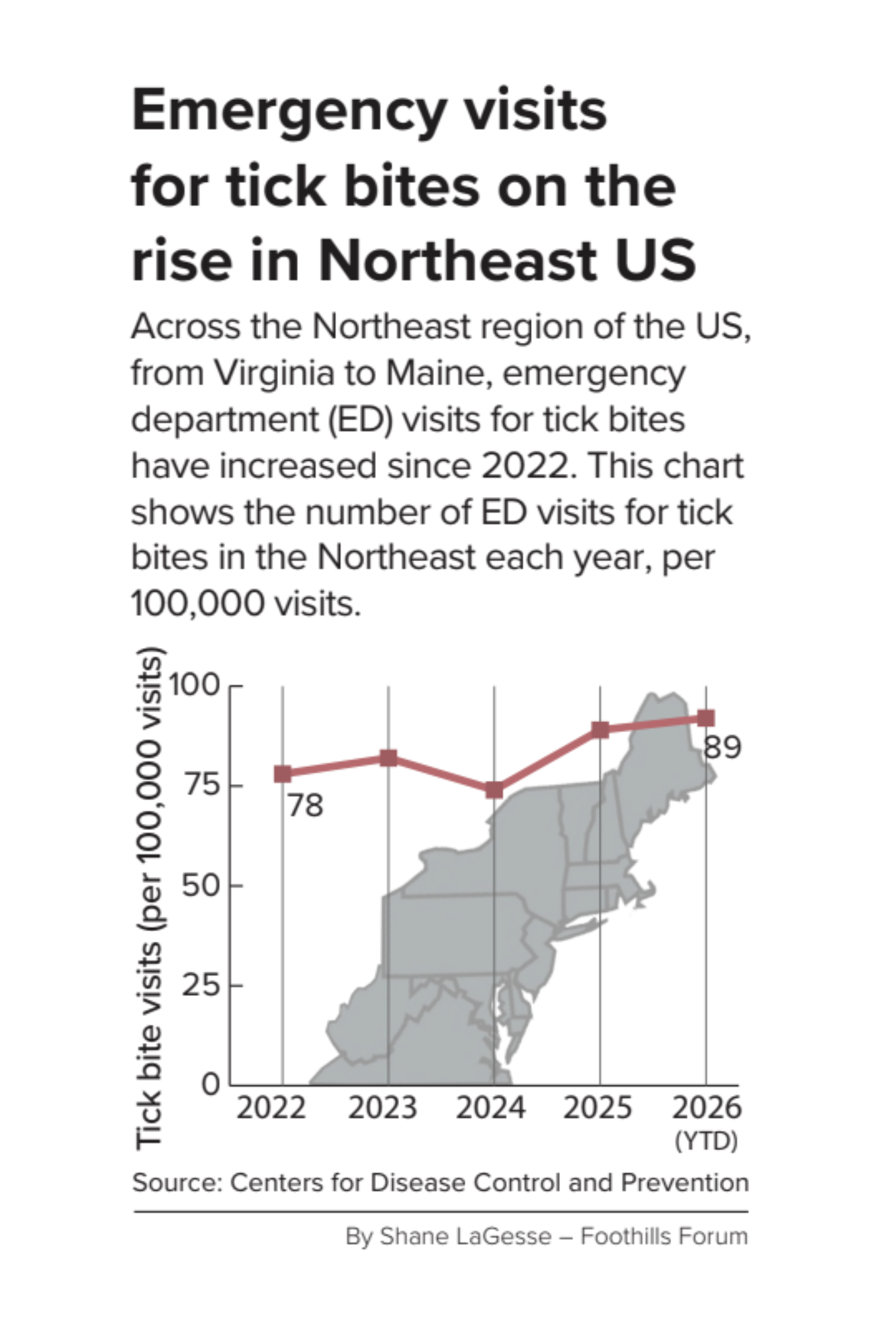
In April, the CDC reported ER visits in the United States for tick bites reached their highest rate since 2017. The Northeast, including Virginia, saw the most cases.
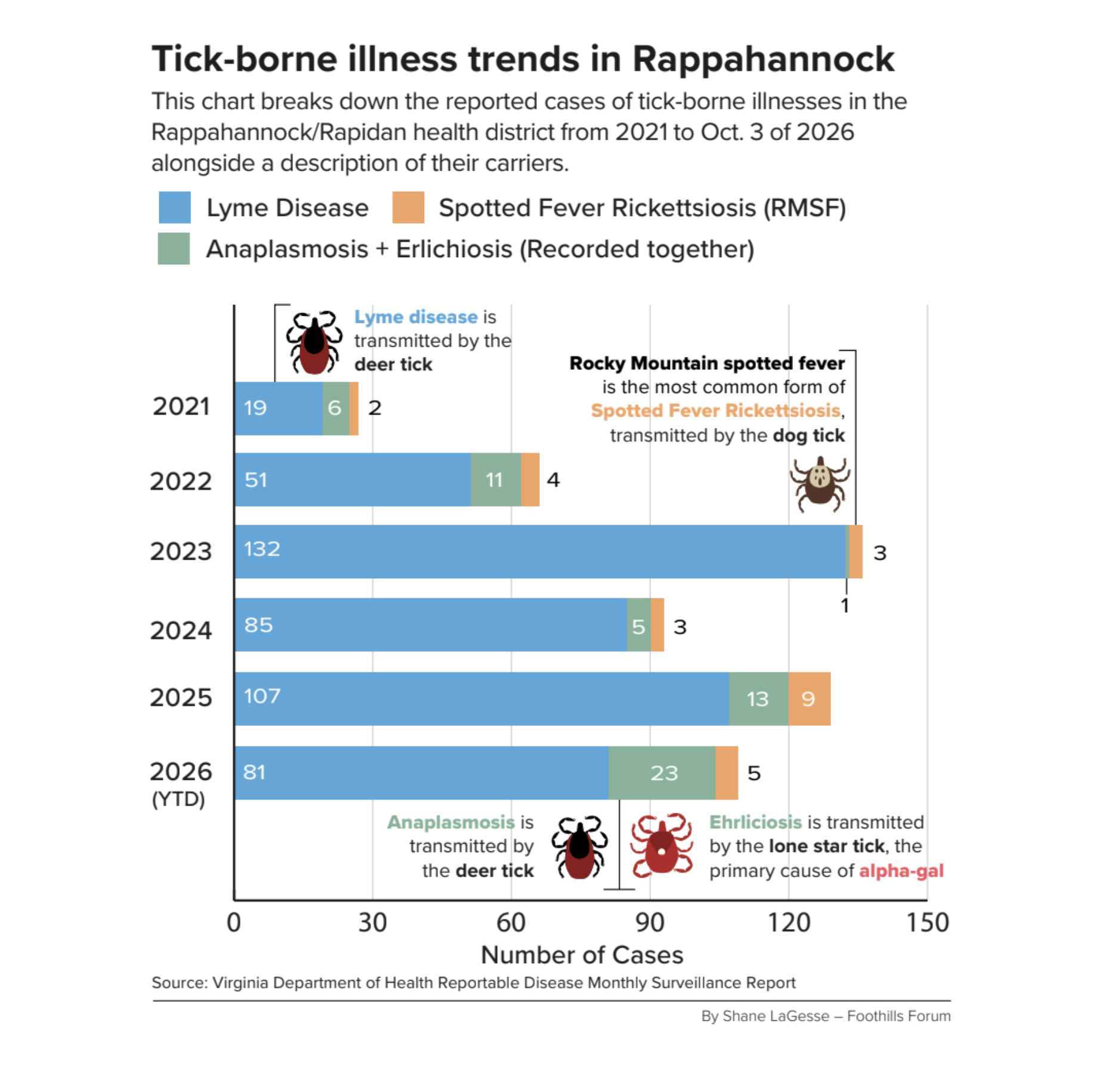
In the Rappahannock-Rapidan Health District — which covers Rappahannock, Culpeper, Fauquier, Madison and Orange counties — the biggest change, the district’s senior epidemiologist Daniel Ferrell said, has been that cases of tick-borne bacterial infections — ehrlichiosis, usually spread by lone star ticks, and anaplasmosis, usually spread by black-legged ticks — have more than tripled.
So far this year, about 23 cases have been reported in the region, up from an average of about seven a year.
“I’ve definitely seen an increase,” said Ferrell. “Those are ones that can cause more severe illness, including hospitalization. I haven’t seen that in years past.”
Lyme disease is on pace or slightly ahead of a typical year, with 81 cases so far compared to a five-year average of 79. Rocky Mountain spotted fever, which averages about four cases a year, is at five with two months to go. And more people in the district have shown up at urgent care centers and emergency rooms with tick bites over the past two years, Ferrell said.
Rise in tick-borne illness
Gillian Eastwood, an associate professor and tick researcher at Virginia Tech, said the rise in tick-borne illness likely comes from two things: more ticks, and doctors getting better at recognizing the diseases they carry.
“There are maybe more ticks and more spread of ticks, but then probably we’re becoming more cognizant of things that are going on, too,” she said. “Things have changed over the last few decades and tick-borne diseases are increasingly recognized.”
In Rappahannock, tick populations are spread across the county, said Kenner Love, the county’s Virginia Cooperative Extension agent, but they can cluster in what he called “hot spots” — cattle operations such as Eldon Farms in Woodville and areas of Old Hollow. One farm might be overrun while another a mile or two down the road has far fewer.
But wildlife like deer continue to spread them along wildlife corridors, and ticks can survive a long time between meals, which he said lets populations linger and then suddenly explode.
“I think it’s a combination of things,” Love said. “The climate has some impact — longer seasons, the wildlife’s there to support them, and they’re just thriving.”
Understanding alpha-gal symptoms
Alpha-gal is a sugar found in mammals like cows, pigs and lambs, and it can be found in the saliva of lone star ticks — reddish-brown ticks whose females have a large white dot in the middle.
In some people, bites from those ticks can trigger a lasting allergy called alpha-gal syndrome.
Virginia began tracking alpha-gal syndrome last year, asking commercial labs in Virginia to report positive blood tests. Since October 2025, participating labs — about 50% — have reported about 1,200 positive tests in the Rappahannock-Rapidan district and 20,000 statewide.
But a positive test indicates antibodies, not necessarily an active allergy, Ferrell said. To meet the CDC’s definition of a case, a person needs both a positive test and symptoms, such as hives, stomach trouble or anaphylaxis, within hours of eating red meat. A recent CDC study found that more than 20% of Virginia adults have alpha-gal antibodies.
Because diagnosis requires both a blood test and a clinical exam, many people never get tested. In 2023, the CDC estimated that as many as 450,000 Americans may be affected by the allergy.
Virginia health districts are now following up on and studying positive results, and Ferrell expects more reliable numbers next spring. “There’s a lot to learn right now because we’ve just started going through a lot of these labs,” he said.

‘Hunting ticks’
Alpha-gal is not the only thing lone star ticks carry, however. Eastwood’s research focuses on tick-borne viruses, which are rare, she said, but often deadly. Two that can spread to humans — Heartland and Bourbon viruses — are vectored by the lone star tick.
Eastwood said lone star ticks are “hunting ticks,” meaning they seek out a host rather than wait for one to appear, like other common species such as black-legged ticks or dog ticks. Lone stars are also more common in Virginia’s Piedmont and Coastal regions, she said.
“That’s a tick that will come at you when it senses you, rather than just hang out on a blade of grass,” she said. “In the Piedmont or Coastal region … it’s a much more predominant tick.”
Ticks active in fallen leaves, tall grasses in fall
According to the Shenandoah National Park, a second peak in tick activity occurs from August through November. Ticks live in fallen leaves and leaf litter, and cool, moist fall conditions prompt them to actively search for hosts.
Key prevention tactics recommended by epidemiologists and the Shenandoah National Park include:
- Wearing light-colored clothing to better spot ticks before they bite
- Tucking pant legs into socks
- Wearing gaiters or compression clothing to make it harder for ticks to attach
- Checking for ticks after outdoor activities, as timely removal is the best defense against contracting a tick-borne illness or allergy
- Using permethrin spray or DEET tick repellents
- Using flea and tick prevention on your cats and dogs. Ferrell recommends oral medications over drops or collars.
Surviving with them
The most important thing people can do, Ferrell said, is protect themselves from bites. Tick seasons are running longer, new species are arriving and ticks are surviving cold winters.
“We’re going to have to live with these things because even after this past year, with all of that extremely cold weather that we had late into January, into February, we figured out the ticks can survive,” Ferrell said. “So one of the things that we’re going to have to do is figure out a way to survive with them.”
Eastwood emphasized the importance of taking small precautions like checking yourself for ticks.
“The little tiny ones are the ones you’ve got to really look for. So being aware of how small a tick is, and really checking yourself when you come in from a hike, hunting or gardening,” she said, but added that the threat of ticks should not deter people from doing “all these wonderful activities that we can do outside.”