

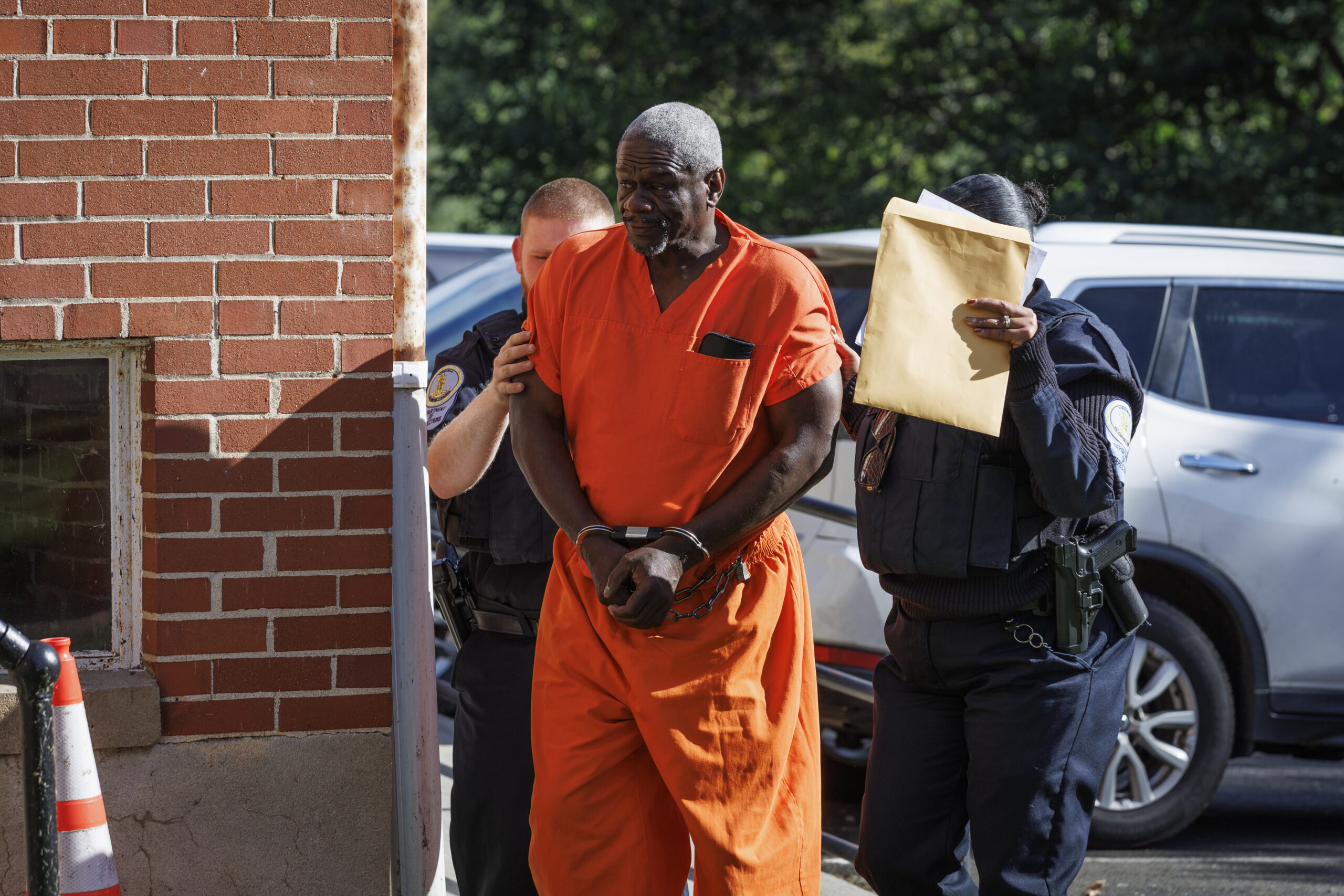
DNA retest delays trial
Chester Brown said in court last Friday that he is in over his head preparing for his upcoming murder trial without a lawyer, and said he wants one back on the case.
“I’m overwhelmed,” Brown told Rappahannock County Circuit Court Judge Robert Smith. “I see things now that I didn’t foresee … not knowing really what I was getting myself into. It’s more than the courtroom action.”
Brown, who is charged in the 2023 murder of Washington resident Doris Critzer, fired his public defender in August — the second time he has done so — and has represented himself since.
Even so, Brown won a key ruling when the judge upheld his request to have DNA evidence from a blood-stained dollar bill retested at a third-party lab, despite firm objections from Commonwealth’s Attorney Art Goff. The retesting will delay the weeklong trial, which had been scheduled to start Oct. 26. A new trial date has not been set yet.
“We’re going to retest the dollar bill,” the judge said. “There’s nothing that says I can’t do it.”
‘All this paperwork’
Smith said he would look into the legality of granting Brown’s request for a new attorney, but said he worries Brown could continue a pattern of getting a new attorney and not liking how they represent him.
“I don’t know if you can say, ‘I want to represent myself,’ then, ‘I changed my mind’ … I told you this was not a good idea,” the judge said. “It can’t be used as a stall tactic.”
Brown said that since the trial date will be moved anyway, there is time to appoint a new attorney.
“[This could] keep on going and going, where’s the end of it?” Goff said, adding that he is in “an impossible position” trying to balance ensuring Brown gets his due process, and considering the “family sitting behind me who has a dead mother,” referring to several members of Critzer’s family seated in the courtroom.
Smith said that if he granted the request for a new attorney and Brown then decided to represent himself again, he would not grant another continuance.
“You’ve got my word,” Brown told Smith. “I didn’t know really what I was getting myself into … What I didn’t foresee was all this paperwork,” Brown said, referring to the motions, briefs and court filings he said he has been “bombarded with” since taking over his case.
“You have created this problem you’ve got,” the judge said.
He also said Brown’s decision to represent himself was a big reason he ordered a competency evaluation to ensure Brown was competent to both stand trial and represent himself. Smith announced that the evaluator found that “at least in a mental sense, he’s competent.
“Is he legally competent to represent himself? No, but that’s his choice,” he added. “This is why we’ve gone through that [competency] inquiry; this is not a good idea.”
The judge will make a final decision about Brown’s counsel at an Oct. 27 hearing.
DNA retest
The retest of DNA has to do with a small drop of blood on a one-dollar bill collected from Brown’s backpack a few days after Critzer’s murder. The state forensic lab said it contained a mix of Critzer’s and Brown’s blood. Before Brown asked for a new attorney, his public defender Paul Fore requested that the court release the DNA evidence for retesting at a third-party lab — Bode Technologies in Fairfax. The evidence was previously tested in the state Department of Forensic Science lab.
Smith originally denied the motion, then reconsidered and granted the request Aug. 28 after Brown brought up a closed-door hearing in which another judge allowed state funds to be allocated for reanalysis and expert witnesses.
Smith then asked Goff to write a brief explaining why he objected to the retest before the court officially ordered it. “I might change my mind and rule with you,” Smith had told Goff.
“Aside from a somewhat nebulous interpretation of the discovery rules, no specific statutory authority exists in Virginia law for third-party testing of Commonwealth’s evidence,” Goff wrote in the brief, and suggested “it would appear reasonable” to get clarification from the other judge about the intent of his order.
Goff was unable to sway Smith. The judge ordered that the dollar bill, Brown’s DNA and a “blood card” containing Critzer’s DNA be sent to Bode Technologies for retesting.
Goff said he is in no way “acquiescing,” but said if the bill is to be sent to Bode Technologies, Capt. James Jones of the Rappahannock Sheriff’s Office will accompany it there.
“We don’t want to let that dollar bill out of our custody,” Goff said. He also offered that if the retest happened at the state lab, he could “pull some strings” and get results before the October trial date, a suggestion which the judge did not entertain.
To allow time to schedule the retest and coordinate getting Critzer’s blood card from the chief medical examiner — a task Goff said may be difficult — the trial was postponed.
“I don’t think it can be done by Oct. 26,” Smith said, referencing the trial’s original start date.
Goff said issuing new subpoenas to his nearly 30 witnesses will be a challenge, especially for the four state forensic specialists who are called to testify at trials across Virginia.
“This is a tall order,” Goff said. “It’s almost a practical impossibility, but we’re going to try.”
The judge noted that the trial could still be moved to Loudoun County if a jury could not be seated in Rappahannock. He suggested that, for simplicity in subpoenaing witnesses, instead of following the original plan to move the venue on the fly the week of trial, the court could set two trial dates — one in Rappahannock and one in Loudoun a few weeks later as a backup.
Trial dates will be finalized on Oct. 27 and could be in late March or early April of next year, according to discussions among the judge and clerks of court.