

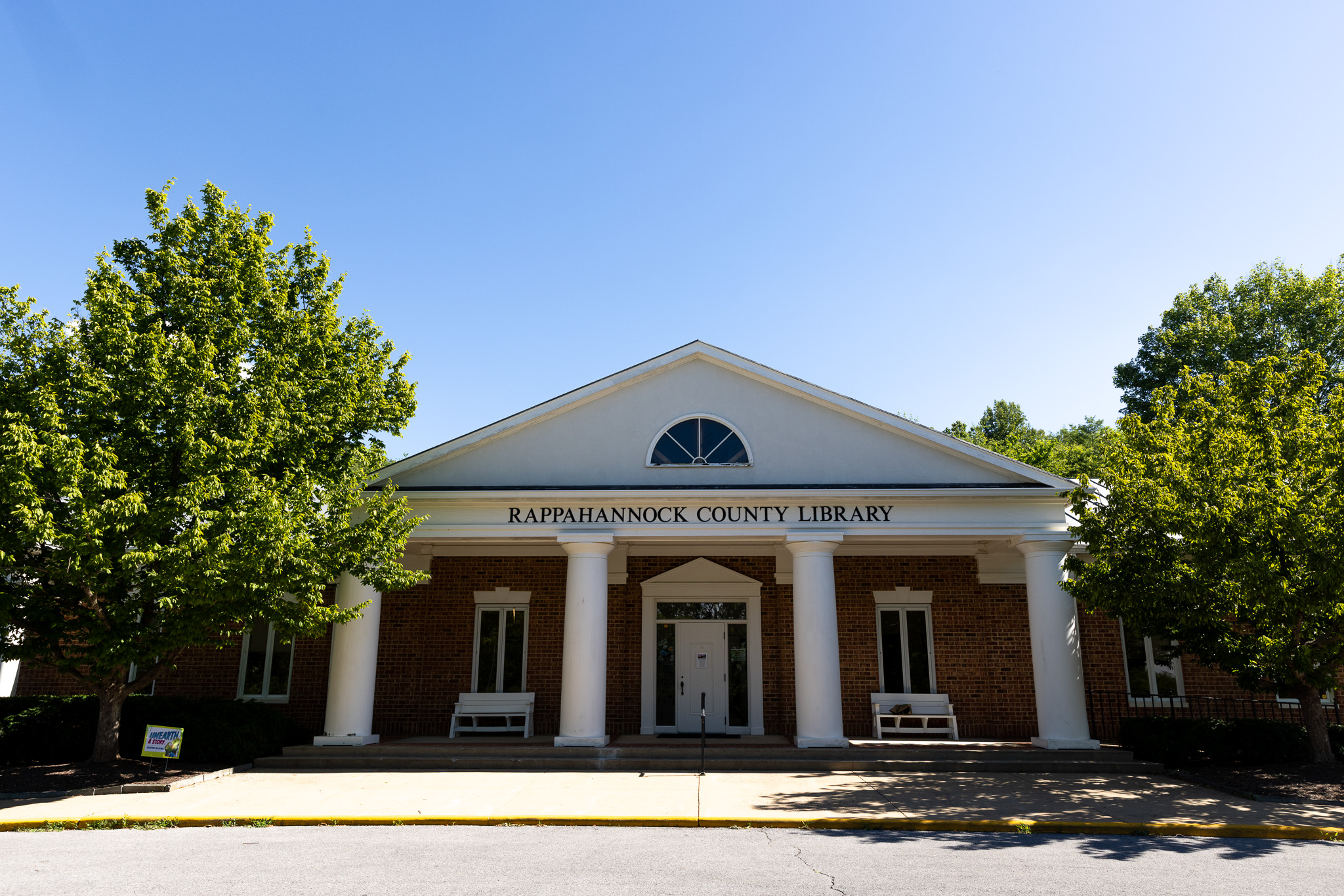
A judge on Monday gave the Rappahannock County Public Library Board of Trustees 10 days to turn over to him lease documents relating to a potential move of the library to Rush River Commons in the Town of Washington.
The documents are being sought in a lawsuit alleging the board violated the Freedom of Information Act (FOIA) by unlawfully denying requests for documents and terms related to the lease.
Once Rappahannock County Circuit Court Judge Thomas Horne has the documents, he said, he will decide whether they should be made public.
His ruling is expected to be returned before the board’s next meeting Aug. 27, when a decision may be made about the move.
“I’ll have an answer to you before then,” Horne said.
The lawsuit was filed last week by local attorney David Konick on behalf of several county residents.
Konick has requested a draft lease, meeting minutes and other records related to negotiations with Black Kettle LLC, the developer overseeing the Rush River Commons project, where the new library could be constructed.
In a nearly two-hour hearing on Monday, Konick argued the documents are not exempt under FOIA and should be released — at minimum, in redacted form — to him and his clients.
Jeremy Capps, representing the library board, countered that the board is exempt from releasing documents tied to ongoing negotiations, arguing public disclosure could jeopardize its bargaining position.
“I think this is a matter of law,” Capps told the judge. “The draft agreement is properly withheld under FOIA.”
Court testimony
Konick called two witnesses — Bonnie Jewell, assistant county administrator and local government appointee to the board of trustees, and Victoria Fortuna, president of the board. He asked them questions about the relocation negotiation committee that was formed to handle the potential move terms.
On the stand, Jewell answered questions about the committee’s seven meetings and a nonbinding letter of intent with Rush River Commons, but was not required to disclose details from closed sessions after Capps objected, and the judge sustained the objection.
Although the committee has since drafted minutes for all closed-door meetings, Jewell said, the board has not approved them yet. They are currently unpublished except for portions read aloud in court.
Konick asked Jewell and Fortuna when the board hired pro bono attorney Michael Goodwin to assist in negotiations. The hiring was never documented in the board’s official minutes, Konick said, which he argued violates state transparency law. Fortuna testified that Goodwin was engaged around December 2025, to the best of her recollection.
Fortuna testified that, because negotiations are ongoing, the board should not have to release working drafts or reveal closed-session discussions, arguing that disclosure in the midst of negotiations could allow third parties to interfere or expose the board’s strategy.
“Another party could say, ‘Look, Chuck [Akre], I’ll give you a better deal’ and scuttle the whole thing,” Fortuna said.
Fortuna said she and other board members created a “highlights sheet,” distributed at a July 23 public hearing, to inform the public about agreed-upon lease terms. “I believe the public has a right to know what’s going on,” Fortuna said.
However, both she and Jewell testified that many details — including building termination rights, parking, construction costs and insurance — remain unresolved.

Local attorney David Konick speaking at a public hearing on the library’s potential move last month. (Photo/Ireland Hayes)
Konick zeroed in on a comment from Fortuna that members of the public could find out what the board was discussing and ask questions about why certain decisions were made. “Your honor, if that were the standard, we wouldn’t have any FOIA,” Konick said.
Konick also questioned how Black Kettle LLC became involved and whether the board considered alternative bids. Jewell testified that Black Kettle LLC approached board members John Beardsley and Patti Peterson directly, and no formal bidding process occurred.
Jewell testified that the board and Black Kettle LLC have exchanged seven or eight draft documents.
Konick argued that both parties are already aware of each other’s terms and amendments, so the exemption from FOIA claimed by the board does not apply.
“What in the world could possibly undermine their negotiating power … everyone knows except us — Black Kettle knows, Chuck Akre knows,” Konick said. “The only people in the dark … is the public.
“They’re entitled to know,” Konick said.
Capps made a motion to strike evidence and dismiss the case on all counts, which Horne denied.
The judge will conduct a private, in-camera review of the unredacted documents, meaning he will privately review them outside the view of the public to decide whether they can, in fact, legally be withheld from the public.
Konick had asked the judge to block the board from moving forward on any decision related to the lease until a ruling is issued, but Horne declined, noting the board does not meet again until Aug. 27 and a decision is expected before then.