

Judge: ‘I think I’m right, but maybe I’m not’
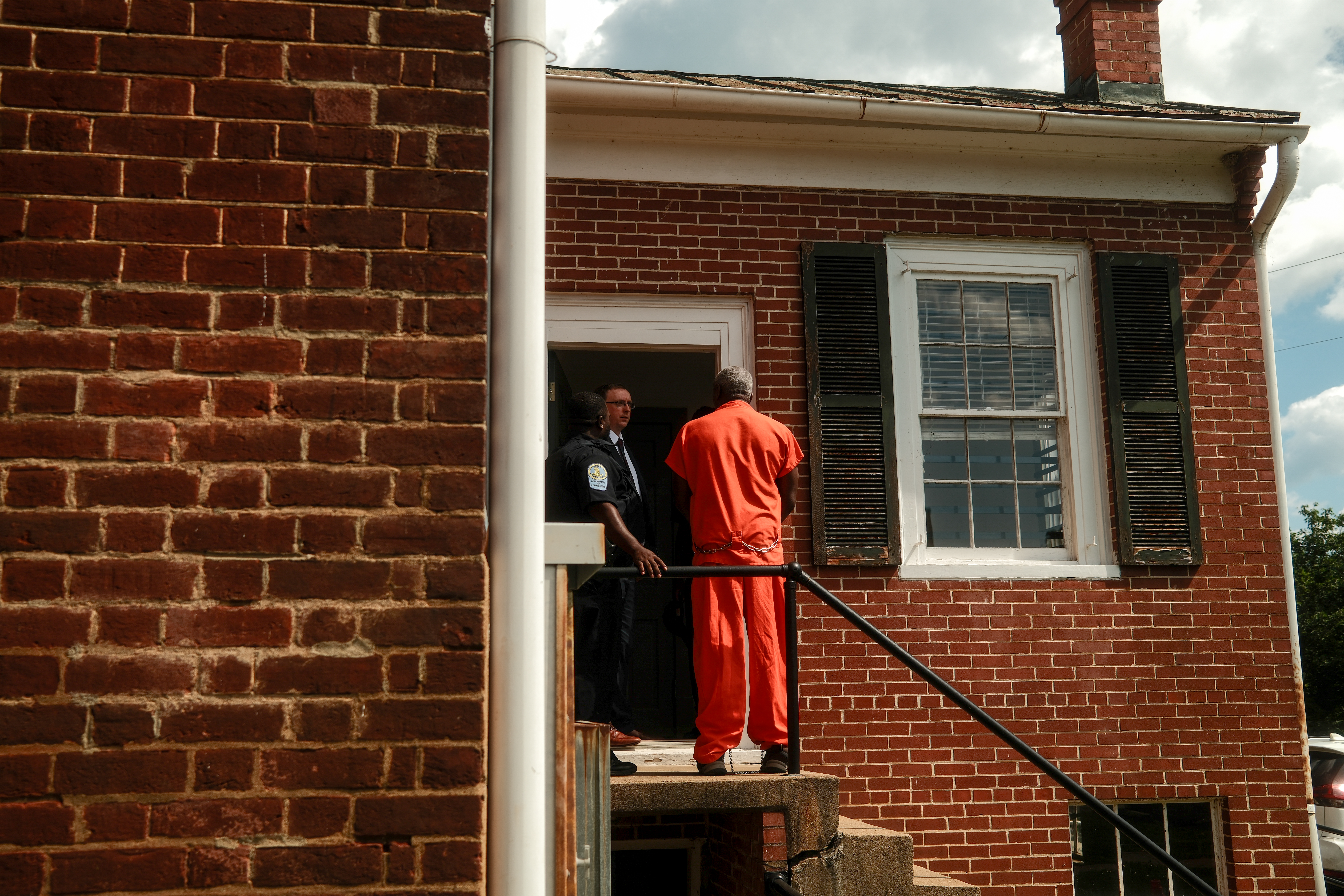
Chester Brown won a round in court Tuesday when a Rappahannock County Circuit Court judge ruled that DNA evidence gathered during the investigation into the murder of Washington resident Doris Critzer could be independently tested at a private lab.
The ruling didn’t seem to sit well with Commonwealth’s Attorney Art Goff, who says he plans to fight it intensely. He told Judge Robert Smith he thought the judge was “committing an egregious error” and misinterpreting Virginia law.
“I disagree that you’re following the law, your honor, very much so,” Goff said. “You seem a little biased against the commonwealth, particularly on this issue.”
“The commonwealth thinks I’m wrong,” the judge told Brown. “I don’t know, the commonwealth may be right … But you kind of won today.”
The evidence in question is a bloodstained one-dollar bill that was found among about 50 other bills in Brown’s backpack days after the murder of Doris Critzer — which occurred three years ago this month. The Virginia Department of Forensic Science found a mixture of DNA from Critzer and Brown — who stands charged with her murder and strangulation — in a drop of blood on the back side of the bill.
“I’m entitled to have it reexamined,” Brown told the judge Tuesday.
At an Aug. 12 hearing — before Brown decided to represent himself — the judge heard arguments from public defender Paul Fore requesting that DNA evidence in the case be released for retesting at a third-party lab — Bode Technologies in Fairfax.
During that hearing, Jessica Harris, a senior forensic scientist at the Virginia Department of Forensic Science lab in Manassas, testified that when she was testing the drop of blood — which was a combination of Critzer and Brown’s — on the back of the bill, all of the blood was swabbed up, or “consumed.” She said about 25% of another stain on the other side of the bill was left — a stain that came back positive for only Brown’s DNA.
Harris said the only further testing that could be done on the consumed portion of the DNA was retesting the stored, dried sample she swabbed up — which may have degraded some over time naturally — or cutting into the dollar bill where the stain was and analyzing the fibers inside. She said the paper of the bill is porous, and oftentimes DNA from several people who “are not involved” but handled the bill during its circulation is detected.
“That could be the DNA of Joe Schmuckeroony … anyone who touched the bill,” Goff said.
Smith originally had denied the motion to retest, saying he believed “it’s been accurately tested.” A week later, however, he decided to reconsider the issue when Brown told him that Circuit Court Judge Dennis Hupp had approved funds for the new expert testing in a closed-door hearing in June — something Smith said he did not realize when he ruled the week prior.
Fore, who is now serving in an advisory role to Brown rather than counsel, confirmed this.
When Smith learned of the other judge’s ruling, he said he would need to take the issue “under advisement” and study the law. Tuesday, he announced his ruling — the DNA could be retested at the third-party lab.
Goff argued that the funds approved by Hupp were not explicitly for retesting. Goff said an independent expert often testifies using the results of the state tests and the techniques used, as well as any flaws they see in how the evidence was tested or handled.
Goff said he has never seen retesting done and referenced a case in Washington, D.C., in which the Bode Technologies lab lost a key piece of evidence in a murder case. He said that if the dollar bill and Critzer’s DNA were sent to the lab, he and Capt. James Jones would take it there themselves and return it to the evidence locker after the test.
“If the DNA is going to be retested, I’m going with it,” Goff said. “It stays with us … We’ll bring our sleeping bags if we have to and sit there with that dollar bill.”
“Excellent,” Smith replied.
“The order is silent on retesting … all they were asking for is the funds,” Goff said. “This is a drastic, drastic departure from the law of Virginia.”
Goff said he will file a brief arguing that the ruling is incorrect. He said he had consulted with the Commonwealth’s Attorneys’ Services Council on the matter, and would ask for their help drafting the brief.
“The briefs may convince me otherwise,” Smith said. “I think I’m right, but maybe I’m not … I might change my mind and rule with you.”
Goff reiterated that, according to his interpretation of the law, the state lab should be the only place to send the evidence.
“I don’t understand why Mr. Goff is fighting this so hard,” Brown said. “It’s like asking the same doctor for a second opinion; it doesn’t change.” Brown also asserted that the “tiny, tiny” drop of blood was “a plant.”
All parties will return to court Sept. 25 — after Goff submits his brief and Brown has a chance to respond to it — when Smith will make a final decision. No evidence will be released until after that, Smith said.
“I look forward to your brief,” Smith said to Goff before court was adjourned. “Mr. Brown, you’re on your own to write a response to that brief.”