

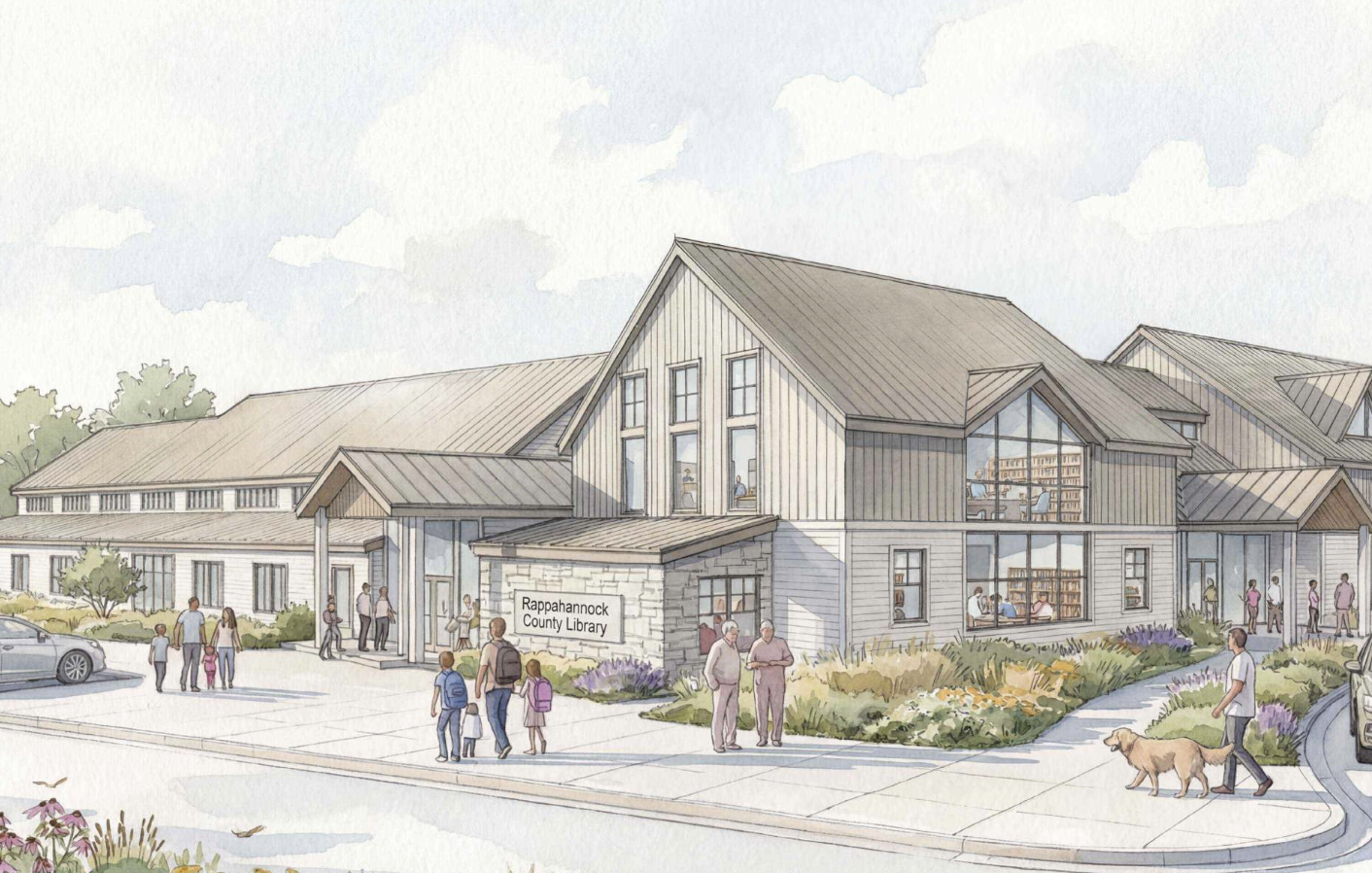
Library board presents new information on potential relocation
In a presentation preceding a July 23 public hearing, the Rappahannock County Public Library Board of Trustees showed the crowd new renderings of a proposed building at Rush River Commons that would house the library, and laid out negotiation details.
“We’ve been working very diligently since 2021 to stay here, and we’ve been approached with a very unique and generous opportunity,” Board President Victoria Fortuna said. “Every one of us here on the board, without question, wants the library to be around in 80 years, no matter where it is, whether it’s here, at Rush River or any place. We see the value in our community having a functioning, thriving and flourishing library.”
The money
- Black Kettle LLC, the developer of Rush River Commons, would pay all construction and permitting costs and take on investment and construction risk for the project.
- The lease would be a “gift” from Rush River Commons, and no rent would be owed. However, a $ 500-a-month building maintenance fee would be charged, and that amount would increase 3% annually.
The lease
- The lease has the potential to be 80 years long, but the initial lease would be for a 10-year term. Then seven additional 10-year renewals would be offered.
- Black Kettle would be responsible for maintenance of the building, but the library would be responsible for maintenance and repairs to fixtures installed by the library and damage caused by library visitors.
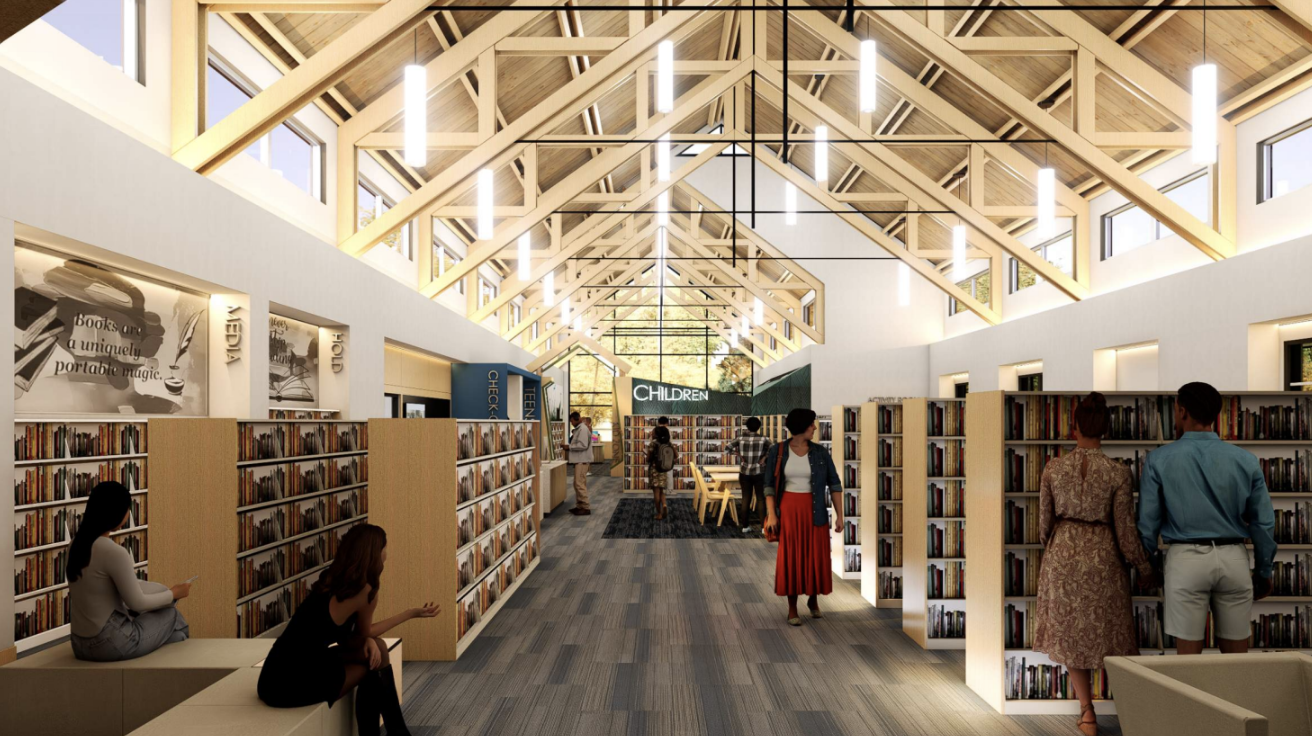
An interior view of what a new library could look like. (courtesy)
The building
- The new library would be “move-in ready,” so the library would not need to close for an extended period of time to accommodate the move.
- The new library would be between 8,000-9,000 square feet and be on one floor. In June, Betsy Dietel, Rush River Commons’ project spokesperson, said a total square footage is still being worked out. The board said proposed office space above the library has been eliminated. The building would be designed to the library’s specifications and needs. The space could potentially have a fireplace, more seating and would be “a generous, light-filled space with a high ceiling,” said John Beardsley, vice president of the board.
- Twenty parking spaces would be designated for library use only, and about 150 more would be available on a first come, first serve basis. The current Library Road site has about 45 parking spots.
- The new library would be fully ADA accessible.
- There would be dedicated teen space, a children’s area and an activity room. Soundproof study rooms for calls and podcasts, outdoor porch and lawn space would also be available.
- The new building would be paired with a community center and connected to Rush River One via a walkway across a restored stream.
What is Rush River Commons and Black Kettle?
- Rush River Commons is a project of the Sherwood Fund, a 501(c)(3) nonprofit described in the presentation as a donor-advised fund. Black Kettle is the company that manages and owns the Rush River Commons development and its construction.
- Chuck Akre, a local philanthropist and founder of the Sherwood Fund, is the financial backer of the project.
Issues at current site
- The current Library Road building is about 5,000 square feet, 35 years old, and not ADA compliant. It also needs a new HVAC system, new plumbing and new restrooms. The board and Librarian Amanda Weakley said the library needs more room for book collections and its growing programming.
- The board said the current site — which it owns outright — limits renovation, and expansion would be very costly — an estimated $7 million — and difficult due to the rough terrain at the site, like rock ledges and a steep hill.