

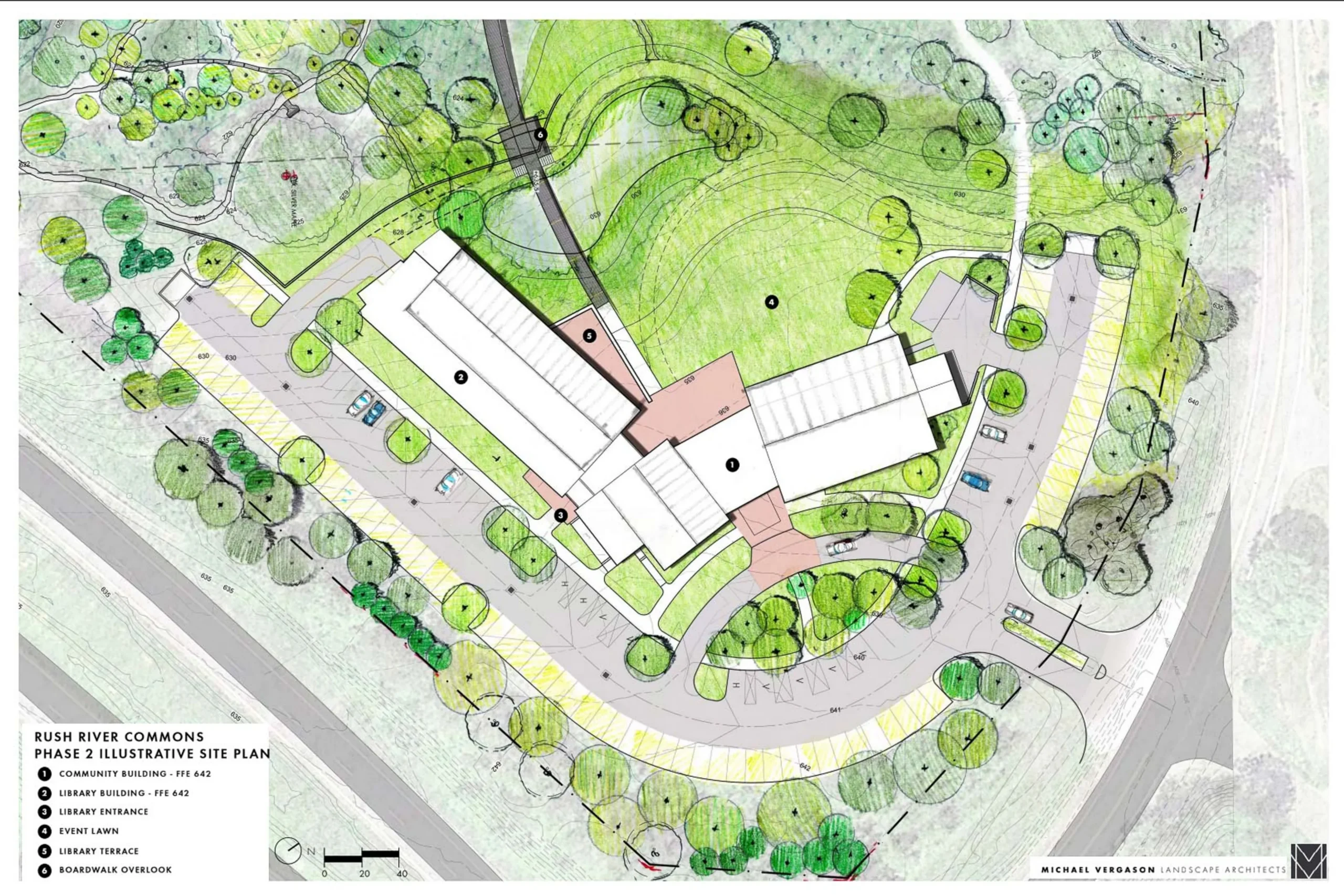
Draft plans for potential move to Rush River Commons
Board frustrated by ‘faulty’ info about project
The Rappahannock County Public Library Board of Trustees has gotten a glimpse of what a new library could look like if it decides to relocate to the Rush River Commons development in the Town of Washington.
“This is all proposed, this is all under negotiation,” said board member John Beardsley during a review of a draft site plan at the board’s monthly meeting last Thursday.
The board had signed a non-binding letter of intent in early March, which technically expires June 6, but the deadline has been extended. President Victoria Fortuna said the board and Rush River still need to finalize designs, reach an acceptable lease agreement and hold a vote. Fortuna expects that process to drag into summer before any decision is made.
“I think everybody feels we’re moving very much in the right direction, and we were willing to not have a hard stop at June 6 if there was good progress being made,” said Betsey Dietel, Rush River Commons’ project spokesperson. “The hope is that we can come to something that works for both groups … we’ve got two more pretty serious working sessions to come up with a final plan.”
The preliminary designs were created by Richmond-based Enteros Design, an architectural firm that specializes in library spaces that the board has been working with since it first considered expansion at the current site on Library Road in Washington.
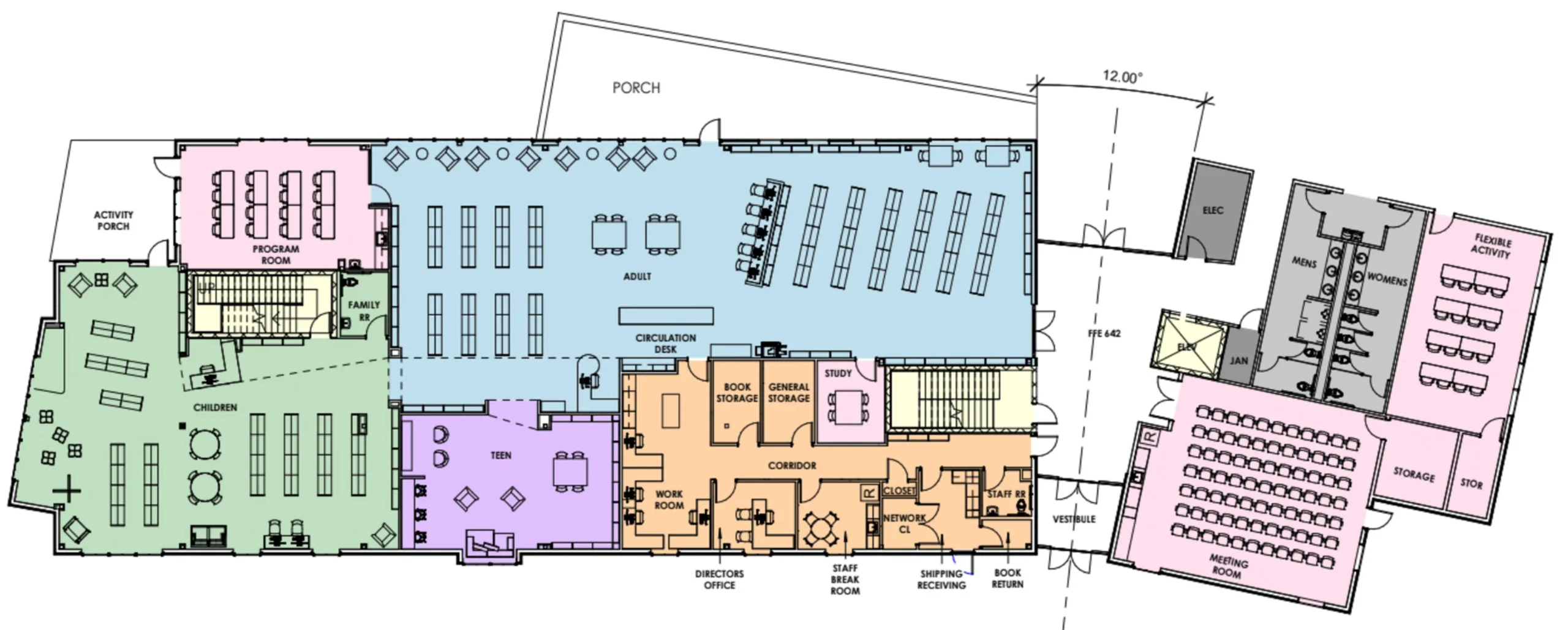
PROPOSED: A potential floor plan for a new library building. “This is all proposed, this is all under negotiation,” said board member (John Beardsley.Courtesy/Enteros Design)
A 2021 community survey gauged how residents use the library and identified needs that pointed toward a roughly 9,000-square-foot facility — with additional programming space, meeting rooms and dedicated areas for children and teens. That same footprint is what the proposed new building would provide.
Under the proposed concept presented last Thursday by Enteros architect Gil Ensminger, the library would occupy its own wing of a larger building — with a total square footage that is still being worked out, Dietel said — that also includes a community hall, shared lobby and restroom spaces, and a meeting room accessible after library hours. The second story of the library was proposed to be office space.
The proposed design features an adult reading area with large windows overlooking a terrace and pond, a teen section and a children’s area with access to a covered outdoor activity porch, along with a flexible program room for events and gatherings.
The proposal also includes a “green roof” covered in foliage which Ensminger said would help manage stormwater runoff while fitting the aesthetic of the surrounding wetlands and green spaces.
Beardsley said Monday that the key item under evaluation by the board at this stage is the floor plan of the library. The board is still negotiating details like exterior design, elevation and how the library would integrate into the rest of the development — including concerns that the overall building design is too large and needs to be scaled back. He said the board met with Rush River officials Friday after its meeting and designs and plans are continuously changing.
“We just aren’t at an elevation we’re comfortable with yet,” he said. He added that the design team is expected to come back with revised plans later this month.
Misinformation
The board has been grappling with what Fortuna described as a misinformation problem in the community. She said residents continue to contact the board with concerns rooted in incorrect assumptions — chiefly, that a move would raise taxes.
“While I’ve received at least six emails within the last 10 days, all in opposition, every one of them has been based upon faulty information, and it just doesn’t sit well with me that we would say the community is against it if the community is working on a false assumption,” said board member Michael Chamowitz.
Fortuna reiterated that if the library were to move, the cost would not fall to taxpayers, but would be funded through private donations and fundraising — the same model the board had pursued for a planned expansion at the current site before a feasibility study last year found that raising the roughly $6 million needed would be nearly impossible.
“They say, ‘I don’t want it because I don’t want my taxes to go up,’” Fortuna said. “[Some people] are mixing a public expense with private donor funding.”
Board member and assistant county administrator Bonnie Jewell suggested the possibility of a publicized public hearing devoted solely to discussion of a possible move.
Communications committee chair Liz Conley said the “FAQ” page of the library’s website, rappahannocklibrary.org/expansion-renovation/, was recently updated with detailed information about the potential move and fundraising efforts. The board also recently hosted four coffee hours, inviting members of the public to talk about their concerns. Conley said in total, about 35 people attended those.