

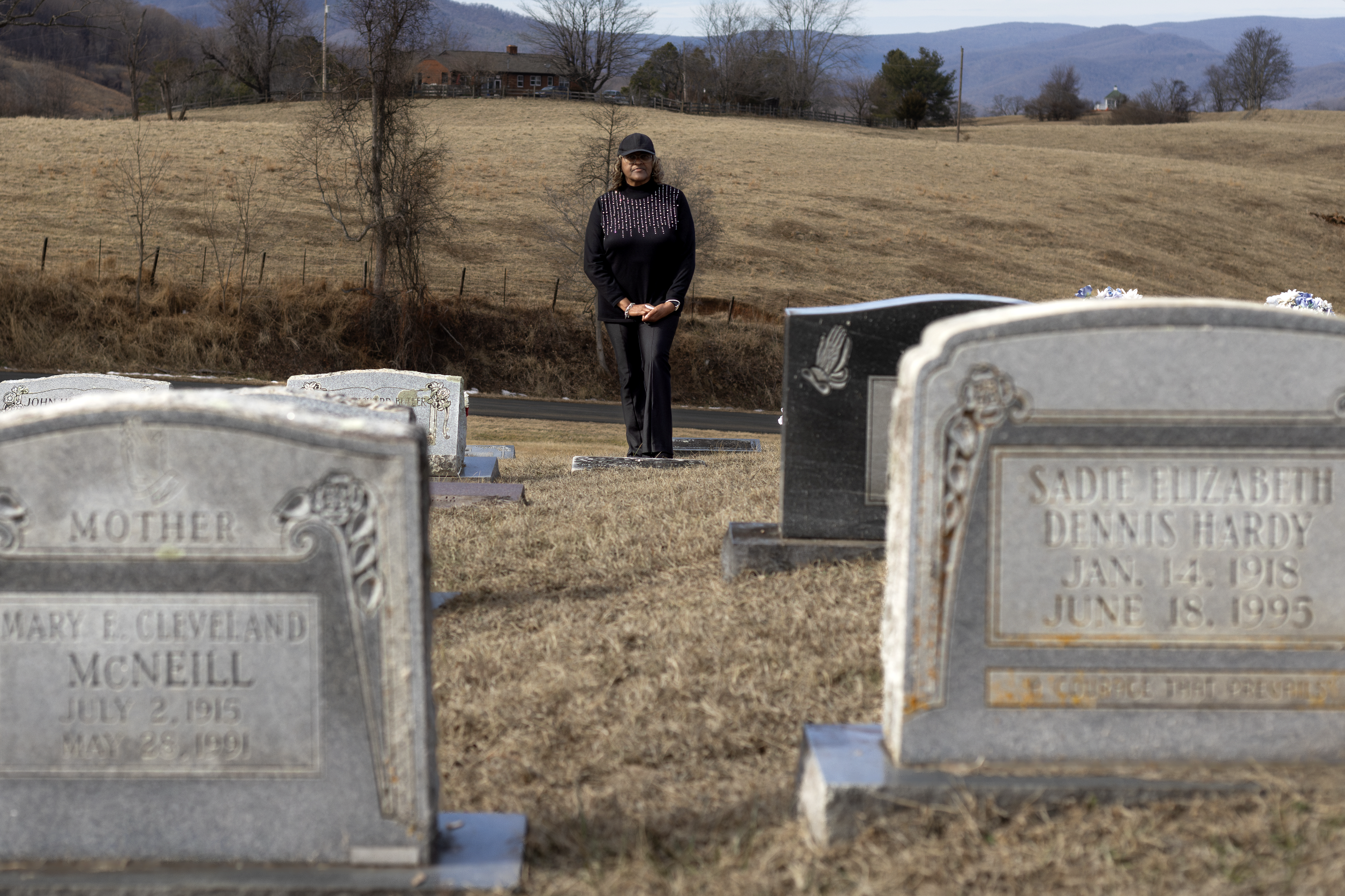
Nan Butler Roberts pictured among the headstones of her many ancestors buried in Woodville. Other family members buried in the same cemetery have no headstone, and Roberts does not know where their graves are located. When she visits the cemetery, she said, she is hit with a wave of mixed emotions. “Lots of memories come back. I tear up just thinking about it.” (Photo/Ireland Hayes)
By Meredith Ogilvie-Thompson
Nan Butler Roberts has stood here many times, a hilltop in Woodville, from where the view is breathtaking — sweeping over a farmland quilt, all the way to the buttresses of the Blue Ridge.
But it’s the cemetery that draws Roberts. Her grandfather is buried here. Along with her parents, aunts and uncles. Including Walter, a vet who survived the war in Korea only to die in a car accident on his return. It was the year before Nan was born, though she knows the story because of the military stone that honors his service. Somewhere in this ground, though she cannot say precisely where, two of her grandmother’s babies also are buried, one a few days old; the other a few months.
“It creates a question mark that’s always in your mind,” said Roberts. “I would love to place markers with their names. But the exact locations have been lost.”
Rappahannock County holds its dead everywhere. From church grounds to private farms and the Shenandoah National Park. Even town lots, where neighbors pass without knowing who lies beneath their feet. The Rappahannock Historical Society’s cemetery database runs to nearly 50 pages, documenting thousands of burial sites scattered across the county’s 267 square miles.
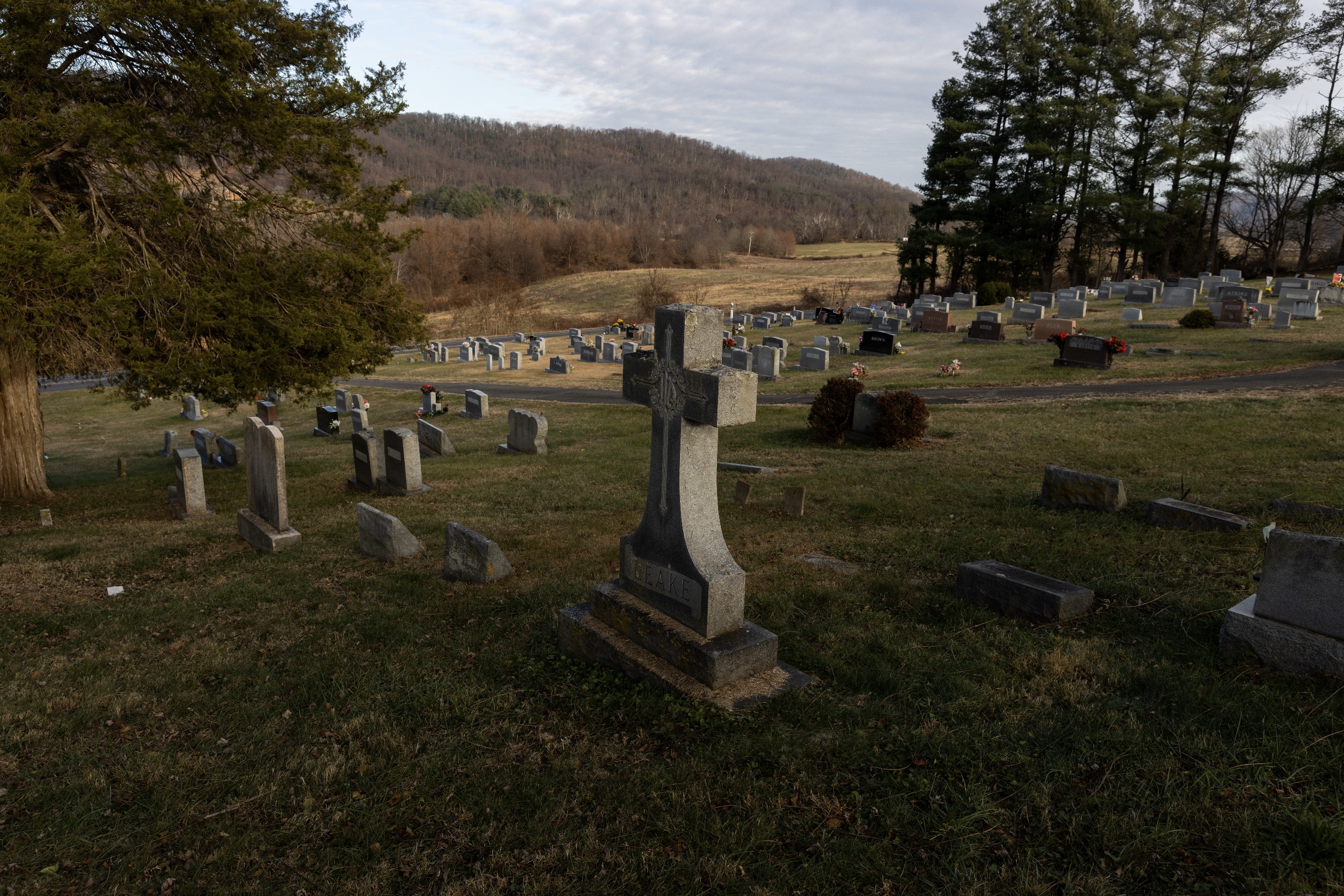
A hill sprawling with headstones at the Sperryville Cemetery. (Photo/Ireland Hayes)
When Brian Noyes and Dwight McNeill bought their home on Mount Salem Avenue in the Town of Washington last August, they inherited more than a house. Behind a dense thicket of privet there was a small family burial ground, on a portion of their property that once was attached to the adjoining Middleton Inn, the historic manor house on Main Street. For years, the graves had been hidden in plain sight.
“The first thing I did was have the overgrown hedges trimmed back so people could see the gravesites again,” said Noyes. Once the brush was cut to four feet, passing neighbors told him they’d never known the cemetery was there.
“I had no idea there were so many graveyards in the county,” said Eva Grimsley, the historical society’s executive director who has spent 18 years documenting the county’s past, and whose own family has lived here since the 1700s. “Absolutely no idea that there were so many.”
The society’s database is the culmination of decades of volunteer work recording GPS coordinates, transcribing inscriptions, noting what had survived and what hadn’t. Some entries include precise directions, some are vague, and others simply say “fieldstones only.”
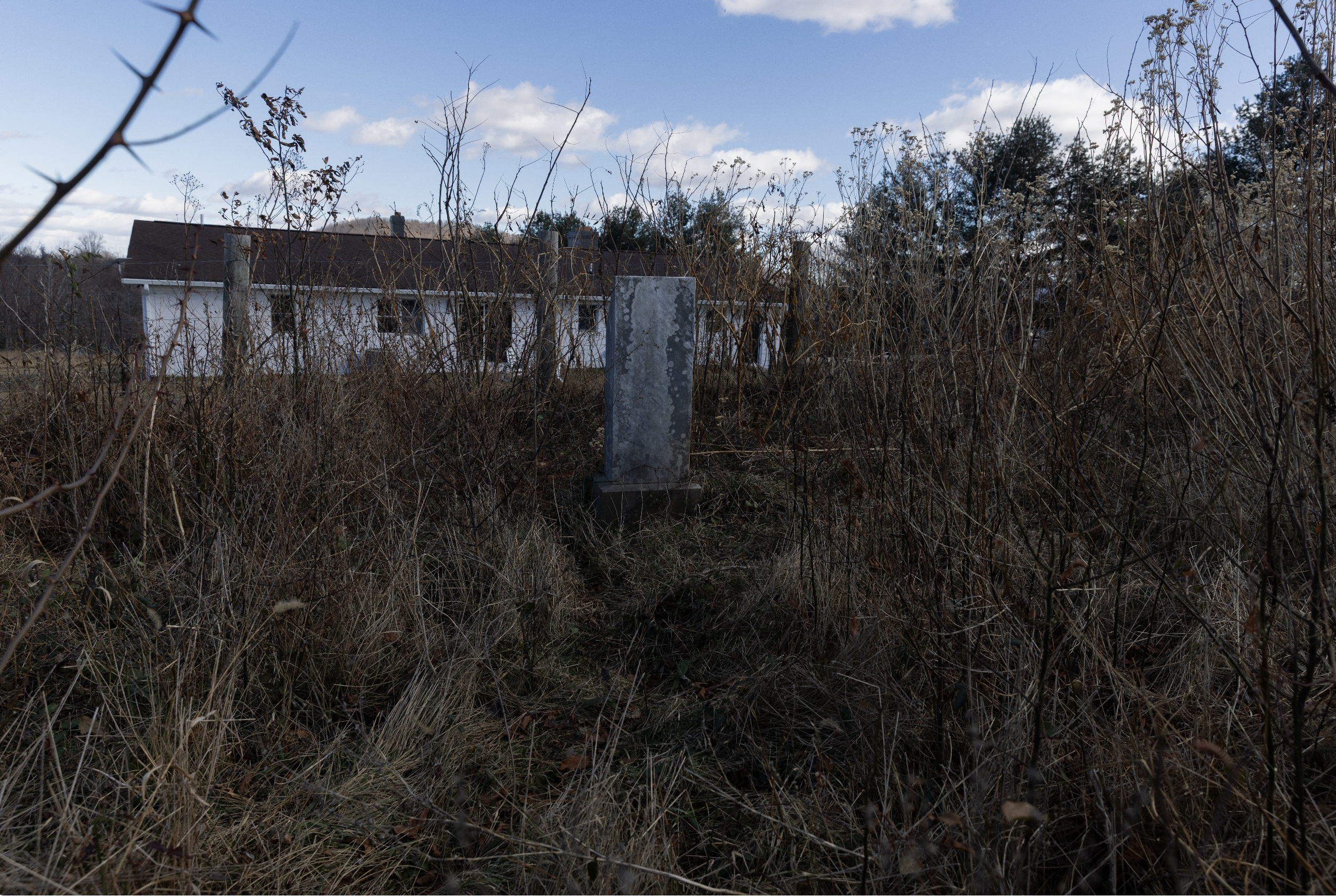
A grave hidden in thick brambles and brush on a Sperryville property. Most of the graves surrounding the large center stone are completely hidden from view. (Photo/Ireland Hayes)
What gravestones reveal
For Kristie Kendall, cemeteries are cultural landscapes, records of lives lived and how a society was ordered. A historic preservation professional who spent more than 12 years at the Piedmont Environmental Council documenting disenfranchised and displaced communities across Virginia’s Piedmont, she now runs her own practice, mapping post-emancipation freetowns, tracing lost settlements, and documenting communities that left behind few written records.
“When a place goes back to nature, typically all you have left are the cemeteries. They may be the only reminder that people lived there at all,” said Kendall, who has mapped more than 50 cemeteries within Shenandoah National Park alone — the burial grounds that remained after the 1930s, when families were evicted; homes dismantled; and farms seized to create a wilderness preserve.
Through her work, Kendall has become adept at reading what the stones reveal, from the ornamentation of a cemetery’s enclosure, which reflects a family’s position and wealth, to the headstones, which tell a story over time.
“The transition from elaborate markers to simple fieldstones often maps a family’s declining fortunes after emancipation ended the enslaved labor their prosperity had depended on,” said Kendall. “Why are some people buried inside the wall and others not? The stones don’t explain themselves, but they don’t lie.”
Jim Northup knows the kind of man Samuel Morrison was — a subsistence farmer on a rugged Blue Ridge mountainside, clearing land by hand, building stone walls that still thread across the property. Morrison also taught at the Laurel Dale School in Riley Hollow near Flint Hill, and ran a grist mill on Mill Hill Road. He farmed there for decades but he died leaving almost no trace.
His grave, a single headstone snapped in two, face down in the mud in a thicket of thorns and brambles, was the only evidence he had been there at all.
“I can remember as a little boy walking out and looking at the gravestone,” said Northup, who grew up visiting his family’s property in the Blue Ridge foothills. “And then for years, we just couldn’t find it.” A hunter eventually located it.
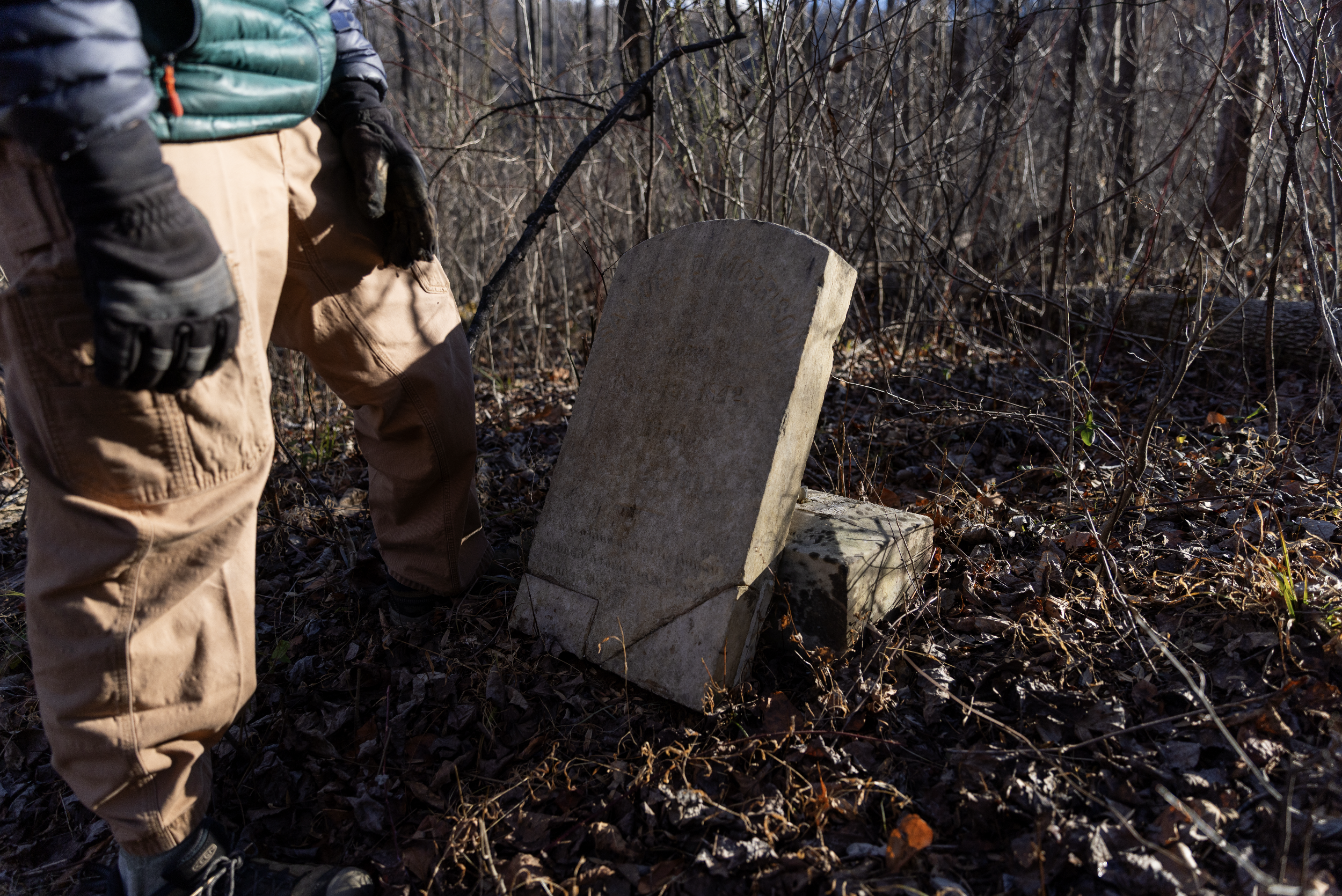
Jim Northrup stands next to the broken headstone of Samuel Morrison, a subsistence farmer on a rugged Blue Ridge mountainside that Northrup now resides on. Northrup worked to restore the family cemetery, where others are believed to be buried, and welcomed Morrison’s ancestors to visit the burial site. “I had no idea I was a steward of a family cemetery,” said Northup. (Photo/Ireland Hayes)
Northup had known Kristie Kendall from his time as superintendent of Shenandoah National Park. He asked her to help piece together Morrison’s story.
Digging through old land tax records, she determined the house on the property was built in 1819 by a man named John Morrison, Samuel’s father. A government appraisal from 1929, prepared when the land was briefly condemned for inclusion in the nascent Shenandoah National Park, described a two-story log home with six rooms. The Morrisons had farmed the mountainside for nearly a hundred years. When John died, Samuel bought out his siblings and stayed on with his widowed mother, his wife and 11 children.
Kendall asked if she could do a little more research, specifically about the man in the grave. Within three days, with the help of Ancestry.com, she found Ed McKinney, Samuel Morrison’s great-great-great-grandson, living in Maryland. Northup emailed him soon after: “We’ve never met. We’re not related in any way. But I believe one of your ancestors may be buried on some property my family owns in Rappahannock County.”
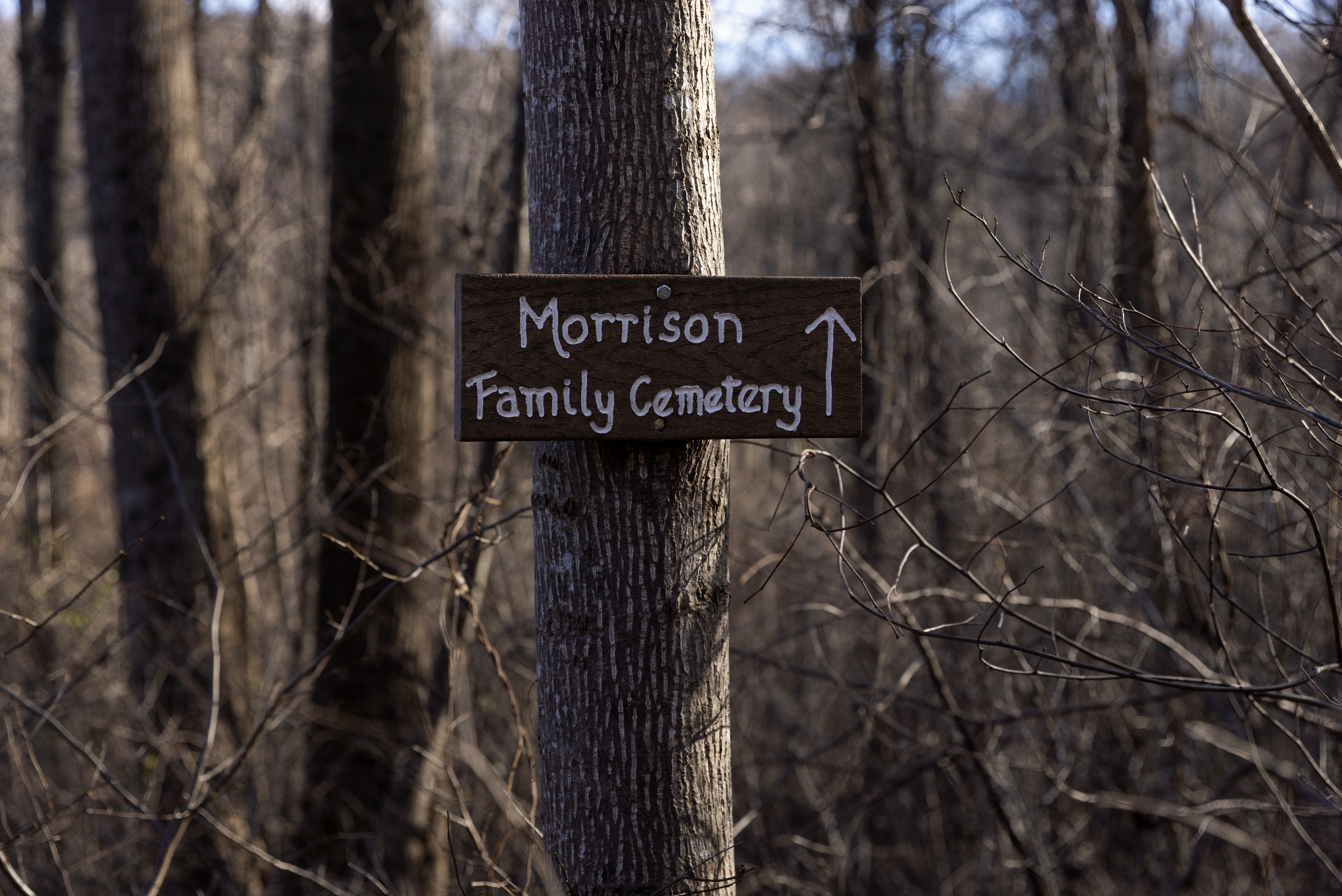
A sign leading to the Morrison Family Cemetery. (Photo/Ireland Hayes)
McKinney replied the same day. He and his wife had spent years searching for Samuel Morrison’s grave, checking church records around Flint Hill, consulting cemetery registers, but had never found it. The two men became fast friends.
In the ensuing months, Northup found a craftsman who restored historic headstones and sent the broken marker away for repair. A year later, when it came back, he called McKinney and suggested a small rededication. Four generations of Morrisons arrived, some from as far as North Carolina. They picnicked on the mountainside and stood at the grave of an ancestor most had never known existed.
In time, McKinney told Northup what the family research had turned up: Eight or nine other family members were buried in the woods alongside Samuel Morrison. They had lived and died there. Eventually, workers clearing the brush in careful concentric circles from the headstone found depressions in the earth, three or four unmistakable burial sites, in which coffins had collapsed, settling back into the ground. Several infants also are believed buried there, but their exact locations have never been found.
“I had no idea I was a steward of a family cemetery,” said Northup.
A plaque now stands near the reconstructed cabin foundation, listing the family members believed buried nearby. And though Ed McKinney has since died, the connection he sought between living descendants and the land their ancestors worked endures.
“We tend to think the history of a property begins when our family bought it,” said Northup. “That’s simply not the case.”
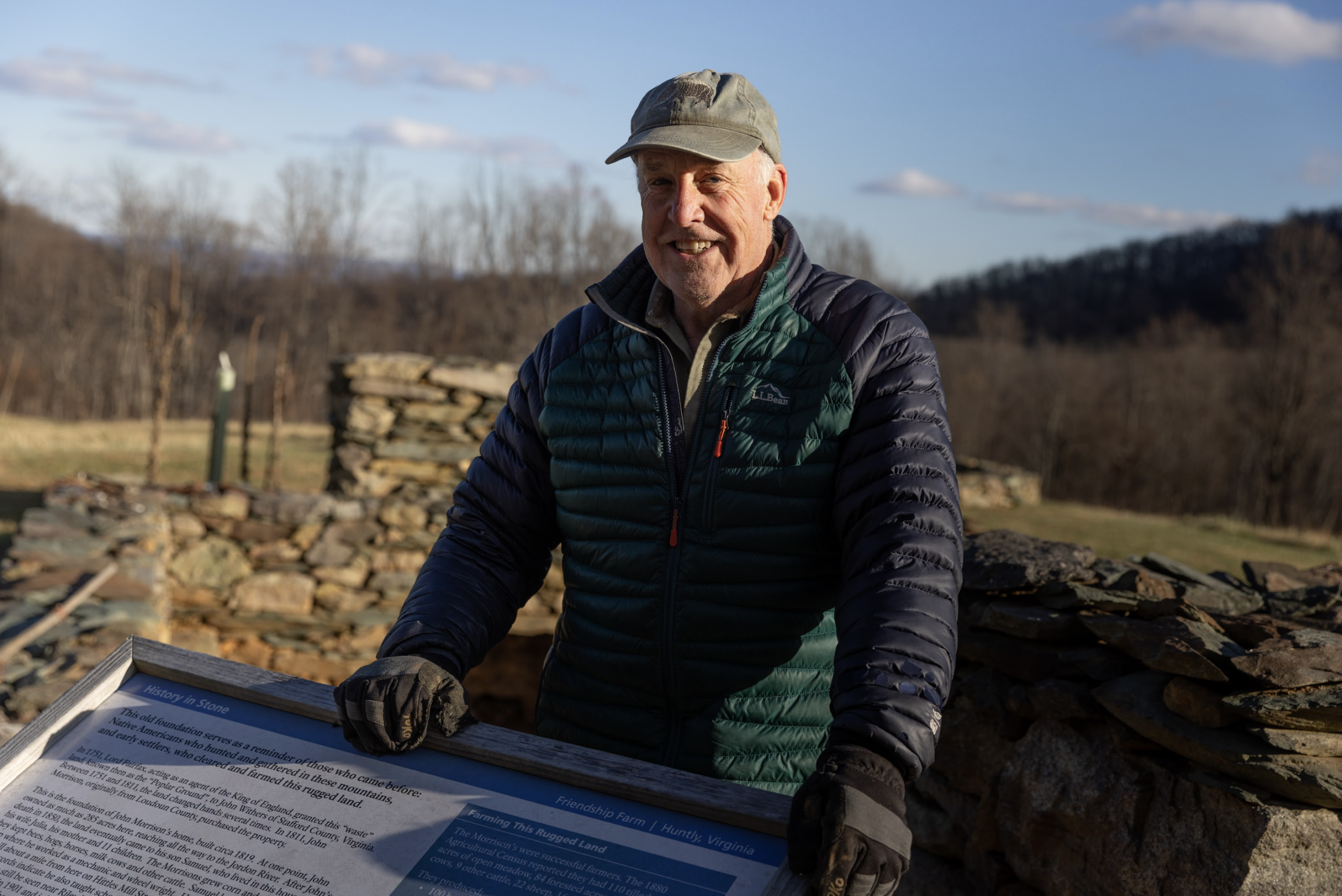
Jim Northrup photographed at the site of the former Morrison home which he has preserved. (Photo/Ireland Hayes)
Why cemeteries matter
Jon Heddleston spent 30 years as pastor at Reynolds Memorial Baptist Church in Sperryville. Dating back to 1778, it’s one of the oldest congregations in the region. Though Heddleston officiated at more than 200 funerals, visiting dozens of cemeteries across the county, he suspects there are burial sites he hasn’t found.
“We always get surprises in Rappahannock,” said Heddleston. “Even though I’ve lived here 40 years, I’m still making connections with the families and the names and the people.”
Heddleston’s reverence for burial grounds was shaped in boyhood, when his father took him to visit the grave of his Uncle Bobby who’d been killed by a sniper in Berlin, two weeks after the war in Europe ended.
“Dad insisted Bobby’s body come home from Germany,” said Heddleston. “He took me there as a little boy to show me. Because of that, I’ve always had deference, not just for the dead, but for the family and the veterans who sacrificed their lives for the freedoms we enjoy.”
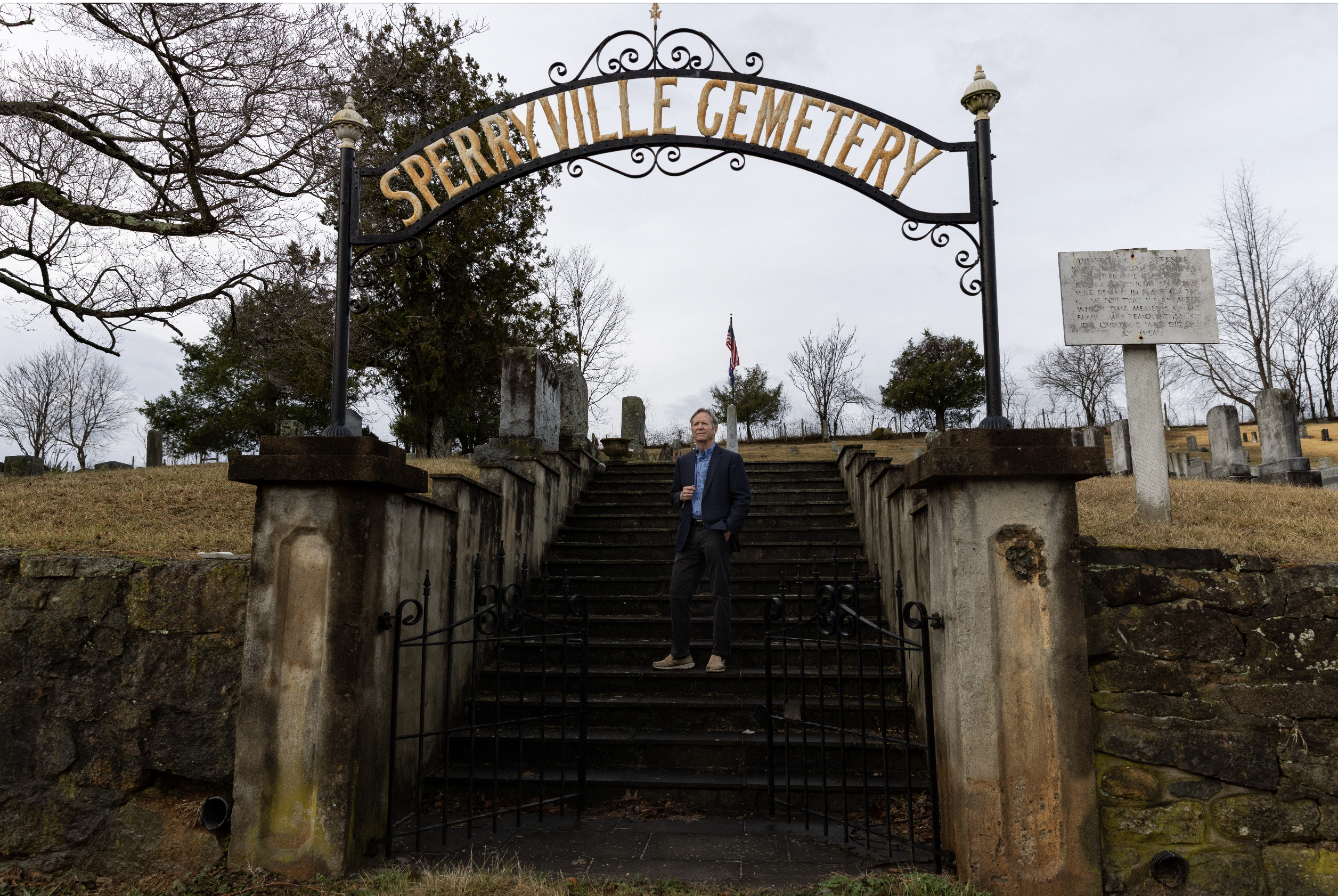
Rev. Jon Heddleston standing on the steps of the Sperryville Cemetery. Heddleston said he has given sermons at over 200 funerals, many of them at those grounds, and he works hard to honor each life well lived. “A life is a terrible thing to waste and, as a pastor, you have maybe 15 minutes to do it justice,” he said. (Photo/Ireland Hayes)
That instinct to fully honor a life shaped how Heddleston approached funerals. If he didn’t know the deceased, he would stand in the receiving line the night before and interview those who came to pay their respects.
“I am not going to blow this,” he said. “They’re going to hear that guy represented my grandmother pretty well. A life is a terrible thing to waste and, as a pastor, you have maybe 15 minutes to do it justice.”
For Heddleston, this goes to the heart of why cemeteries matter. “Why is the Gettysburg Address the single most sublime piece of writing in our literature? Because it’s about human connection. We draw that line more closely the older we get. The closer we come to checking out ourselves, the more we want some connection to the past.”
In Rappahannock, as elsewhere in the American South, a county’s history often is as much about where people were buried as where they weren’t. The Reynolds Memorial Baptist Church records — before the congregation moved from Old Hollow to Sperryville prior to the Civil War — listed only 26 “colored” members, two noted as “free.”
“Even in worship,” said Heddleston, “some of the historic churches had an upper room. That’s where the Black members sat during services. It was still segregated. And if they were buried in the same cemetery, I seriously doubt they were buried in the same section.”
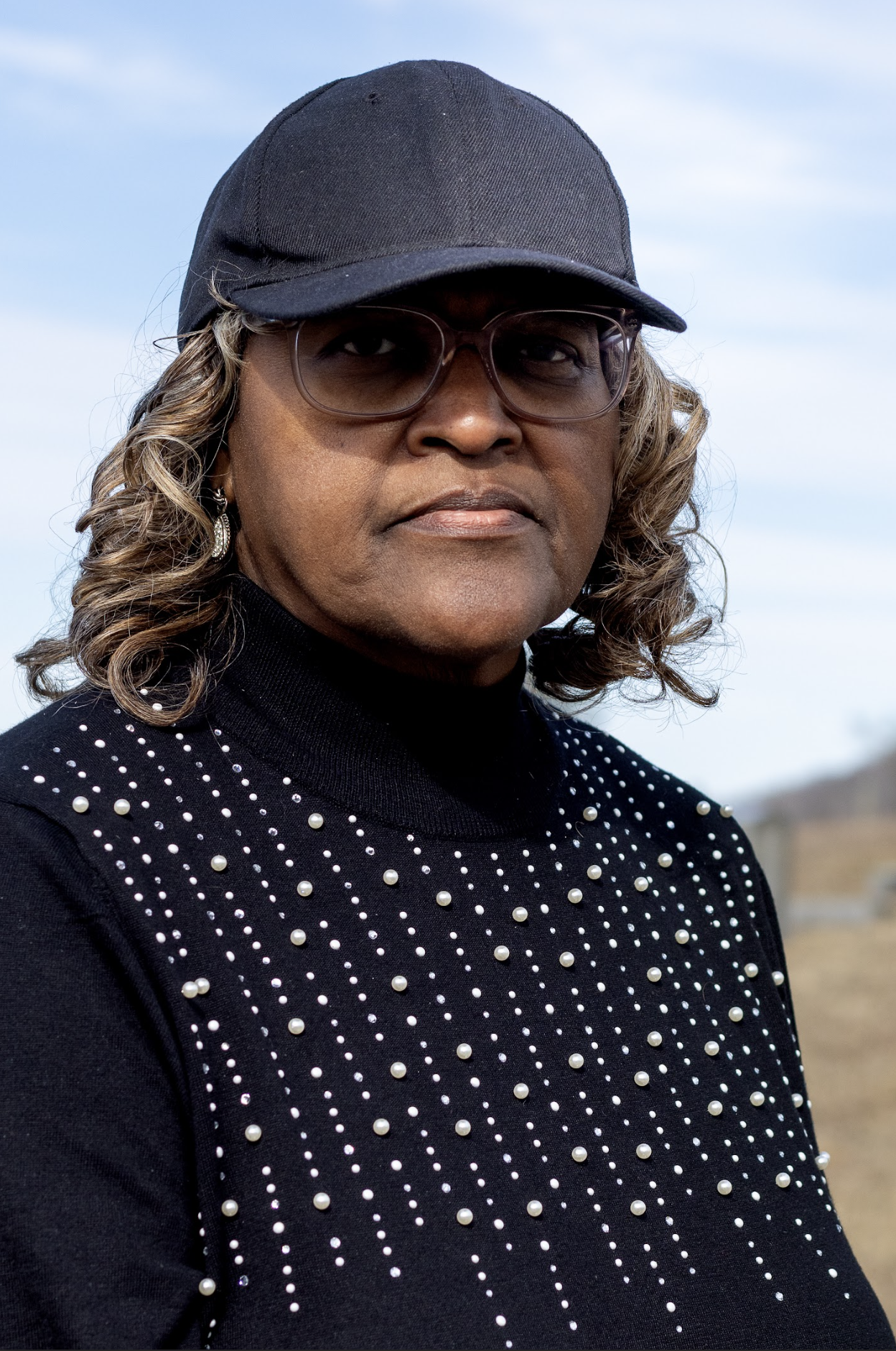
For Roberts, walking among her family’s graves evokes a mix of grief and gratitude. “I have no idea where my great-grandparents are buried,” said Roberts. “I wouldn’t even know where to look.” (Photo/Ireland Hayes)
Walking through the county’s older burial grounds, you can still see the evidence. Some graves are marked by ornate monuments, carved with names and dates. Others are only depressions or fieldstones.
Who’s buried where
Odd Fellows Cemetery, a historically Black burial ground on Fodderstack Road just outside the Town of Washington, was so overgrown it had become impenetrable. Yet the headstones told it was a cemetery. Despite that, Roberts remembers people dumping trash there and, at one point, someone putting up a sign: No Dumping.
When a community cleanup began in the 1980s, led by a local man named William Carter, workers discovered a fence and, just beyond it, a White cemetery. According to Roberts, the Black community had always known both were there — their parents had told them.
The fence came down as the cleanup continued. Carter kept at it until his death in 2017. His son and other community members, including Donald Porter, have carried on the work.
“There are White cemeteries and there are Black cemeteries in Rappahannock,” said Roberts. “As far as I know, there is not a single integrated cemetery in the county.”
The Black church funeral tradition is testimony to that separation. Where a mainstream service might run 45 minutes, a Black Baptist funeral is a full day event — letters from congregants read aloud, family and community testimony, a printed bulletin that amounts to a biography of a life. Roberts has kept boxes of those bulletins since childhood. White churches have bulletins too, but there the tradition is optional. In the Black church, it is essential.
“That tradition was born out of obscurity,” says Heddleston. “The African American community wasn’t written up in the newspapers. They were invisible in life. So at a funeral, someone makes sure they are not invisible in death.”
But visibility, if only in death, was not guaranteed. Some cemeteries were destroyed entirely. The Amos family graveyard in Amissville was lost when Route 211 was built. Others have been plowed under by landowners who didn’t recognize a fieldstone as a grave marker. Fodderstack Road itself — the road that runs past Odd fellows — is believed to pass over ground where enslaved people were buried.
“If somebody comes along and they’re not really seeing or don’t really care,” said Grimsley, “they would plow it under because it didn’t look like a big pretty stone.”
Before vital records were standardized and formal church graveyards became common, burial happened at home. As such, Virginia law requires that landowners provide descendants with reasonable access to family graves on private property. Most, according to Grimsley, are gracious about it, with the Historical Society often working as an intermediary, connecting descendants who call looking for ancestors with landowners whose properties hold burial grounds.
“People like to have that connection,” said Grimsley. “They may not even live in the county anymore, but they like to know where their family is.”
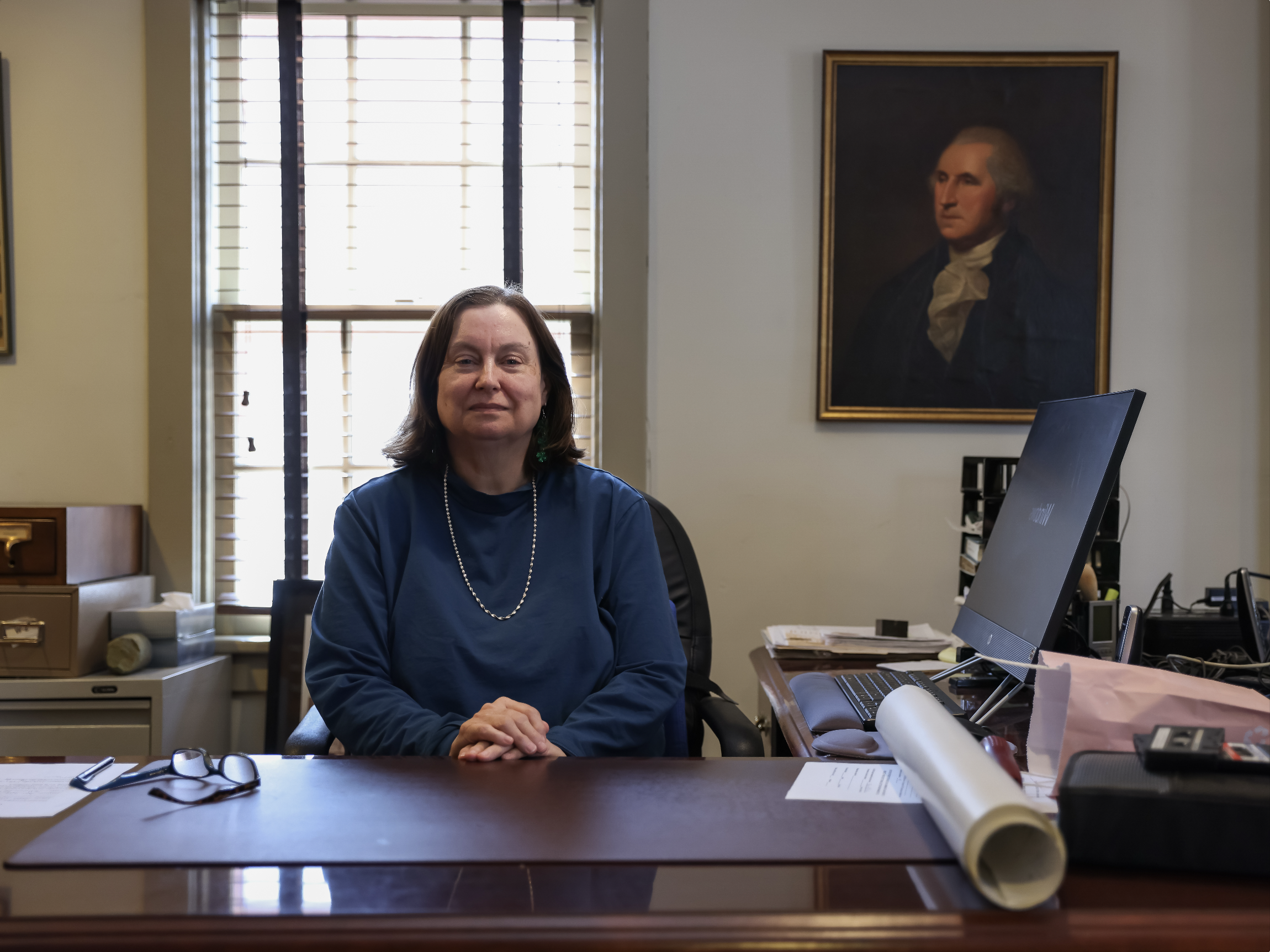
Rappahannock Historical Society Executive Director Eva Grimsley in the historical society in Washington. (Photo/Ireland Hayes)
The prevalence of DNA ancestry services has significantly increased those inquiries. Descendants who never set foot in Rappahannock are discovering this is where their people are from, and they are calling, writing, driving down. Some find what they’re looking for and some don’t. And while the database can confirm a family lived here, it cannot always say where they are buried.
A new coalition, which includes the African American Association for Rappahannock County, the Scrabble School Preservation Foundation and the Historical Society, is working to document much that has been missing, from schools and businesses to birthplaces and burial grounds. It’s early days and slow going – but it has started.
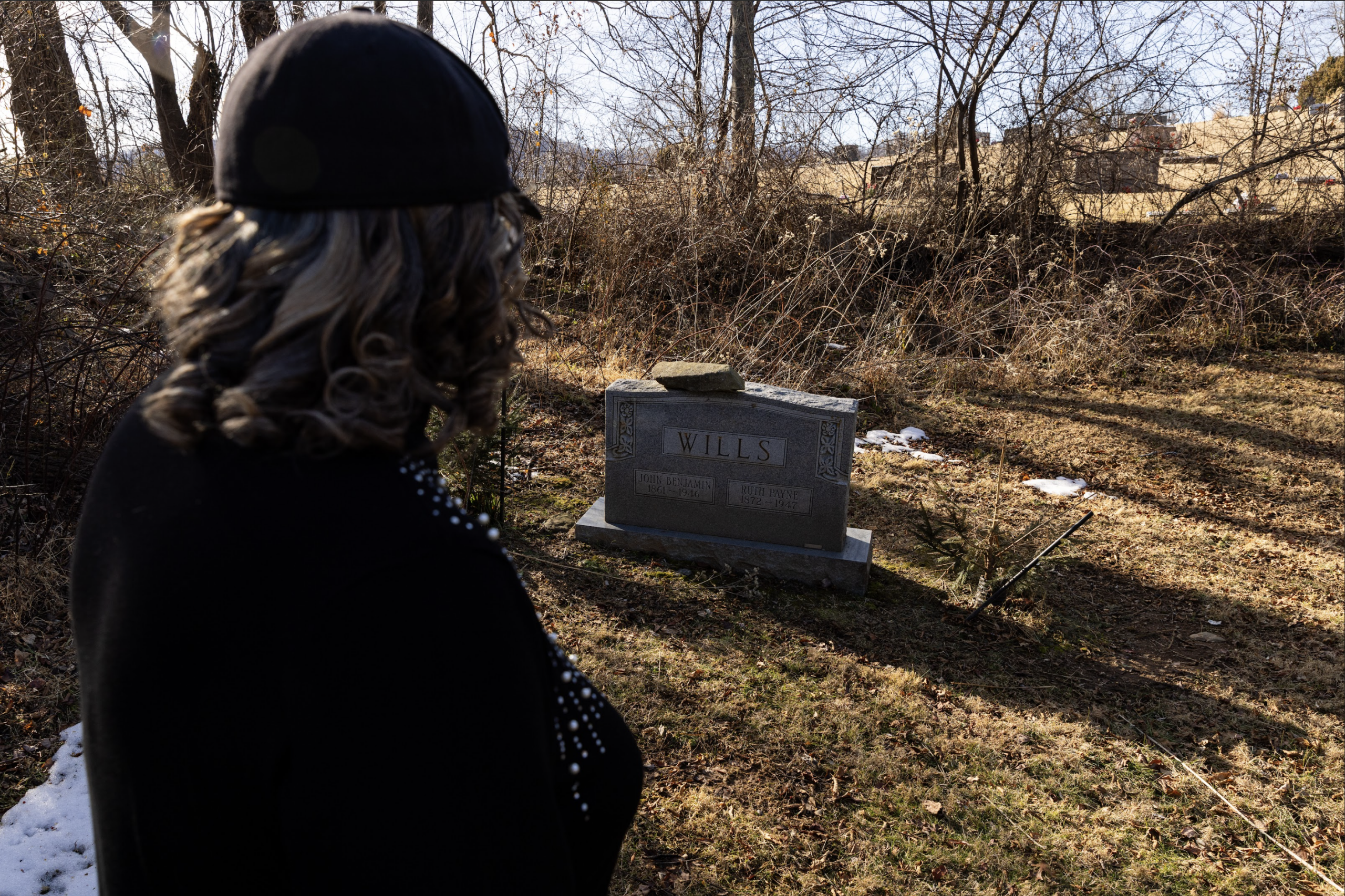
Roberts looks over the graves of family friends in a cemetery outside of Washington. (Photo/Ireland Hayes)
For Roberts, walking among her family’s graves evokes a mix of grief and gratitude. She remembers homecoming Sundays, when families who had moved away returned from cities up north, filling the church and grounds with food and music. She also remembers a photograph of her two aunts, uncle, mother and two other relatives standing in the churchyard, the cemetery visible in the background. All are now buried there.
Roberts’ knowledge, however, stops with her grandfather’s generation. Her great-grandparents were enslaved in Rappahannock County. Before 1870, burial records for enslaved people were rarely kept. Many were interred in unmarked ground, sometimes near the families who enslaved them, sometimes in separate plots that were never formally recorded. Over time, markers disappeared, land changed hands and fields were plowed.
“I have no idea where my great-grandparents are buried,” said Roberts. “I wouldn’t even know where to look.”
Her situation is not unique. The same historical silence that denied enslaved people agency in life — over their names, their families, their labor, their movement — denied them dignity in death. Without markers, there is no thread to pull.
In Rappahannock County, history lives as much in fields and forests, behind hedges in town, on mountain ridges and church hillsides, as it does at the courthouses and in archives. Some graves are marked in marble. Some are marked only by a rock set upright at the head of a depression in the ground. Some can be found. Some cannot.
For Nan Butler Roberts, the graves in Woodville are a place of memory and belonging, a hilltop where generations of her family rest together within sight of the mountains. The graves she cannot locate are another thing entirely — questions that linger and a history that has faded to silence.
Learn more about Rappahannock cemeteries
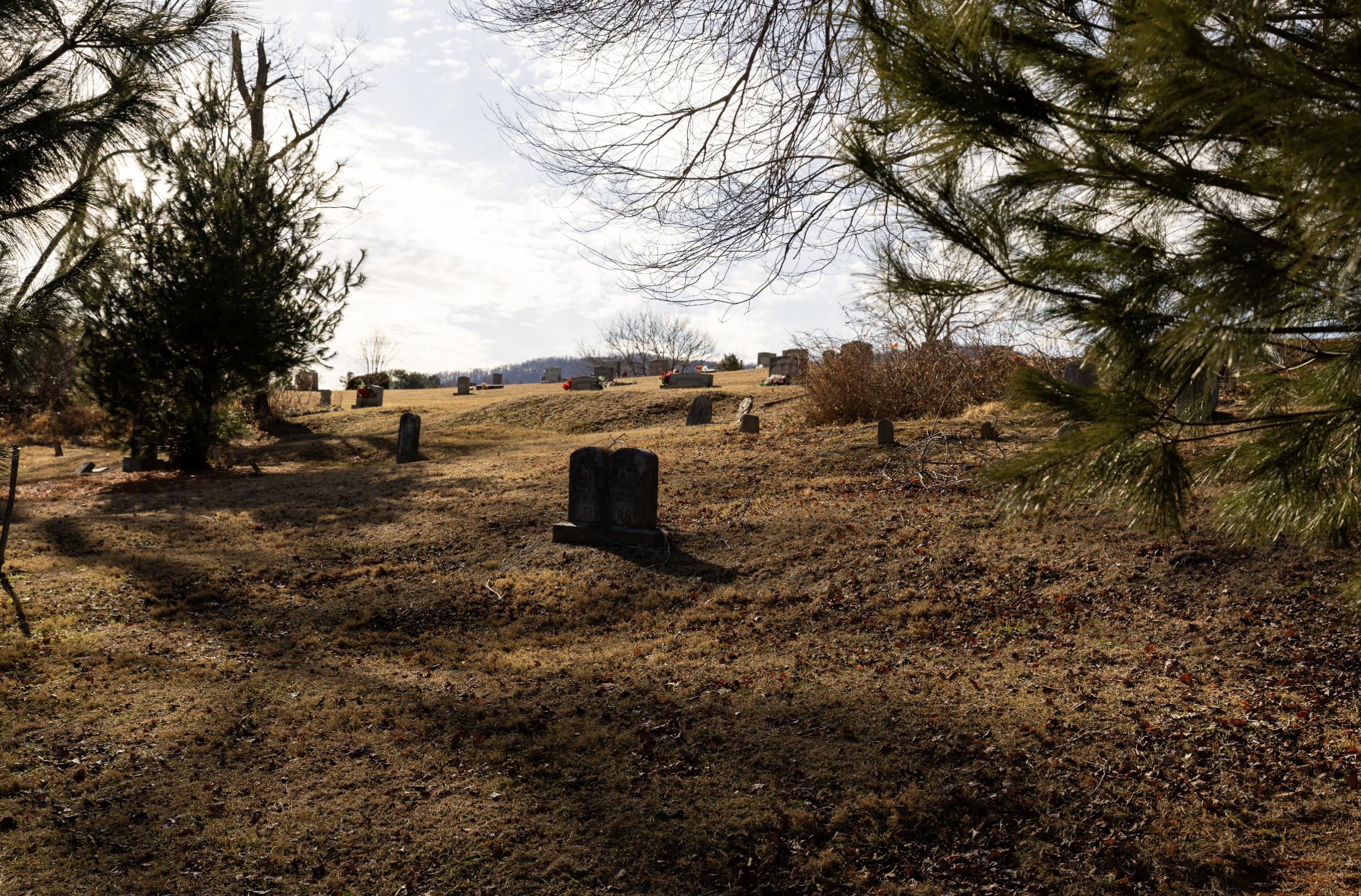
Graves lining the former border between the “white” and “Black” sections of a cemetery outside of Washington. (Photo/Ireland Hayes)