

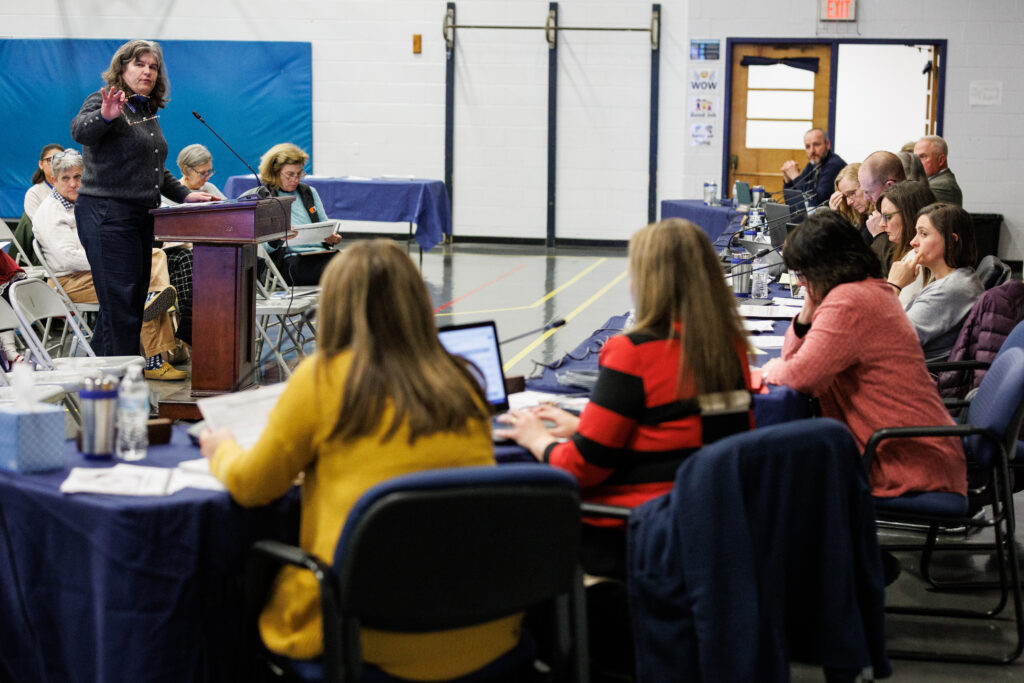
Assistant County Administrator Bonnie Jewell presenting the county’s draft capital improvements plan to the Board of Supervisors and School Board Tuesday. (Photo/Luke Christopher)
Confront FY27 budget pressures in joint session
The Rappahannock County School Board laid out major line items in its fiscal year 2027 budget to the Board of Supervisors (BOS) Tuesday, with state-mandated salary and insurance increases and an estimated $6 million of capital improvements driving that budget up.
In the first joint session of the budget season, the meeting of the two bodies was uncontentious, and members of both boards agreed they will need to continue to work together as budget planning goes forward to ensure necessary fixes and improvements at the schools are completed.
“I sure appreciate this meeting, and it’s great, there isn’t any tension here … I think we’ll get through this,” Stonewall-Hawthorne Supervisor John Genho said at the end of the joint meeting. “I think we’ve got to fund those projects that are not going away … projects that must be done.”
Raises, state mandates
In her report, Superintendent Shannon Grimsley laid out the budget priorities for the school district in FY27, noting the top priorities as:
- Teacher and staff recruitment, retention and professional development
- Maintaining average daily membership (ADM) and enrollment
- Capital improvements at both schools
Grimsley said the draft state budget allocated about $4 million to the school system, a $323,000 increase from last year. However, the state is also proposing a mandated 2% raise for teachers and 20-25% increase in health insurance costs, which she said would quickly eat up that increase. She also mentioned a proposed mandated bonus for teachers that may be required to be given in the current fiscal year.
Grimsley noted that because state funding is driven by average daily membership (ADM), enrollment levels directly determine how much revenue the district receives. She presented a chart to the BOS that showed those numbers stayed relatively steady in the last few years.
“I sure appreciate this meeting, and it’s great, there isn’t any tension here … I think we’ll get through this,” Stonewall-Hawthorne Supervisor John Genho said at the end of the joint meeting. “I think we’ve got to fund those projects that are not going away … projects that must be done.”
Jackson Supervisor Donna Comer said that the ADM is not totally on the schools’ shoulders. She noted that the median age in the county is 50, rising over the last few years, and the county as a whole could be doing more to draw people and children to the county.
“When we’re looking at the ADM, we have to look at the entire picture,” Comer said. “Why does this entirely rest on the shoulders of our school system … we all share a little bit of responsibility for that and community planning.”
Hampton Supervisor Keir Whitson said he is concerned about staff turnover and doesn’t “have a good handle” on how much salary competitiveness is tied to the issue of teacher retention. “I don’t know if it’s all about money,” Whitson said.
He added that he feels the boards are in an “oddly good position this year,” not “dreaming and speculating about some miraculous legislative initiative that’s suddenly going to pump another million dollars into our school.”
For several years, the schools and county have advocated on the state level for a lift in a funding cap on the district that dates back to the 2008 recession with little success.
Grimsley said “hope is not all lost” on the state level, and work is being done by the Coalition of Small and Rural Schools to advocate for an adjustment in funding to account for the economies of scale for small school districts.
Capital improvements
Assistant County Administrator Bonnie Jewell and the schools’ Executive Director of Administrative Services Robin Bolt presented to both boards about the capital improvements needed at the schools, including:
- Repairs and improvements to the HVAC units at both schools
- Replacement of the elementary school roof
- Required wastewater improvements at the high school
- Other school improvements like new doors, new carpet, ADA-compliant bathrooms and lights and sound systems in the auditorium
Jewell presented the county’s draft five-year capital improvement plan (CIP), which she presented at the February BOS meeting. According to that draft, school capital improvement projects make up about $6 million paid over the next five years. Some $2.3 million of that is planned for FY27.
Jewell said it has been difficult for the county to fund school and county operations, let alone capital improvements. At a previous meeting, she said BOS Chair Debbie Donehey asked her to be “blatant” about what the needs of the county are, and this CIP is the response to that.
“We are being blatant. We are being collectively blatant about the CIP needs of the school,” Jewell said. “It’s not going to be easy to do this, but this is being blatant.”
“At least now we know what is needed, we can make an educated decision on where the money goes and where the money comes from,” Donehey said.
Part of how that could get done is a 1% increase in sales tax in the county, a way, Jewell said, for the county to raise more money without impacting real estate or personal property taxes. But, state legislation to allow that increase is still being considered by the General Assembly.
School Board Chair Wes Mills said he doesn’t “have high hopes” that county voters would approve the 1% increase, which would require a referendum.
Mills and other board members added that the bodies need to work together on educating the public on why the increase is needed, and that the funds it raises will go to capital improvements, not operating costs.
“It’s really a good idea to have a contingency plan, because things are going to have to get done, and nobody wants to say the B word — bonds. But how else are we going to pull together $2 million to start getting things done if the 1% thing doesn’t work?” Mills said.