

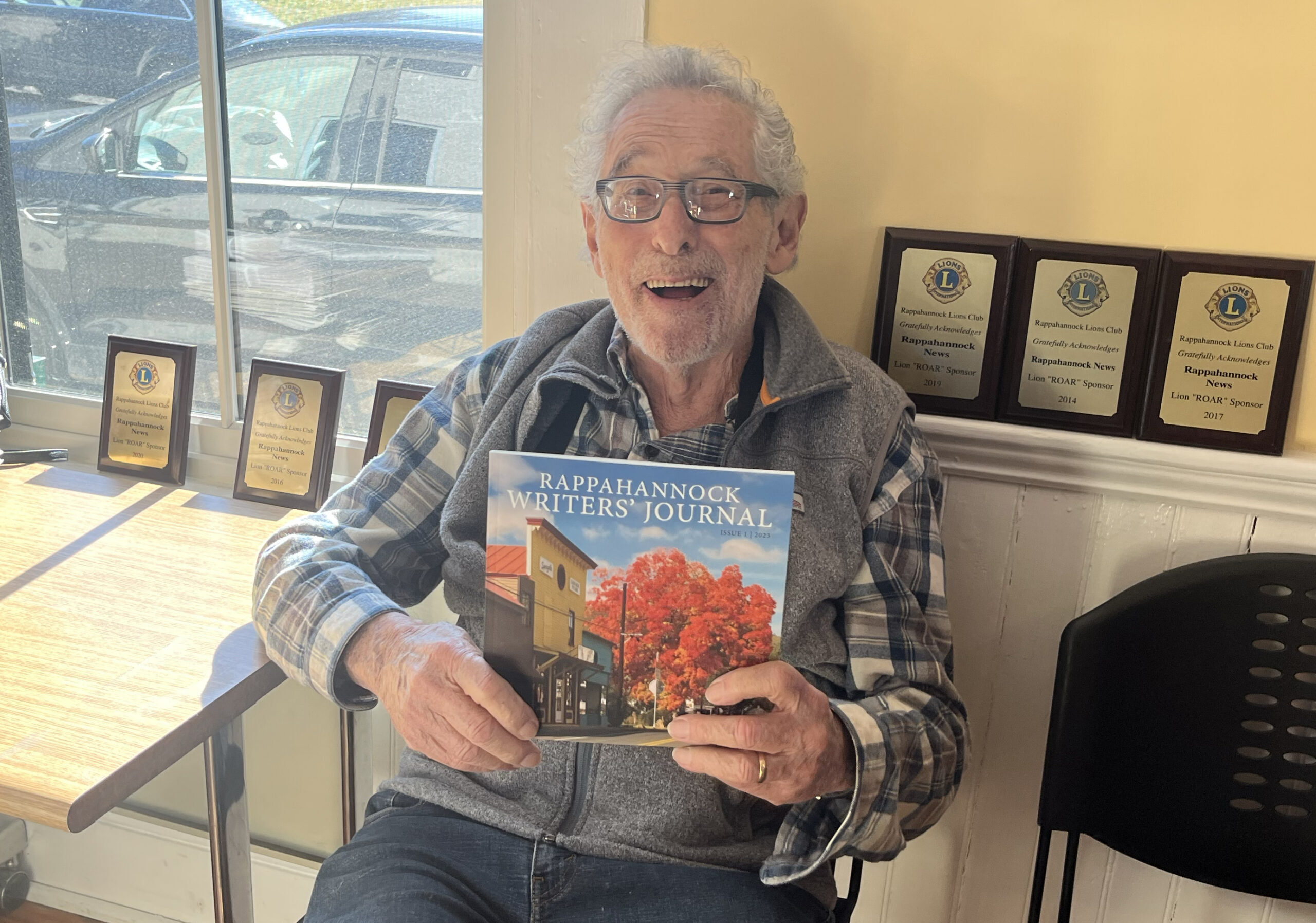
Peter Hornbostel, 89, who died Aug. 2, was an actor and director of Rappahannock plays, a diplomat, an international lawyer and creator of the Rappahannock Writers’ Journal. (Photo/Courtesy)
Actor, director, lawyer, diplomat, storyteller takes final bow
Multiple lives came to rest on Aug. 2 when Peter Hornbostel died two months short of his 90th birthday.
The much-admired actor and director of Rappahannock plays was also a
diplomat, a writer and teller of quirky tales, an international lawyer and an honorary member of the Brazilian Air Force.
“He wanted to live to 100,” said Susan Hornbostel, his wife of 60 years, in an interview from their Flint Hill home. But congestive heart failure, and multiplying complications, thwarted his aspiration.
“He loved the theater and had such a rich understanding of plays,” said Sallie Morgan, a board member of the Rappahannock Association for Arts and Community (RAAC) and a stalwart actress and organizer of productions over the last 45 years.
An American from a disrupted European family, Hornbostel graduated from Brown University and Columbia Law School, earning a Fulbright Scholarship to study in Vienna, Austria before working for the United States government in Brazil and later establishing a Washington-based international law practice.
In 1971, following six years in Brazil, the Hornbostels bought a weekend Rappahannock cabin unencumbered by modern plumbing. Encouraged by Julie Portman, the late Obie-award winning actress, playwright and artistic director of the Ki Theatre in the Town of Washington, Horbostel immersed himself in the art of storytelling, writing and guiding theatrical productions.
This mix became Hornbostel’s culminating zone of mastery. Acting and directing at the Ki Theatre and becoming artistic director at its successor organization, the RAAC Community Theatre, he cast actors in roles where their personalities and psychological insights might find spacious expression, while choosing plays that would draw audiences.
“The bar was raised every time they did a production,” said Ray Boc, longtime photographer of the performances by RAAC.
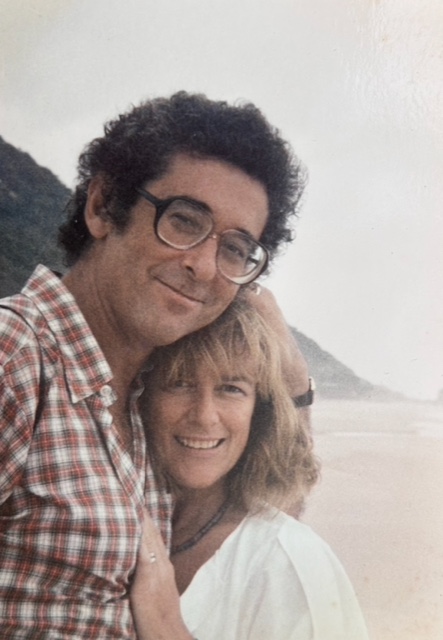
Peter Hornbostel and his wife, Susan, newly married 60 years ago. (Photo/Courtesy)
A family story unfolds
Unusual origins create unusual people. As Hornbostel told the story, his parents met in Berlin in 1927 and fell in love, notwithstanding the complication of his mother already being married with three children. Her husband, an older, respected professor of psychology, moved the family to New York after hearing one of Hitler’s ranting radio speeches. Johannes von Hornbostel, the lover, soon followed.
Unfurling the family saga, Hornbostel draws on both history and imagination. In a memoir published in the Rappahannock Writers’ Journal, which Hornbostel created and chaired, the professor is named Moritz Kirchbaum and was offered a teaching job at Columbia University. But in a story published in “Come On In — I’ll Tell You a Story,” Hornbostel’s collection of short stories, the professor is named Max Rosenbaum and taught at The New School in New York City.
Both accounts bring Peter Hornbostel into the world in 1936, and neither leaves doubt as to the child’s paternity. But the short story version includes a characteristically off-kilter detail: Hornbostel’s mother went into labor and drove the family Buick to the hospital, parking on West 110th Street; but when she emerged with Peter, her baby, four days later, she discovered that the car’s seats had been stolen. According to the short story, the professor later decided replacements would be too pricey and bolted a set of dining room chairs to the floor of the car.
Another detail in the short story version was that Albert Einstein occasionally visited the family home in New Rochelle, New York, playing music and bouncing young Peter Hornbostel on his knee. Friends of Hornbostel said they don’t know whether these encounters were history or fiction. Nor do they care. Their friend lived in a world of rich memory and rollicking invention. The stories, through repetition and embellishment, came to include factual and fabulous elements.
A new country, a partner for life
Two defining changes came in the 1960s: Hornbostel began working in Brazil under contract with the United States Agency for International Development (USAID), and on a periodic stay in Washington, he met Susan Bratley. A Bethesda native, she was a Brown University graduate with an art history masters from the University of Michigan. She had just begun a job at the Smithsonian American Art Museum when Hornbostel showed up at a party she threw.
A flurry of romantic letters from Brazil followed, along with visits to Washington. In December 1966, the couple married in a space they had managed to secure in the historic Halcyon House in Georgetown, built in 1787 for the first Secretary of the Navy, Benjamin Stoddert. Wedding guests were asked to bring the food. The next day, Hornbostel flew back to Brazil.
“I’m not sure I knew him that well,” Susan said half-jokingly. “I guess it worked out. ”
Two weeks later she joined Hornbostel in Rio de Janeiro, and Brazil quickly became her adventure as well as his, starting with arduous language lessons at the U.S. embassy. Brazilians delighted them both.
“We liked these people so much, and, of course, the country was beautiful,” she said. “People spend a lot of time sitting and talking with each other. That really appealed to Peter.”
The Hornbostels’ first sojourn in Brazil overlapped with the early military dictatorship that followed the 1964 coup, in which a group of conservative generals, with secret U.S. backing, toppled an elected president seen as sympathetic to communism. “Everyone knew someone who had disappeared,” Susan said.
The experience informed a thrilling spy novel Hornbostel wrote titled, “The Ambassador to Brazil,” published by Four Winds Press in 2015. In classic Hornbostel style, the story weaves together historical and imagined events, including sex scenes Hornbostel said his editor claimed would boost sales. The book’s serious side revolves around how the U.S. imposes its will on other countries.
Brazil had made its mark on the Hornbostels. In the 1980s, needing a change, they returned for four years. Their daughter, Monika, lived there for 15 years and married a Brazilian. Two years ago, she took her father, mostly in a wheelchair, back to the country that had enchanted him a half century earlier.
Susan still owns a small apartment in Rio. She can’t say just what her husband’s honorary membership in the Brazilian Air Force entailed, except to emphasize that he didn’t fly Brazilian airplanes.
Emergence of a ‘great storyteller’
Susan Hornbostel cited a later crucial influence: “After we got back from Brazil, and bought our property in Nethers, we discovered Julie Portman.”
Julie Portman wrote and directed largely autobiographical plays and led a “life-stories workshop” that evolved into the popular No Ordinary Person program that RAAC presents each year.
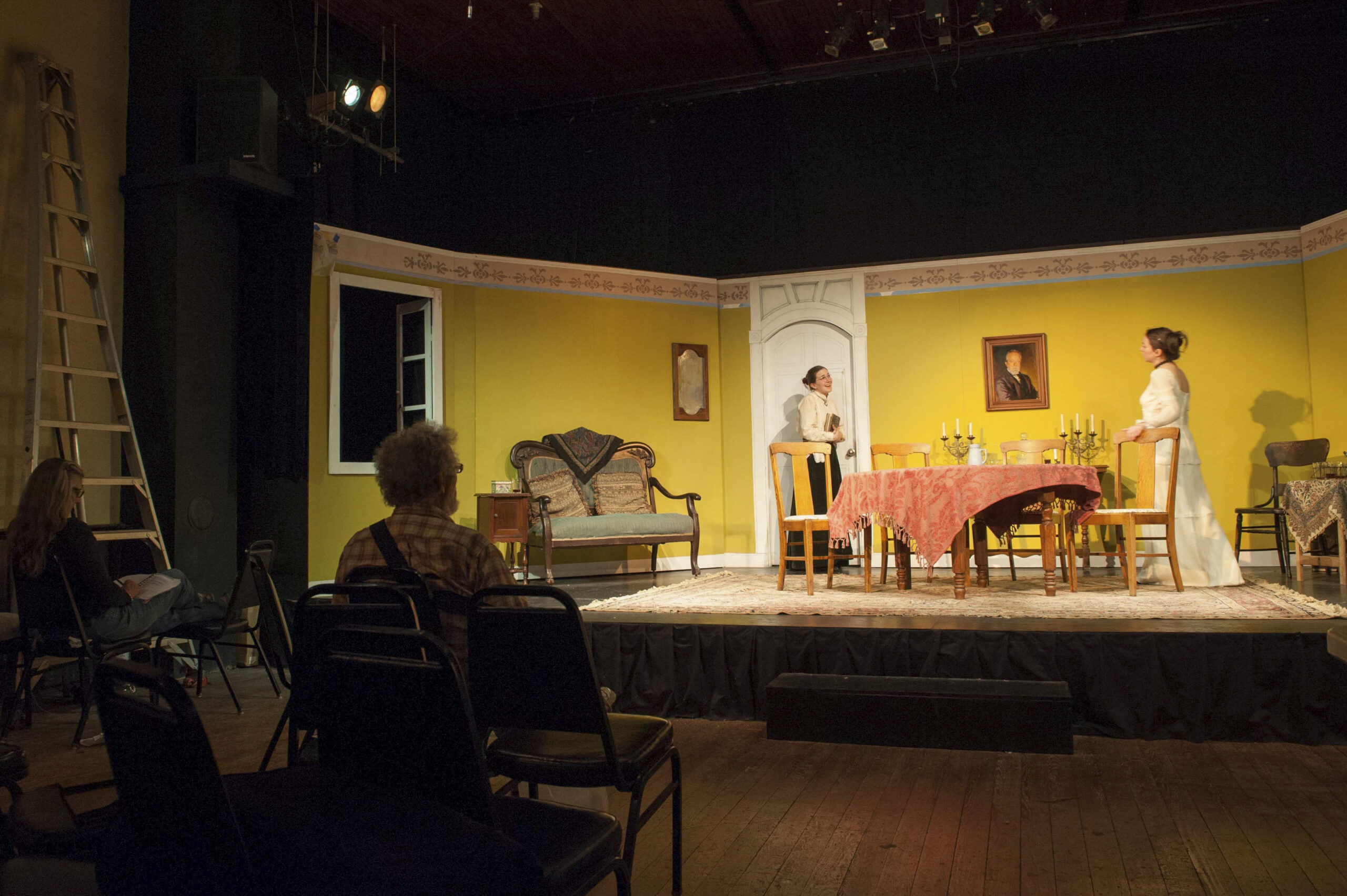
Peter Hornbostel (seated left) directing Chekhov’s “Uncle Vanya” for RAAC Community Theatre in 2013. (Photo/Ray Boc)
Hornbostel absorbed Portman’s outlook on theatre and storytelling, while taking responsibility for Christmas season productions of “The Shepherd’s Play,” a rustic drama based on a 15th-century English medieval mystery comedy, that mixes farcical elements with the biblical story of Jesus’ nativity.
Patty Hardee, the theater company’s current artistic director, remembered Hornbostel heightening the comic element by parading a live sheep onto the stage. “It was funny,” she said, “and messy.”
Chekhov comes to Rappahannock
After Portman’s death in 2008, and a subsequent period of uncertainty, the actors and directors at Ki Theatre reformed as the RAAC Community Theatre with Hornbostel assuming the role of artistic director.
Hornbostel had strong views and a lawyer’s capacity for persuasion. Sallie Morgan recalled that entering a contrarian mood, Hornbostel might announce: ‘“I’m going to be the skunk in the garden.’” In recent years, he criticized the theater’s choices of two bleak, tragicomic Samuel Beckett plays, “Waiting for Godot” and “Endgame,” though he later congratulated the actors and directors for successful performances.
During Hornbostel’s years on and behind the Rappahannock stage, he offered a string of popular plays like, “You Can’t Take It With You,” “The Gin Game,” “Proof” and “The Dining Room.” But Hornbostel’s deepest attachment was to Anton Chekhov, Russia’s great playwright and short story writer.
“Peter loved Chekhov,” Susan said.
The Russian, a doctor who died young of tuberculosis, appealed to Hornbostel’s dramatic range. Chekhov characters might be trapped in their own inaction and despair, but intermittently, they were hopeful, loving and humorous.
Hornbostel put on “The Bear, ” a one-act Chekhov play in 2009, and in 2022, “The Good Doctor,” a Neil Simon work drawn from a batch of Chekhov’s short stories.
But to many Rappahannock playgoers, Hornbostel’s crowning achievement was the 2013 production of Chekhov’s “Uncle Vanya.” Andy Platt, in the title role, remembered Hornbostel giving the actors space to come to an understanding of the drama. “Peter picked people he thought could do the job,” he said. “I don’t remember him ever telling people how to do it.”
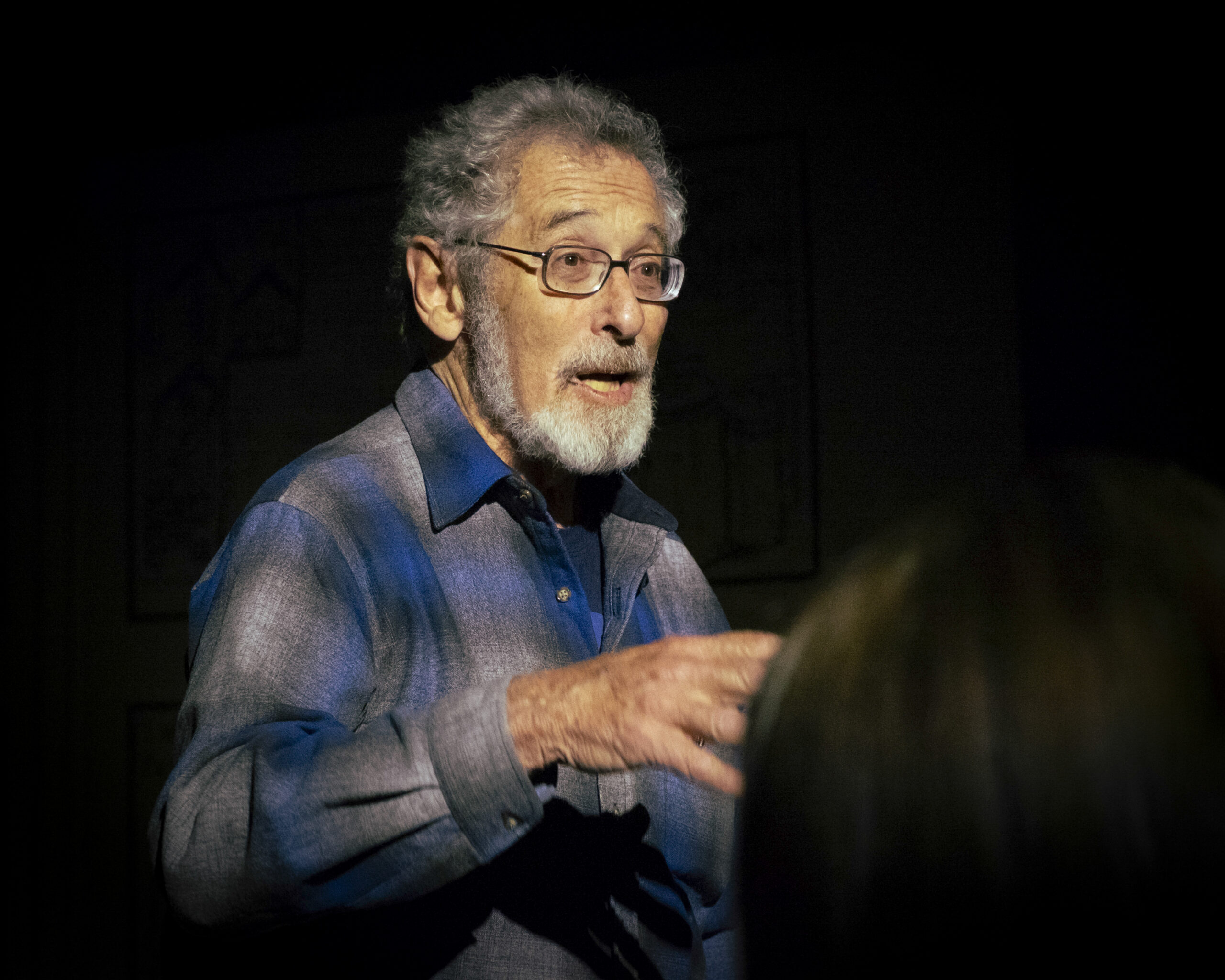
Peter Hornbostel directing a play for RAAC Community Theatre in 2015. (Photo/Ray Boc)
Caretaking
As Hornbostel’s general health deteriorated, he focused on the Rappahannock Writers’ Journal, bringing in Daphne Hutchinson and Richard Antony as editors, with Ray Boc providing photography and Bill Pragluski managing typeface and design. Dozens of local writers have published memoir pieces, short fiction and poetry in the three published volumes of the journal, available in local shops.
Susan could often be seen wrestling her husband’s wheelchair into the back of their car, or transporting him to doctors, errands, or, more happily, the Little Washington Theatre for plays or movies.
At home, Samantha Taubenberger, an artisan neighbor and friend, came regularly to help. “She was for me a very calming and caring person,” Susan said. “Peter didn’t want to be taken care of by anyone but me. But she would tidy up, make wonderful food and drive Peter.”
In his last months, Hornbostel struggled to enlist friends in a pet cause: bringing plays back to the old Ki Theatre, now defunct and in need of massive structural repairs. “It became an obsession,” said Platt, though he never persuaded others to join the cause.
On July 31, Hornbostel stopped speaking. While he slept, Susan talked about his love of Chekhov. If he heard her, he perhaps was reminded of the final monologue in “Uncle Vanya” in the old theater he hoped to resuscitate. To a spellbound audience, the character Sonya tried to console an exhausted Vanya:
“We shall see heaven shining like a jewel. We shall see evil and all our pain disappear in the great pity that shall enfold the world. We shall rest. We shall rest. We shall rest.”