

Boosts emergency response by adding AEDs, planning paramedic home visits
Rappahannock County is moving ahead with two new iniatives aimed at one of its biggest challenges: providing emergency and preventive healthcare in a rural county with an aging spread-out population and few medical services.
The Board of Supervisors last week approved funding to begin building a countywide network of publicly accessible Automated External Defibrillators (AEDs) to treat sudden cardiac arrest, while emergency officials are also preparing to launch a community paramedicine program that would send specially-trained paramedics to check on residents with ongoing physical or mental health needs.
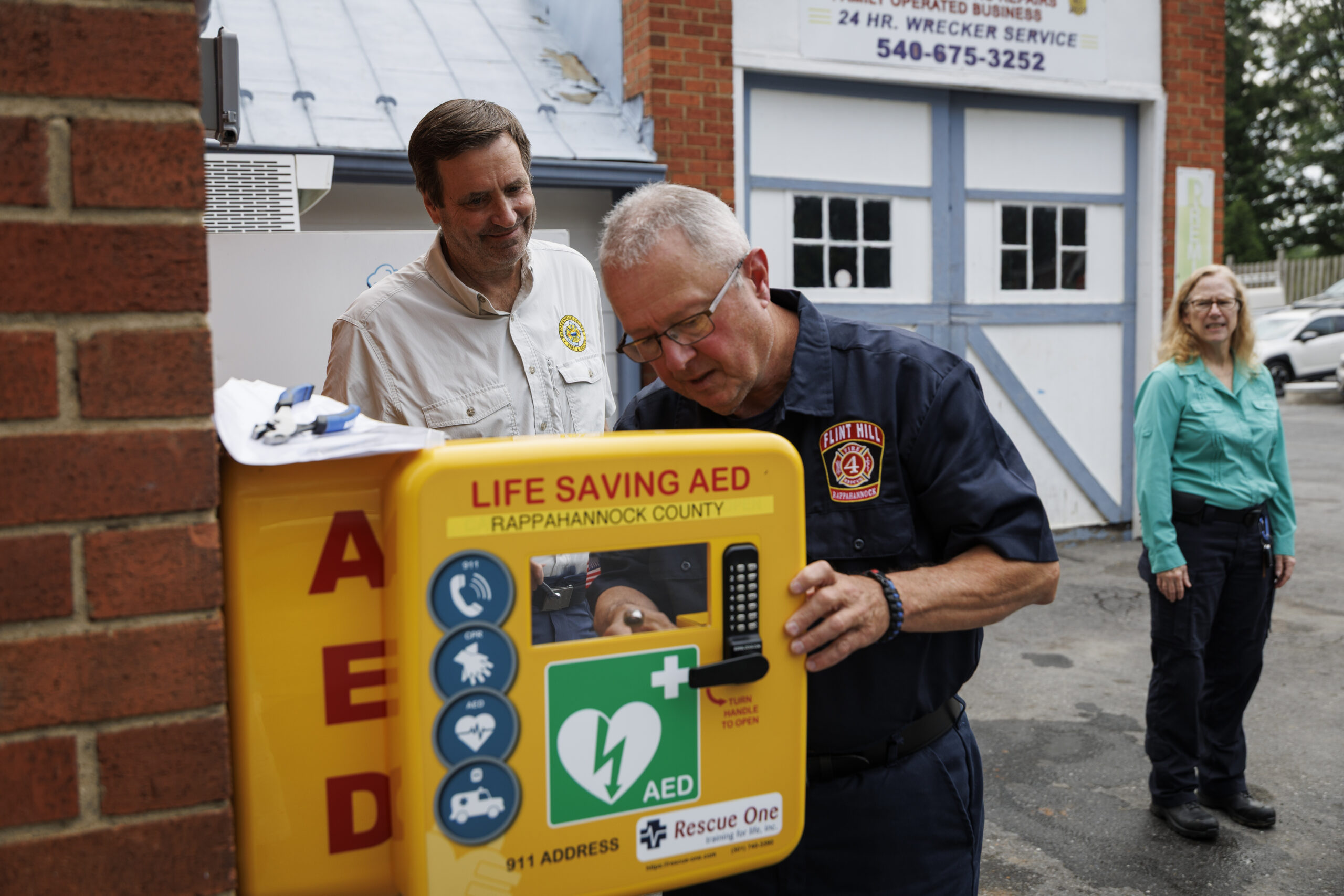
The AED project has been largely driven by Hampton Supervisor Keir Whitson, along with Darren Stevens, the county’s Emergency Services Coordinator.
Whitson has a deeply personal motivation — his near fatal heart attack while visiting his mother in Wisconsin four years ago. Fortunately, emergency responders were nearby and arrived within minutes of being called. Since then, he has made a point of sharing his realization that he probably would not have survived if that had happened in Rappahannock. With that has come the belief that a network of publicly accessible AEDs would fill a critical community need.
“My thinking is that even though we don’t have population density in a lot of places, we do have these hollows where a lot of people live. I’m one of them,” Whitson said. “In my dream scenario I’ve been imagining a system where you’re driving along say Harris Hollow Road, and there’s an AED in a climate-controlled box alongside the road, and everyone who drives back and forth every day gets used to seeing it. And then, in a time of need, they know where to go.”
Whitson’s vision got a big boost last week when county supervisors voted to allocate $26,500 from unspent funds the county received as part of a national settlement with opioid manufacturers and retailers. Going forward, $8,000 of that funding will go to purchase AEDs and for related training every year.
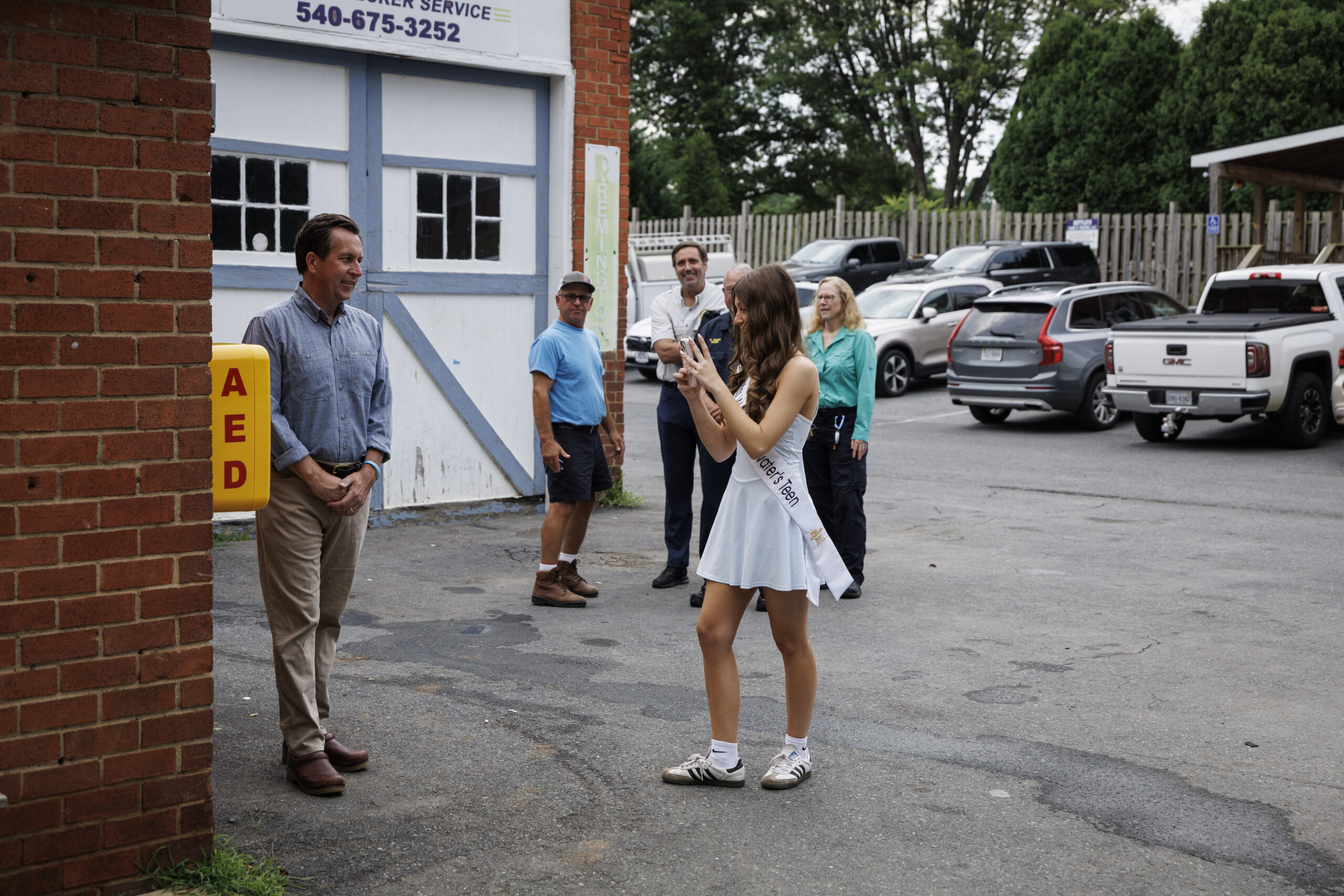
Lucy Whitson takes a photo of her father Keri Whitson, Hampton District Supervisor, who championed installing AEDs in the county. Lucy semifinalist at the 2026 Miss Virginia’s Teen competition. As part of the competition, delegates promote community service initiatives. Inspired by her father’s survival of cardiac arrest, Whitson founded Project CARE: Cardiac Awareness and Response Education. (Photo/Luke Chirstopher)
The initial focus will be on using that money to purchase and install AEDs at popular public locations, such as the Quickie Mart on Route 211 and Settle’s Grocery and Garage in Flint Hill, and paying to provide climate-controlled cabinets so that locations that already have the devices can move them outside. Some businesses, such as The Marketplace in Sperryville, have bought their own AEDs, which the county has installed.
Stevens has identified 34 current or potential AED locations, but Whitson sees that as only the first phase of the initiative. He hopes that the community will eventually be able to mimic a program in Roanoke, Va., where CPR training is provided to congregations at rural churches to which an AED is then donated. The goal, in his mind, is to build a “robust” AED network that not only saves lives, but also helps to reduce the healthcare costs to someone who suffers a medical emergency.
“I know how much it cost for me to be in the hospital,” Whitson said.
A plan for paramedics
Meanwhile, Stevens is also making progress on the paramedicine program, for which he’s preparing a proposal for a grant from the PATH Foundation.
“I’m really excited about this,” he said, explaining that enabling paramedics to regularly check on Rappahannock residents, particularly those who frequently call 911, will reduce the demand on fire and rescue services in the county.
“It’s not only the cost of a 911 call in terms of the cost of fuel and the wear and tear on both rescue crews and equipment, but it’s also that you could lose the availability of an ambulance for an hour and a half,” he said.
“When any of our EMS crews goes out to a call, we only really have two options,” Stevens continued. “We can either take them to the hospital or they can sign a refusal and stay at home.This provides another alternative instead of just walking away thinking, ‘I wish we could have done something more for this person.’”
The idea would be to have trained paramedics dedicate up to 16 hours a week visiting homes where they would meet with people who have medical issues, but don’t necessarily need emergency treatment. Part of the focus, he said, would be patient education where the paramedic would be able to answer questions about a person’s ailments and medications, and keep an eye out for any mental health concerns. They could also do safety checks to see if handrails in a bathroom or smoke detectors are needed.
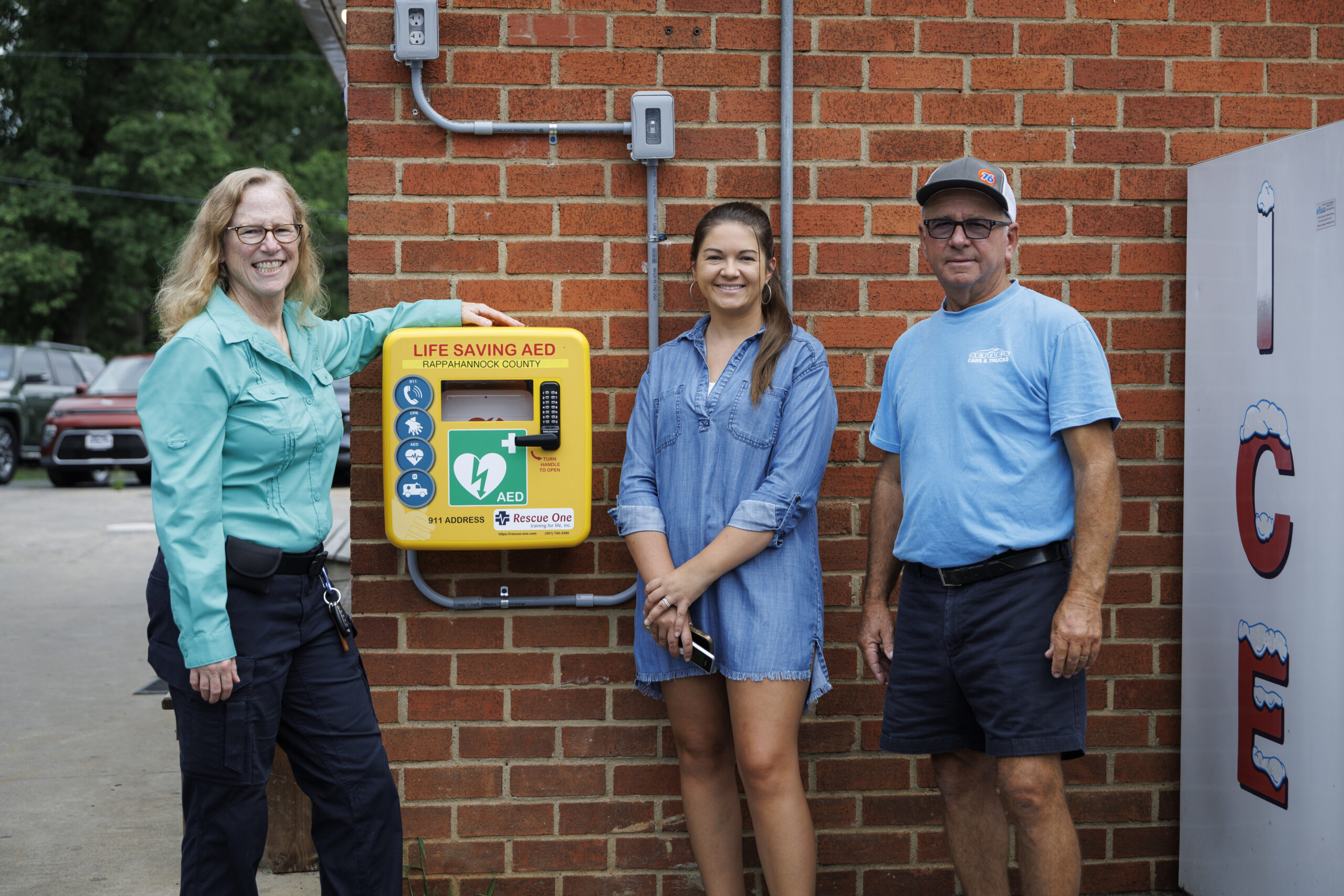
Wakefield District Supervisor Debbie Donehey and EMT with Flint Hill Volunteer Fire and Rescue, Kendra Settle and her father Bubbie Settle at a newly installed AED station at Settles Gas and Grocery in Flint Hill. (Photo/Luke Chirstopher)
That’s where the paramedics could tap into the existing hub of community nonprofits such as Rapp at Home and the Benevolent Fund.
“Say they learn that someone’s not getting their medicine because they’re not able to get to their doctor, they could contact Rapp at Home and ask if we could help with rides for this person,” said Joyce Wenger, who has played a central role in forming the Rappahannock Rural Health Network, a collaboration of health-related nonprofits and organizations in the region.
“Or maybe they have some mental health issues as part of whatever else they may be dealing with, the paramedics can put them in touch with the right people,” she said.
The two paramedics who would participate in the program, Stephanie Clark and Michelle Rossignol, are expected to work with those organizations to identify people who could most benefit from their visits, said Stevens. Both women run calls from the Sperryville Volunteer Rescue Squad station.
“We are an incredibly rich community in terms of resources,” he added. “One way to look at it is that these paramedics would be the hub and there would be all these spokes to all those resources.”