

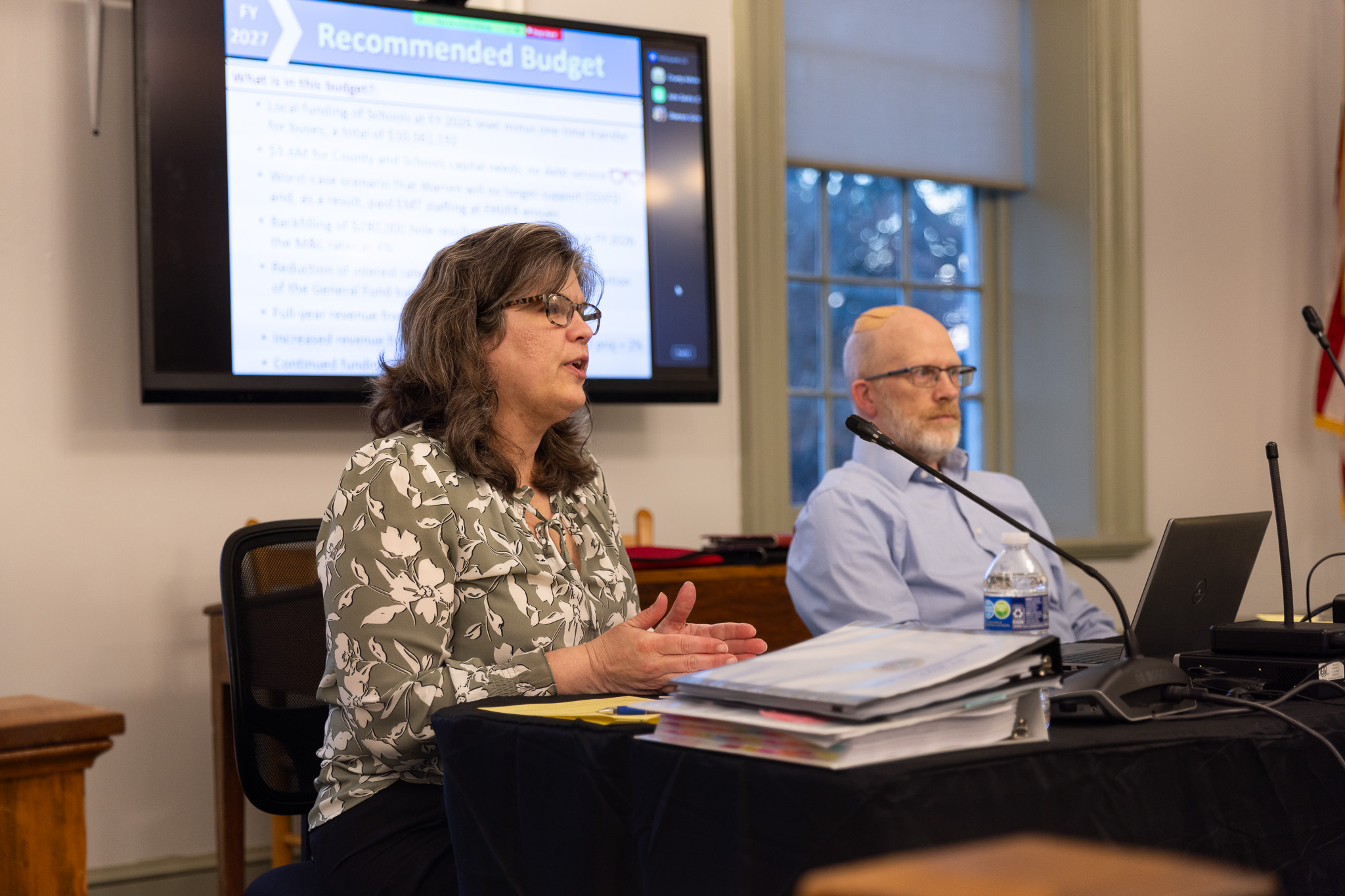
Rappahannock’s proposed budget signals a new focus on big, and chronically postponed, capital projects, such as a roof for the elementary school and a fresh county courthouse in the Town of Washington.
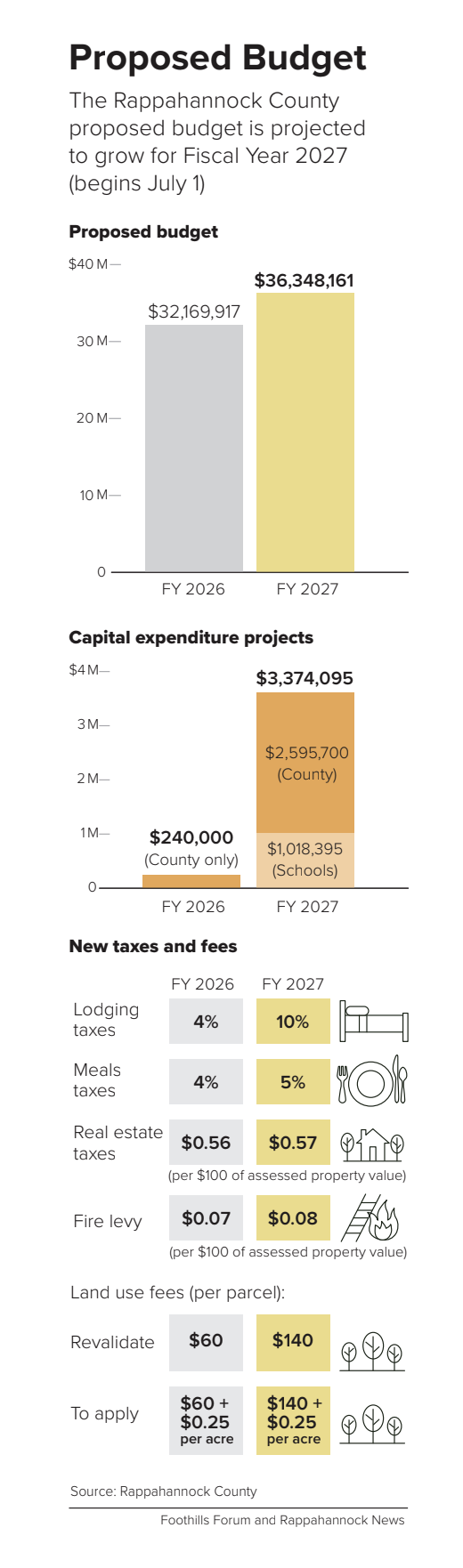
The blueprint drawn up by the county administrator to present to the Board of Supervisors at its March 11 meeting, calls for spending of $36,348,161 during the 2027 fiscal year that begins July 1, a 13% jump from $32,169,917 this year. The bulk of the increase relates to spending on capital projects, which would surge to $3,614,095 from just $240,000 in the current fiscal year.
For the county, the largest capital project is the new courthouse, with the latest conceptual designs bringing the cost estimates to a range of $17.6 million to $19.2 million. Only working designs and full architectural renderings will enable planners to gain a more precise fix on construction costs. The proposed budget for the next fiscal year would cover $1.7 million in design work.
The county plans to borrow funds needed for the courthouse in the bond markets, through a state borrowing facility that pools a mix of local projects. Under this approach, the State of Virginia would be the borrower, and the local governments that would make use of the funds wouldn’t be required to hold voter referenda, as they would if they were directly raising money in the bond markets. The localities that use the funds raised in the bond market would be responsible for servicing the debt through interest payments and repaying the principal.
For the schools, the biggest project is a new roof for the elementary school. The proposed budget calls for $304,600 for this upgrade, assuming a $450,000 grant from the state. Meanwhile, the high school needs to rebuild its HVAC system, laying in new underground boiler piping.
Other big-ticket items include a $469,200 upgrade for public safety radios, replacement for specialized vehicles like pickups, mowers and tractors, and a three-bay garage for EMS vehicles.
“These are things that people have known about for years,” said Assistant County Administrator Bonnie L. Jewell. “With last year’s budget, we struggled to balance the operating expenditures with our revenues. There was no room to consider the big projects.”
But during the winter, Board of Supervisors Chair Debbie Donehey, representing Wakefield District, called on the administrator’s office to begin tackling the large investments that will only grow more costly if they’re further deferred.
Without commenting on the specifics of the proposed budget, Donehey made a case for focusing on public structures and other assets, and informing the public about what is damaged or deteriorating.
“The public deserves a clear and honest picture of where our infrastructure stands,” she said. “These are long-term investments funded by taxpayer dollars, and we can’t plan responsibly if we aren’t upfront about what truly needs attention now.”
The operational budgets — paying teachers, law enforcement officers and professional emergency responders — often dominate budget debates. Last year, two public meetings focused on funding proposed budget increases for Rappahannock County Public Schools, the county’s largest single financial commitment. In the new budget, apart from the capital projects, school funding would remain flat at $10,561,192. (This figure represents the county’s financial support after a one-time transfer in the current fiscal year to buy two new school buses.)
List of 22 projects in need of repair, replacement
The burden of the largest capital projects is certain to grow as it evolves from planning and design to construction. Jewell has worked up a list of 22 projects where buildings and equipment are in need of repair and replacement.
The largest projects will see a rise in expenditures after the next fiscal year. The Capital Improvement Plan envisions $1.7 million in design work for the new courthouse in FY2027, surging to $10.5 million the following year when construction gets fully underway. For the fiscal years from 2027 through 2031, the plan anticipates $20.9 million in outlays.
Similarly, the high school’s HVAC repair and replacement project would use up $63,795 in FY2027, but $1.2 million the following year. For FY2027 through FY2031, this project would require $2.88 million.
Taken together the 22 projects in the Capital Improvement Plan, would need $3.6 million in FY2027, rising to $14.1 million the following year. For the four year period, FY2027 through FY2031, the full list, if fully funded, would require $38.2 million, according to the plan.
Taxes for visitors, landowners
Because Virginia law stipulates a balanced budget, the proposed blueprint contains a cluster of new or expanded revenue streams to support the increased spending. Among these changes:
- Real estate taxes would rise to 57 cents per $100 of assessed property value, up from the present 56 cents.
- The fire levy would also rise by a penny, to eight cents per $100 of assessed property value.
- Lodging taxes would rise to 10% from 4%, while the tax on meals would inch up to 5% from the current level of 4%.
- Fees linked to the land-use system of tax breaks would rise. The revalidation fee for participating in land use would jump to $140 from $60. The application fee for land use also would rise to $140 from the present level of $60. An added application charge of 25 cents per acre would remain unchanged.
Smaller financial cushion for future
Jewell, who pieces together the proposed budget each year, pointed out that the county tapped its reserves in the current fiscal year, leaving a smaller financial cushion for future needs. She pointed to draws on the county’s general fund this year that weren’t supported by any taxes or other revenue:
- The budget assumed a meals and lodging tax of 6%, but the supervisors opted to keep it at 4%.
- The supervisors opted to close a gap in the school’s budget by drawing down the general funds.
- The general fund covered costs associated with a newly hired assistant commonwealth attorney this year.
Together, these steps reduced the general fund by $560,236. Jewell said the cushion for future contingencies stands at $3.1million.