

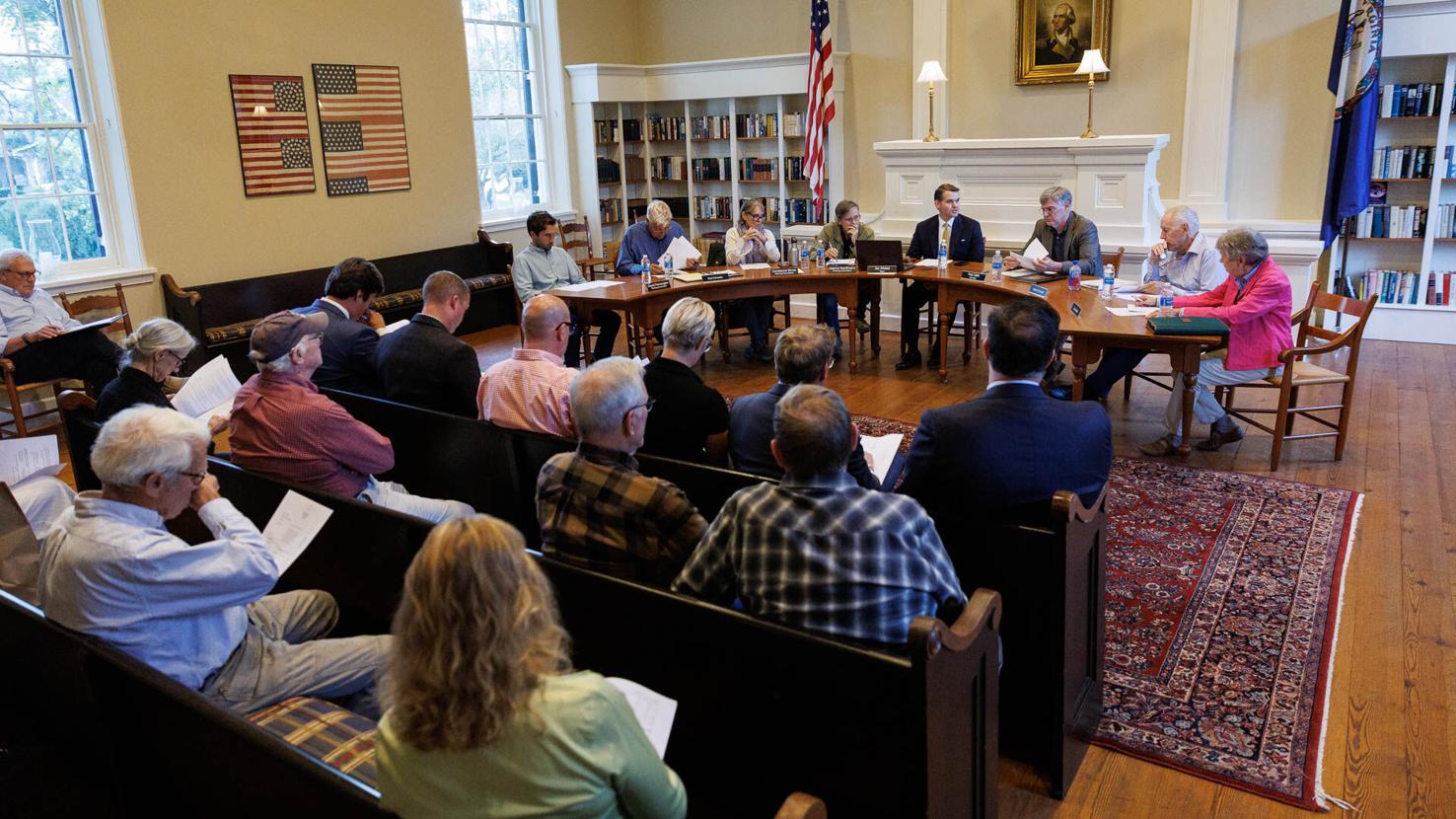
Town of Washington planners press pause on major Rush River Commons’ development plans
Rush River Commons’ second phase has hit headwinds in the Town of Washington, where the Planning Commission raised questions at its Monday meeting about processes, and more seriously, purpose for buildings proposed for 3.9 acres where Warren Avenue meets Lee Highway.
Following an hour and a half of discussion, the town’s Planning Commission sent the Rush River team back to the drafting table — with instructions to return in a month with more information, and more far-reaching explanations, on questions ranging from sewer and water and building scale to landscape design.
But more fundamental doubts surfaced during the meeting about whether the main components of the planned development — an office building and a large community center — are necessary or beneficial for the town and county.
Following an extended discussion with John Foote, the attorney speaking for the Rush River Commons’ project team, Planning Commission Chair Caroline Anstey said, “We come away not really knowing what you’re going to use the office building for, not really knowing what the community building would be for.”
The Planning Commission, which reviews development proposals and makes recommendations to the Town Council, deferred action on a request to simplify a number of processes that would enable the project to move forward with fewer regulatory hurdles and public hearings.
Most significant multi-use project
The building plans under scrutiny are part of the most significant multi-use development project the town has taken on in its long history. Chuck Akre, a Washington resident and active philanthropist, fathered the project, donating more than nine acres of property he owned, and then covering the extensive design, engineering and construction costs.
The first phase of the property focused on affordable housing for local families and a permanent home for the Rappahannock Food Pantry which attracted support from many town officials, some hoping the project would demonstrate that new structures, when carefully vetted, could fit comfortably into Rappahannock’s hamlets.
Rush River II is proving to be a tougher sell. During the meeting’s period of public comment, former Washington Mayor John Fox Sullivan asked: “Do we really need an office building? Is there really a demand for that?”
Questions also surround the need for the proposed community center. The town currently uses the large auditorium at the old Washington School and the historic Town Hall for community events, and the Rappahannock County Public Library is mapping a major expansion to accommodate its role as a community center. Pointing to the library’s initiative and the plan for the next phase of Rush River Commons, Anstey said, “There seems to be quite a lot of overlap between the two.”
Meanwhile, the Rappahannock Association for Arts and Community (RAAC) is raising funds for an expansion and upgrading of the Little Washington Theatre, which often functions as a community center. (Separately, the Planning Commission voted unanimously to endorse a zoning adjustment necessary for RAAC to extend its playhouse onto a strip of land that had been zoned for residential use.)
Objections to the large scale that is envisioned for Rush River’s second phase erupted last October at a Planning Commission discussion with the project’s backers and architects. At Monday’s session, Planning Commissioner Jeanne Kauffman said, “I’m disappointed that after all the feedback provided (at the earlier meeting) I don’t see any of that included in this presentation.”
Office space and ‘an awful lot of asphalt’
Anstey repeatedly noted that with the second phase of the development, Rush River would be adding 18,000 square feet of office space, plus “an awful lot of asphalt” to accommodate parking.
Washington’s costly water and sewer system presents another complication. When the town approves a new project, it is obliged to provide water and sewer service. Currently officials are working to calibrate the new demands resulting from The Inn at Little Washington’s plans to add pools and spas, plus expansions at developer Jim Abdo’s hospitality sites. It isn’t clear how much additional demand will emerge from the new Rush River structures, and there are worries that the water and sewer system is edging toward full capacity.
Food and beverage enterprises have been long envisioned for the next phase of Rush River Commons, but the size and nature of the eateries is still unknown. The project proposal sought leeway to build “coffee shops, cafes, sandwich shops, and restaurants offering quick service and full service.”
No one at the meeting called for cancelling the next phase of the project. And as the questioning continued, some commissioners made a point to applaud the generosity of the Akre family.
Speaking for the project team, Foote made it clear that the project planners would address the various information gaps the commissioners found worrisome.
Anstey, though critical, pointed to the town’s strong support for the first phase of Akre’s ambitious project. “We would all like to be as enthusiastic about this one as we were about the first one,” she said.