

Veditz_group
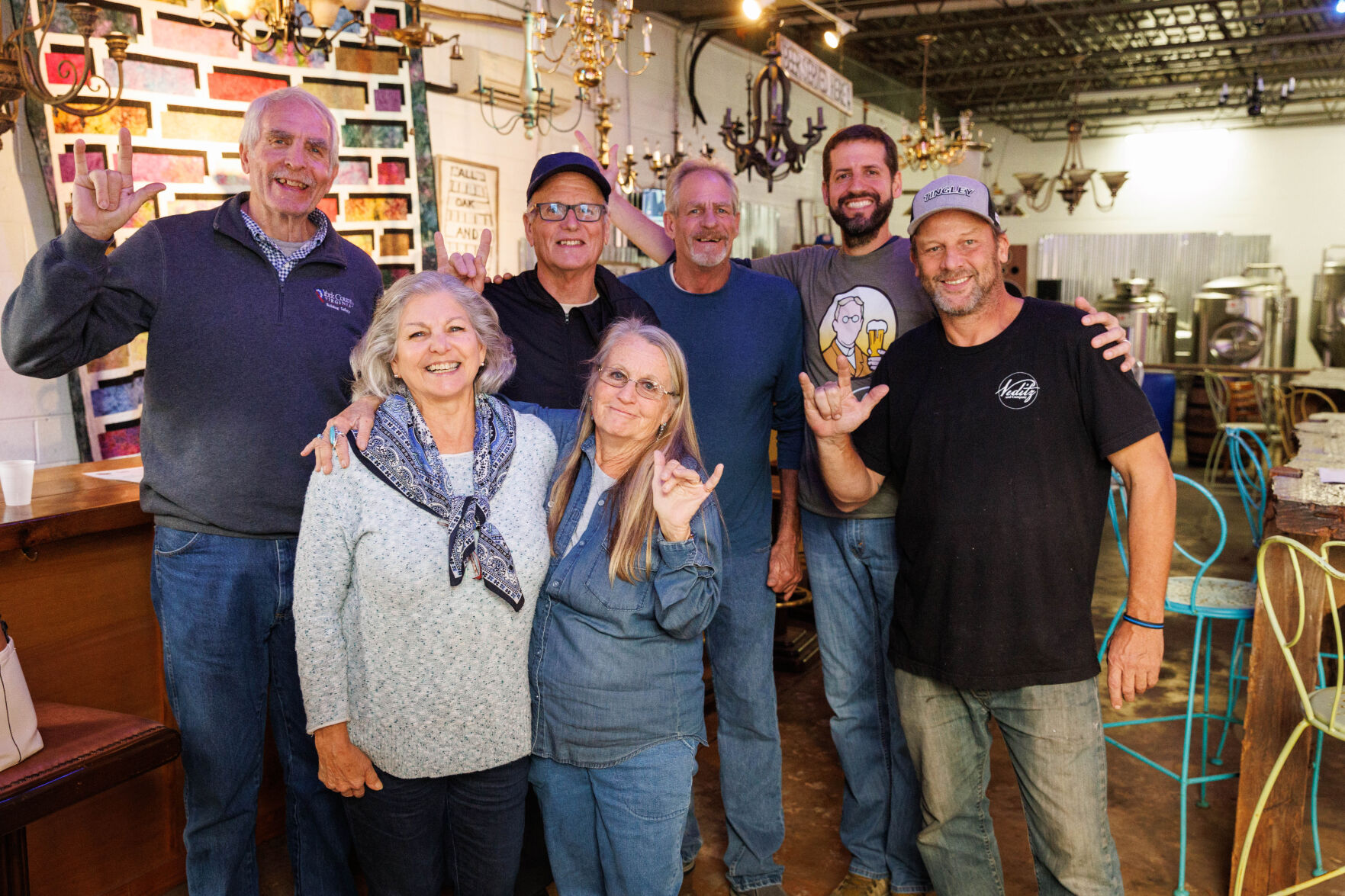
Paula Veditz Marotta, Debbie Veditz Griffith, front row, with Greg Randall, Ray Veditz, Frank Veditz, Rick Veditz and Joey Seifner at Veditz and Company Brewing’s Fall Family Fest last month.
Veditz and Company Brewing makes history as county students, adults learn American Sign Language
Veditz and Company Brewing is much more than the beer it serves. It is the first Deaf-owned brewery in Virginia and the third of its kind in the country.
The entrepreneurial trio of Greg Randall, Amit Rupani and Joey Seifner launched the new brewery on Labor Day weekend in Sperryville as a tribute to the historic icon George Veditz who worked passionately more than a century ago to preserve American Sign Language (ASL) using early motion pictures.
The owners are making history of their own as they build a bridge between the Deaf and hearing communities.
For Randall, working in a taproom is where he was bound to be. He grew up in a house built with bricks his father salvaged from an old, razed brewery. His first name, Greg, is a type of mini keg; his last name Randall is a hop filtration device.
After college, Randall toured breweries around the world to learn the trade. During the Covid-19 pandemic, he turned his basement into a beer lab, and from there the business partnership grew.
With ASL at the heart of Deaf culture, the owners honor their natural language when naming their beers. Many of the brews feature Deaf idioms with artwork from Deaf artists illustrating the significance.
“We’re excited when a hearing person wants to understand the story behind the name and proud when they order a beer using the signs,” Randall wrote in an email interview.
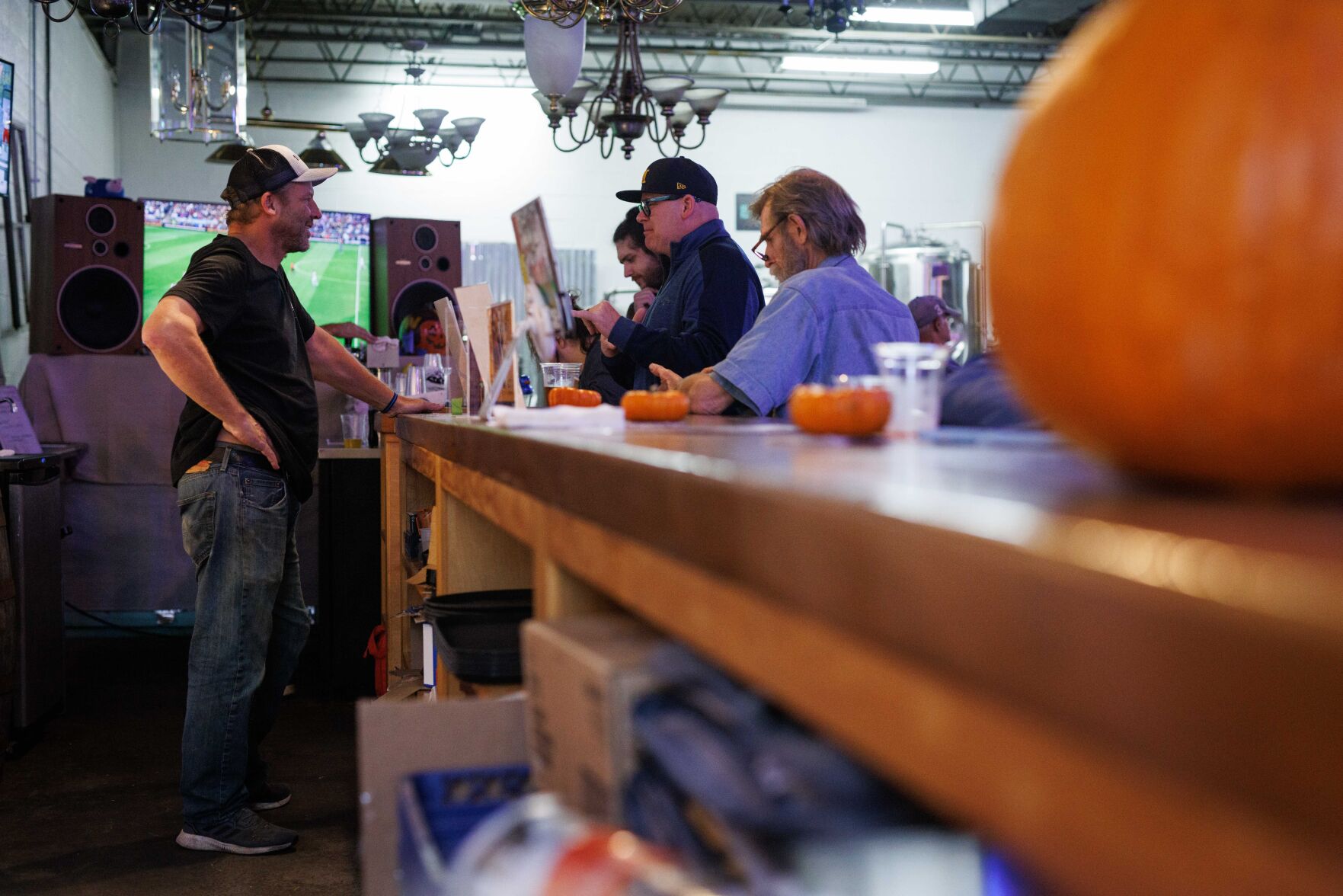
The industrial, steampunk style taproom located in the River District is spacious and accommodating with room for a band to play on weekends. With conversational seating, the owners host Deaf chats each month for people in the county to gather and converse and use social media like Facebook to announce these and other gatherings.
“As you can imagine, the Deaf community in Rappahannock is small but mighty,” the owners wrote. “Some stop by often, because it’s always nice to engage with others who use your same language.”

In photos | Dropping in at Vedits
A look at Veditz and Company Brewing in Sperryville, Virginia.
All art on the walls is by Deaf artists. Some works are by Randall, others are by local artists, and some are pieces from renowned artists in the Deaf community including originals by Louis Frisino and prints and originals by Ellen Mansfield.
In a nod to Gallaudet University and the school’s athletic mascot, a towering bison head is mounted high upon a wall. The space beneath has become a guest book where visitors, borrowing a marker from the bar, have signed their names on the painted cinder blocks.
Meeting the Veditz family
When the owners chose their business name, they never imagined they would meet the Veditz family, but that is what happened last month.
Descendants of Veditz’s first cousin Harry Rudolph Veditz traveled to Sperryville to meet the businessmen who adopted their family name. The great-great-nephews and nieces were delighted to be celebrating all that Veditz accomplished for the Deaf community.
Although the owners are deaf, Randall, Rupani and Seifner each come from hearing families.
When Randall became deaf at the age of two, his parents learned ASL along with him as he grew. He attended public schools in New York with Deaf programs and interpreters.
Seifner’s parents encouraged him to learn to speak English before learning ASL, so he attended an oral school for the deaf. It took him many years to learn to speak using hearing aid devices.
According to ASL interpreters, one common misperception of hearing people is that ASL is a manual form of the English language. On the contrary, ASL is a complete language with its own pronunciation, structure, grammar and rules. Like spoken languages, ASL can have regional dialects.
ASL in Rappahannock
Engaging with others who use ASL is occurring in other parts of the county and awareness is becoming more prevalent.
Carol Johnson, assistant superintendent of Rappahannock County Public Schools (RCPS), reports there are no Deaf students enrolled in RCPS, but 13 high school students are enrolled in an online ASL course this year.
ASL counts as a foreign language credit at RCHS, as it does in many high schools around the country. Some students have chosen to study it instead of a traditional foreign language such as Spanish.
Wakefield Country Day School in Huntly offers ASL to students through in-person instruction. Eighteen students are enrolled in the introductory and intermediate courses.
The brewery owners hope the young learners will join a Deaf chat as a way to improve their sign language skills.
In Rappahannock’s government offices, the staff assists community members with hearing or speech limitations. During public meetings, the county provides assistive listening devices that allow each user to adjust the audio level. An assistive listening placard is put out for every meeting to let attendees know the service is available.
“After my wife helped to interpret one of our first board meetings with the county, members of the board thereafter arranged for professional interpreters and accommodated us in every way,” Randall wrote, recalling the permitting process for the new brewery.
When ASL is not an option for those seeking services, “we will tailor our services to an individual’s need,” said County Administrator Garrey Curry. “This is one benefit to being a small locality; we can be nimble.”
Some 6.8% of people in the county report having hearing difficulty in a total population of 7,348, according to the latest U.S. Census Bureau data.
A brief history of Deaf education
In early America, many hearing people viewed deafness as an unfortunate affliction, a uniform condition that limited a person’s ability to hear, speak and learn. It wasn’t until 1817, when Thomas Hopkins Gallaudet and Laurent Clerc founded the first American public school for the deaf, that formal education for the deaf became a possibility in the United States.
American Sign Language (ASL) was born at that school from a blend of Clerc’s native French Sign Language and the natural signs Deaf students brought with them from different parts of the country.
As schools for the deaf began to spread in the United States, they became fertile grounds for the growth of an emerging Deaf identity. The students’ common language, ASL, became the cornerstone of their shared experience. This new form of communication grew organically to become a distinct and artful linguistic expression.
The growth of opportunities for the Deaf population seemed to mirror the growth in popularity of ASL. In 1864, Abraham Lincoln signed a law authorizing the first college degree institution for Deaf students, which later became known as Gallaudet University.
Around that same time in Europe, Alexander Graham Bell was experimenting with sound and resonance and ultimately invented the telephone. His studies and lecture circuits led him to American schools for the deaf, where he promoted oralism through speech therapy and lip reading. Bell discouraged the use of sign language when educating Deaf children, causing a dramatic setback for those who embraced ASL.
Bell’s influence prompted a dramatic shift in thought, and for the next century, Deaf education in the United States was mainly through oral methods. It would take until the 1960s for a return to the widespread use of ASL in the country.

Foothills logo – horizontal
Foothills Forum is an independent, community-supported nonprofit tackling the need for in-depth research and reporting on Rappahannock County issues.
The group has an agreement with Rappahannock Media, owner of the Rappahannock News, to present this series and other award-winning reporting projects. More at foothillsforum.org.