

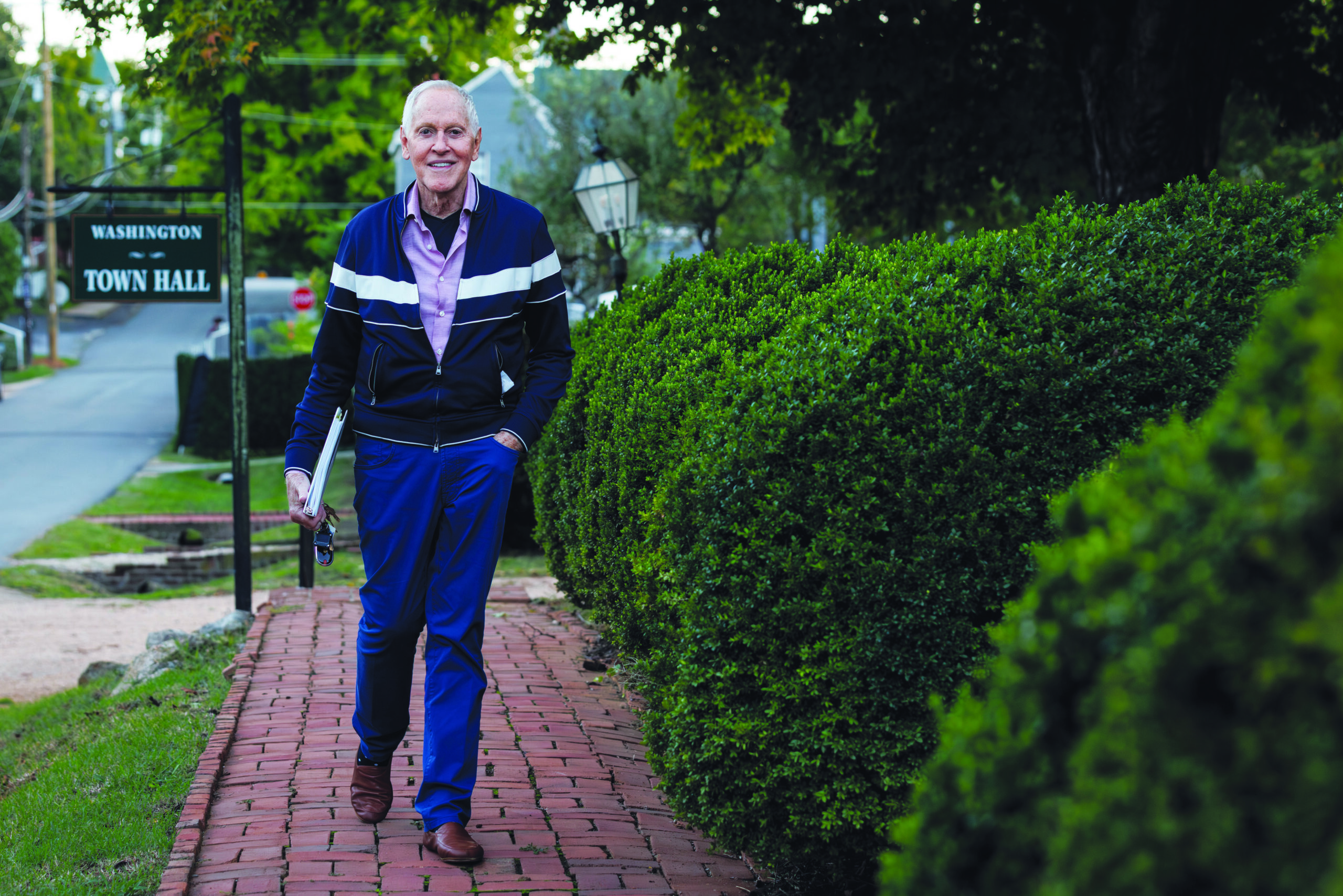
Patrick O’Connell on his way to a Washington Town Council meeting where he’s been a member for over 20 years and the Architectural Review Board (ARB) for 16 years prior to joining the Town Council. (Photo/Luke Christopher)
What unlocked his writing
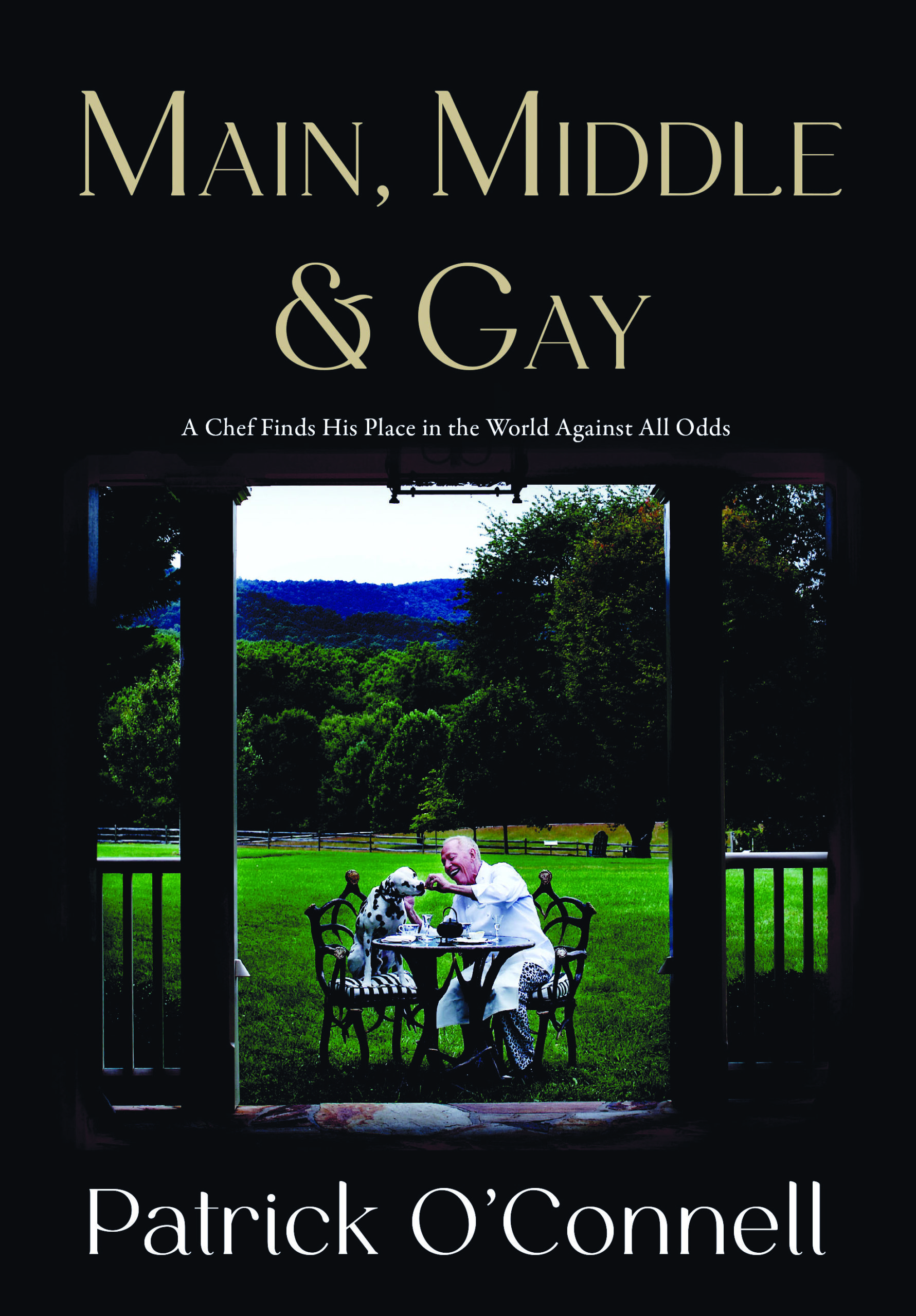
In advance of this week’s launch of his memoir — “Main, Middle & Gay: A Chef Finds His Place in the World Against All Odds” — Patrick O’Connell sat for an interview on how the book came about and reminisced about his 48 years at The Inn at Little Washington.
Chef Patrick O’Connell’s life has unfolded like a story. As a child, it took the shape of a film — early reels of what would become an extraordinary life and career.
After he came to Rappahannock County, it became a novel — one in which he woke each morning, wondering who would believe what had happened the day before. Guests hearing his stories would invariably say, “Oh my God, you’ve got to write a book.”
As O’Connell tells it, he might have procrastinated indefinitely, had it not been for a friend who had taken a memoir class and arranged a telephone call with the instructor, a Californian named Alan Watt.
“I don’t have a problem writing this,” he told Watt. “I have a problem imagining how it may change people’s perception of me.”
Watt told him to stop right there. That he must not write for the guests, or the staff, or the critics — that would only constrain him. He told O’Connell to write for himself.
“And so, the truth of the book sort of wrote itself,” said the chef-turned-author in a recent interview over afternoon tea at the inn.
What he had been constrained by, he said, was not so much a cage as a small window.
“The culture and the media want to give everyone a handle, a label. ‘Oh, you’re a chef, you’re a cook. Okay, we’ve got it. You’re in this box right here.’ And they don’t imagine that your talents or sensibilities should be allowed to extend outside that box,” he said.
As a self-taught cook who studied drama and never trained in a professional kitchen, O’Connell’s decision to open a restaurant in a former gas station in a town of fewer than 100 people at a moment when leaving an American city meant hoping for a grilled cheese sandwich at a diner, might well have ended in tears.
Instead, it led to countless awards and citations and three Michelin stars — the first and only restaurant in the D.C. area ever to be so honored. Over the years, O’Connell came to be known as the Pope of American Cuisine.
‘Intolerable Disappointments’
All of which is a long way from a four-year-old who, coming down the concrete steps of a tenement-like building, promised himself he would find a way not to live like that. It’s a chapter O’Connell called “Intolerable Disappointments.”
But a chef in that America was someone who toiled out of sight, and cooking was what you did if you couldn’t find a real job.
In 1967, O’Connell bought a ticket on the SS France. The night before sailing, he went to see an astrologer. If he simply wanted to make a lot of money, she told him, he could be an interior designer.
But she kept seeing food all over his chart. He said he’d worked in restaurants but had never taken it seriously. Think about it carefully, she counseled.
So how exactly did the boy on those steps end up with 17 acres, 22 buildings and a staff of more than 200? The answer, improbably, is Elizabeth Taylor.
Before the inn, he and his partner ran a catering business out of a farmhouse with no heating and only a wood-burning stove.
The last party they catered was for Elizabeth Taylor after she married John Warner. As O’Connell tells it, the room was full of women in tweedy jackets and A-line skirts. Taylor arrived late, in a purple silk pajama-like outfit, sandals, a great deal of gold and dramatic makeup.
“There was an audible gasp,” O’Connell said. “They’d never seen makeup like it.”
Taylor loved the food.
“She said, did you make all this? I said, ‘Yes, Yes, Yes.’” She told him he needed to open a restaurant. There was nothing in a three-county area — as he put it, only a Frost Diner.
Third Michelin Star
Fast forward to January 1978, to an old garage at the corner of Main and Middle. The Washington Star’s food critic, John Rosson, dined there three weeks after it opened. That April, he called it the best restaurant within 150 miles of Washington, D.C. The third Michelin Star came in 2019.
In November of last year, Michelin took one of them back.
O’Connell has said very little about it, and the inn’s statement, at the time, ran to four gracious sentences.
Gary Danko was rather more expansive. A fellow Grand Chef of Relais & Châteaux, he has known O’Connell since 2001, when O’Connell dined anonymously at his San Francisco restaurant a year after it opened and was impressed enough to nominate it for membership of the invitation-only association. Danko’s own restaurant held a Michelin Star for 17 consecutive years before losing it in 2024.
As Danko described it, recognition is what a grading body gives you — a snapshot, evaluated on anonymous criteria in a specific window of time, usually by a single visit from an inspector.
Michelin describes the process differently.
According to the guide, anonymous inspectors visit several times a year, across seasons and services, and decide as a team against various criteria. The star is for the food on the plate and belongs to the restaurant, not the chef.
“I had no idea of the magnitude of his vision and influence until my first trip to what I thought would be a single-building inn,” said Danko. “Only then did I realize the width and breadth of what Patrick had created.
“It was not just a country inn, but effectively the entire village of Washington, Virginia. At that level, a star downgrade is a media event, but it does not diminish the foundational weight of the chef’s reputation. The art outlives the metric,” he said.
Life after Chef
The question that circulates quietly around town and Rappahannock County — from dinner parties to planning meetings, and among the hundreds of people whose livelihoods rest on the answer, is what happens next? What does life for the inn — and the village — look like after Chef?
O’Connell has no illusions about life remaining the same, nor does he desire to try to control the world from his resting place, when that day comes. He is clear-eyed that nothing remains the same. But he also believes the inn is a stronger entity every day and no longer dependent on one person.
“What I’ve created is a culture, and that culture will live on, like any culture,” said O’Connell. “Not too many people trouble themselves too much about what’s going to happen to the Ritz Hotel in Paris.”
For O’Connell, what started as a garden now is a forest of trees, and the trees have a life and will continue to grow.
At age 19, between shifts waiting tables in Georgetown, O’Connell walked across the street to a cemetery. It was there that he decided he would write a book.
“But I’m glad I waited,” he said.
“Main, Middle & Gay” was published this week.