

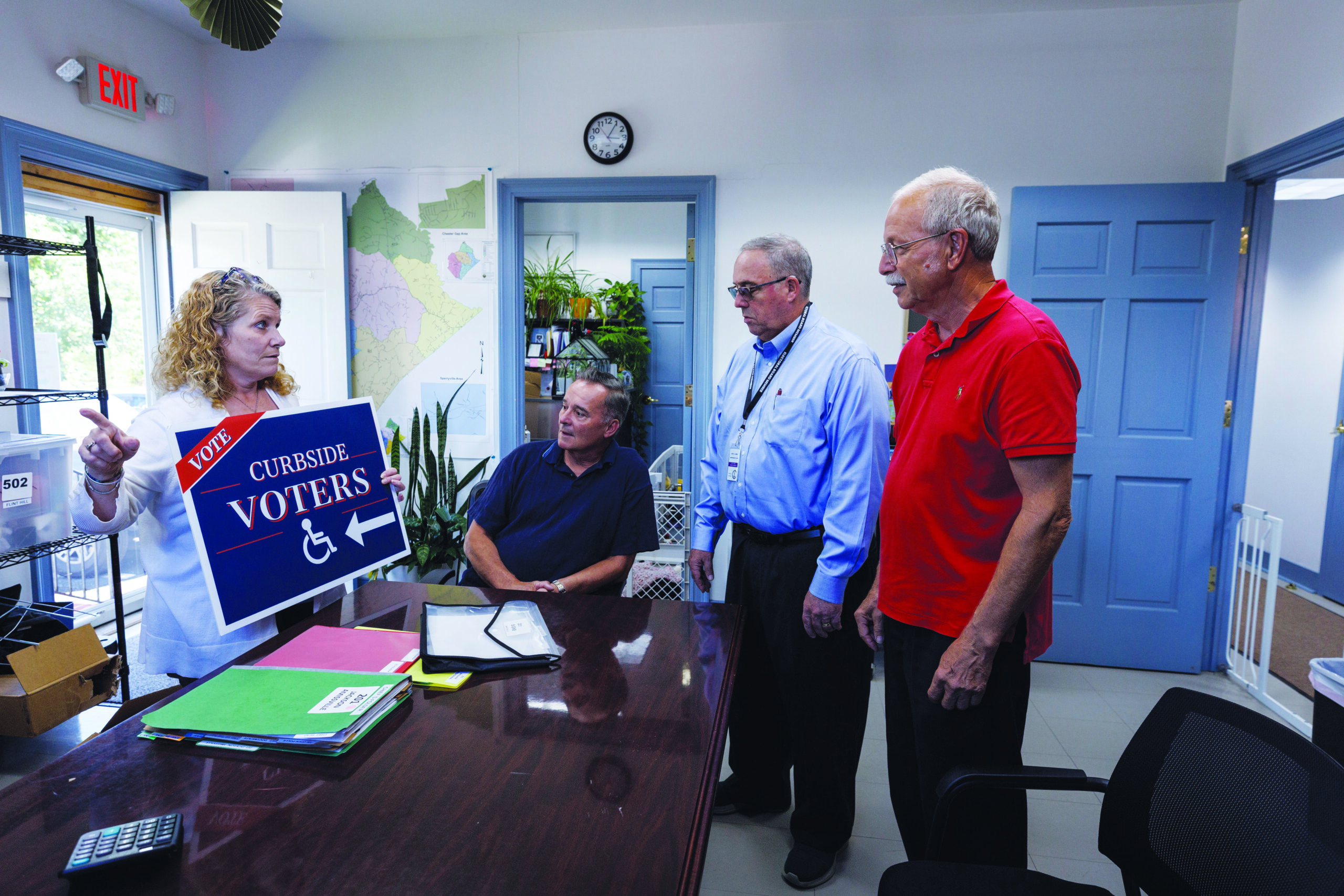
Officials detail layers of checks ahead of early voting
As election disputes and court challenges play out around the country ahead of the November midterms, Rappahannock County election officials emphasize the safeguards built into its process — before a single vote is counted here, systems will have been checked and double checked.
Tamper-evident seals secure equipment and ballot compartments. Ballot counting scanners are never connected to the internet. Voting equipment is tested. Vote tallies are checked three separate times before results are sent to the state.
Behind the scenes, election officials have built redundancy into the process, with multiple reviews designed to catch mistakes before results are certified.
“It’s not some Oz behind the curtain,” said General Registrar and Director of Elections Kim McKiernan in a recent interview. The people running the county’s elections, she said, are “your friends and community members.”
With early voting starting Sept. 18, Rappahannock voters can cast ballots in person or by mail ahead of Election Day, Nov. 3. They’ll choose candidates for the U.S. Senate and the 10th District seat in the U.S. House of Representatives and decide three proposed amendments to the Virginia Constitution dealing with reproductive rights, marriage and voting rights.
Rappahannock voters have historically turned out in relatively high numbers. In presidential elections for 2024 and 2020, turnout was about 79% and 78% respectively. For nonpresidential elections in 2025 and 2022, turnout was about 63% each. As of Aug. 13, there were 6,456 registered voters in the county.
Voters will also decide on a proposed 1% local sales tax referendum to fund school construction and renovation projects, while Town of Washington voters will select a mayor, treasurer and members of the Town Council.
Behind each ballot is a system of registration checks, ballot-security measures and post-election reviews designed to ensure eligible voters can cast ballots and that final results accurately reflect those votes.
At the center is McKiernan’s office at 262A Gay St. in the Town of Washington, which administers voter registration, early and absentee voting, prepares equipment, trains election officers and safeguards early and absentee ballots. McKiernan was appointed general registrar in 2013 after working in the office since 2012. She is a nationally certified election registration administrator with state certification credentials.
McKiernan works with a three-member county Electoral Board in conducting and certifying elections.
Registration, early voting
Early in-person voting runs Sept. 18 through Oct. 31 at the registrar’s office. Virginia voters don’t need to provide a reason to vote early, and McKiernan said the process operates under the same rules as Election Day.
“It’s the same equipment. It’s the same laws,” she said.
The deadline to register to vote or update a registration and cast a regular ballot is Oct. 23. Voters who miss the deadline can still register through Election Day under Virginia’s same-day registration law, but must cast a provisional ballot while eligibility is verified.
Virginia doesn’t require a photo ID. Voters may present one of several acceptable forms of identification, including certain government documents such as passports and federal or state government identification, utility bills or bank statements. Registered voters without acceptable identification may sign a form, under penalty of law, affirming they are the same person they claim to be.
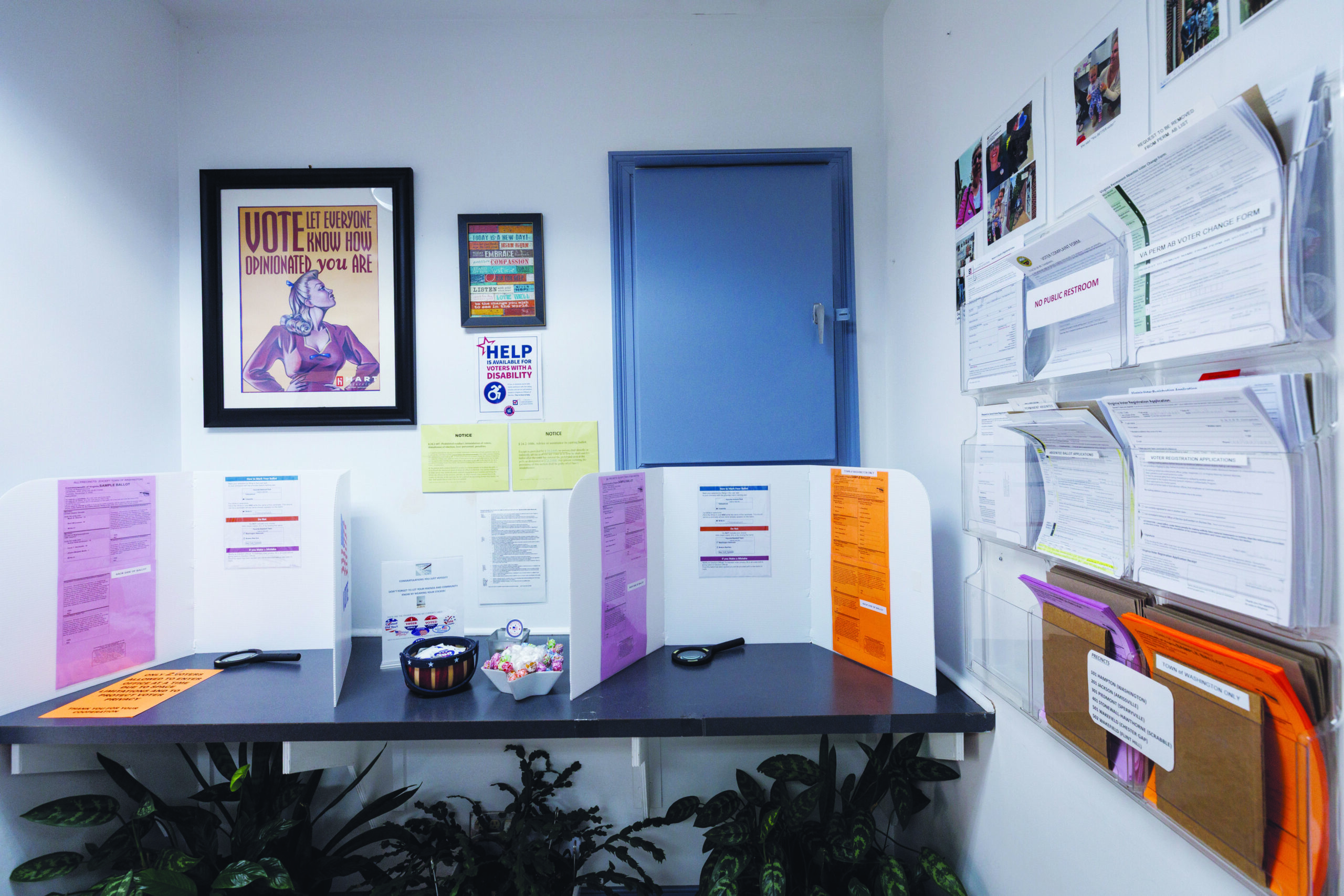
Early voting is only offered at the Voter Registration Office at 262A Gay Street, Washington from Friday, Sept. 18 through Saturday, Oct. 31. (Photo/Luke Christopher)
Voting by mail
To be counted, mail absentee ballots must meet state requirements governing voter information, signatures, deadlines and postmarks. The registrar’s office tracks when ballots go out through the U.S. Postal Service and logs their return as part of a chain-of-custody process.
A voter who receives a mail ballot but decides to vote in person needs to surrender the unvoted ballot at the polls. If the voter doesn’t have the ballot, and election officers cannot establish that it hasn’t already been returned, the voter can cast a provisional ballot while election officials determine whether another ballot was cast.
Rapp’s Electoral Board
Oversight falls to a three-member Electoral Board — currently Chairman Bob Klaus, Vice Chair Denise Chandler and Secretary Tim Grimes — whose members serve staggered three-year terms. Two members represent the political party of the governor and one, the other major party. The board’s composition changes as members’ terms expire following a change in administrations. Members of the board are appointed by the Circuit Court, based on local political party recommendations.
Chandler, who has worked in Rappahannock elections for more than two decades, said party affiliation doesn’t drive the board’s work.
“Our hats come off once we go into being an Electoral Board member,” she said. “We work as a unit,” guided by “the integrity of the election, the accuracy of the election and the security of the election.”
Over 30 Rappahannock poll workers receive state-required online training as well as local hands-on instruction before elections. On and after Election Day, the Electoral Board oversees operations and helps resolve any problems that may arise.
John Warzinski began working Rappahannock elections in 2023 and was appointed an election chief this year. He said the training covers voting equipment, voter identification, election forms and procedures for unusual situations.
“The training is very, very thorough,” Warzinski said.
Inside polling places
Each of the county’s six polling places — Chester Gap, Flint Hill, Amissville, Castleton, Sperryville and the Town of Washington — is staffed by a chief election officer, an assistant chief and trained election officers representing both political parties.
Amissville precinct chief Torney Van Acker said officers arrive before 5 a.m. to set up electronic pollbooks and confirm the ballot scanner starts at zero before polls open at 6 a.m.
Throughout the day, officers reconcile voters checked in against ballots issued and scanned — a check performed hourly, according to Van Acker, who called the system a “belt and suspenders operation.”
If a scanner stops working, voting continues, with completed ballots going into a secured emergency compartment until the scanner is operating again, explained Van Acker.
Provisional ballots
When a voter’s eligibility cannot immediately be confirmed — including in some cases when the voter’s name isn’t in the precinct pollbook — the voter may cast a provisional ballot while election officials determine eligibility. Same-day registrants also vote provisionally.
Those ballots don’t go through the scanner. They’re sealed and sent to the registrar’s office, where staff research eligibility before the Electoral Board decides whether each one counts.
Klaus said Rappahannock typically sees just five to 10 provisional ballots per election.

The Voter Registration Office on Gay Street, Washington welcomes future voters. (Photo/Luke Christopher)
After polls close
When polls close at 7 p.m., election officers reconcile records, print results tapes with vote tallies and report unofficial results to McKiernan’s office.
The next day, the Electoral Board canvasses the results, comparing totals against scanner tapes. An Excel spreadsheet with built-in cross-checks helps catch transcription errors.
“Somebody looks at 75 votes for Joe Smith and reads it as 57,” Klaus said. “I don’t like sending that into the state. I want to check that before we hit send.”
Totals can still change for up to seven days after Election Day as eligible mail ballots arrive and provisional and same-day registrations are verified. The board then certifies the results and sends them to the Virginia State Board of Elections.
Illegal voting
Illegal voting in Virginia is rare. According to a 2024 investigation by the NPR affiliate in Roanoke, Radio iQ//WVTF, a review of more than 650 election-related criminal cases in the state’s court system over the prior 20 years found no instances of a noncitizen being convicted of illegally voting, even as some 48 million votes were cast during that period. Virginia is rejoining the Electronic Registration Information Center, a multistate system used to identify voters who have moved, possible duplicate registrations and deceased voters as part of voter-roll maintenance.
Chandler said greater public knowledge of what occurs behind the scenes could help voters understand the layers of checks surrounding their ballots.
“We want more people to know” what happens behind the scenes, she said, “because then they realize how secure their vote is and how every vote is counted and tracked.”
Grimes offers skeptics an invitation to participate:
“I typically tell people, if you don’t think the elections are done fairly, volunteer to be an election officer,” he said.
Key election dates
Sept. 18 — Oct. 31 Early in-person voting
In-person early voting begins at the Rappahannock County Voter Registration Office, 262A Gay St., Washington. Absentee by mail ballots also begin going out.
Oct. 18 — Weekend early voting hours
In addition to regular weekday voting, voters can cast ballots on Sunday, Oct. 18, from 11 a.m.-4 p.m. at the Voter Registration Office. (State law now requires two Sundays of early in-person voting.)
Oct. 23 — Registration and mail-in ballot deadlines
Deadline to register or update a registration through the regular process. Voters who miss it may still register through Election Day and cast a provisional ballot. Deadline to apply for a mail-in ballot.
Oct. 24-25 — Weekend early voting hours
Saturday, Oct. 24, 8 a.m.-4 p.m., Sunday, Oct. 25, 11 a.m.-4 p.m.
Oct. 31 — Early voting ends
Final day to vote early in person, 9 a.m.-5 p.m.
Nov. 3 — Election Day
Polls are open from 6 a.m.-7 p.m. Voters in line by 7 p.m. may vote. Mailed absentee ballots must be postmarked no later than Election Day to qualify for later receipt.
Nov. 4 — Canvass begins
The Rappahannock County Electoral Board begins reviewing precinct returns and provisional ballots. Election night results remain unofficial.
Nov. 6 — Absentee ballot deadline
Properly postmarked absentee ballots must arrive by noon to be counted.
By Nov. 13 — Local results finalized
The Rappahannock County Electoral Board completes the post-election canvass and certification process and submits the county’s certified results to the Virginia State Board of Elections.
For more information visit the county election website at rappahannockcountyva.gov/registrar
— Bob Hurley