

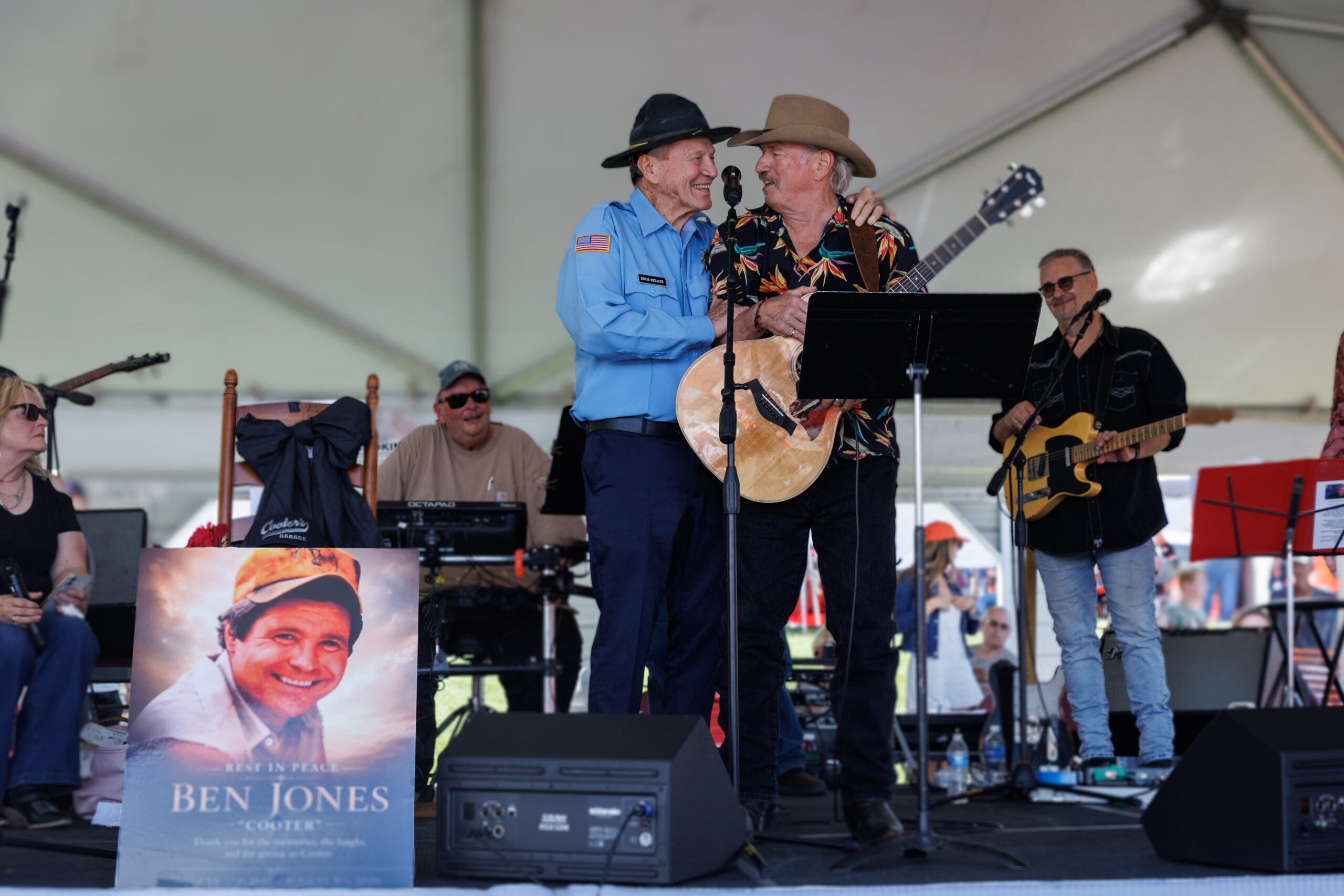
Sonny “Enos” Shroyer (left) and Tom “Luke Duke” Wopat at Ben “Cooter” Jones’ celebration of life last Saturday in Luray, Va. (Photo/Luke Christopher)
Fans bid farewell at Cooter’s Place in Luray
A Dukes of Hazzard revival swept Luray on Saturday, with thousands of cars streaming in for an amplified and tearful farewell to Rappahannock resident Ben “Cooter” Jones, who died Aug. 9 at his Harris Hollow home at 84.
Two of the cars were flame orange Dodge Chargers featured in the Dukes of Hazzard episodes CBS aired from 1979 through 1985, and for years afterward as syndicated reruns. Another 20 or so Dodges, modeled on the originals, lined the asphalt in front of Cooter’s Place, each roof emblazoned with the name General Lee and a Confederate flag.
Drawn to the show, Jones, who studied acting in college, won the part of Cooter Davenport, a genial car mechanic. Over time, he endowed this secondary character with aspects of his own personality. Indeed, an informal merger materialized: Cooter, notwithstanding his wild streak, became hardworking, ethical and reliable; Jones, while famously irascible, came to be revered by his fans as surpassingly kind, generously available to listen, sympathize and share a joke. Cooter, framed in quotation marks, became his middle name.
It was Jones’ singular genius to turn an enthusiasm into an enterprise, and an audience into a community. A smattering of conversations in Luray over the weekend revealed people who had traveled from Tennessee, Wisconsin and Florida to pay tribute to him, as well as Germany and Amsterdam. Many said they felt as though Jones and the show’s other actors had pulled up chairs and loved them, and they wanted to renew the connection. Some of the star actors were present — wrinkled, talking of heaven and patiently signing autographs for long lines of fans standing in the August sun.
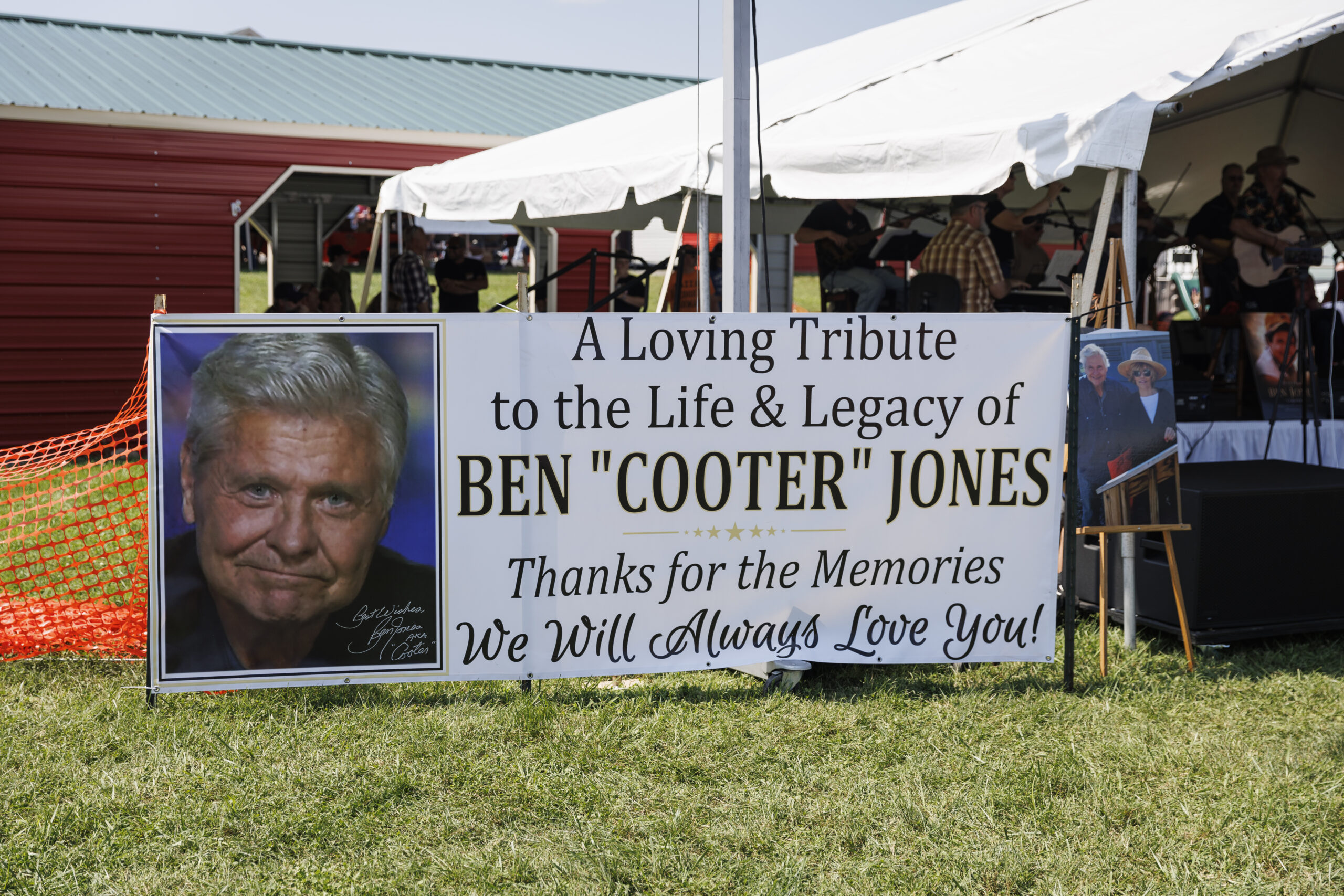
A large sign greeted fans attending the celebration of Ben ‘Cooter’ Jones’ life this past weekend. (Photo/Luke Christopher)
Joe Caldwell, a retired police officer from New York City who owns one of the two original cars, drove to the celebration with his wife Roxanne. “We’re just paying our respects to Ben and Miss Alma,” he said, referring to Alma Joyce Viator, Jones’ wife of 33 years.
Recently, a fan offered $300,000 for his car. “I turned them down,” he said. Caldwell, who is White, said he has been struck by the number of African American men who step out to cheer the flashy vehicle as it edges through crowded streets in the Bronx.
Will and Terry Burns of Gloucester, Virginia, rolled into Luray in another original General Lee. They remember meeting Jones in Sperryville years ago; they said he talked to them as though he had known them for decades.
Weary and protected by dark glasses, Jones’ wife addressed a cheering audience spread across a grassy field on folding chairs they had brought from home.
”Someone said we were like peanut butter and jelly,” she said, “but Ben said we were actually dynamite and a match.” The crowd of 5,000 roared back with shared affection for the husband she married at a small ceremony in the chapel of the U.S. Capitol in 1992, when Jones, a Democrat, was a Georgia congressman.
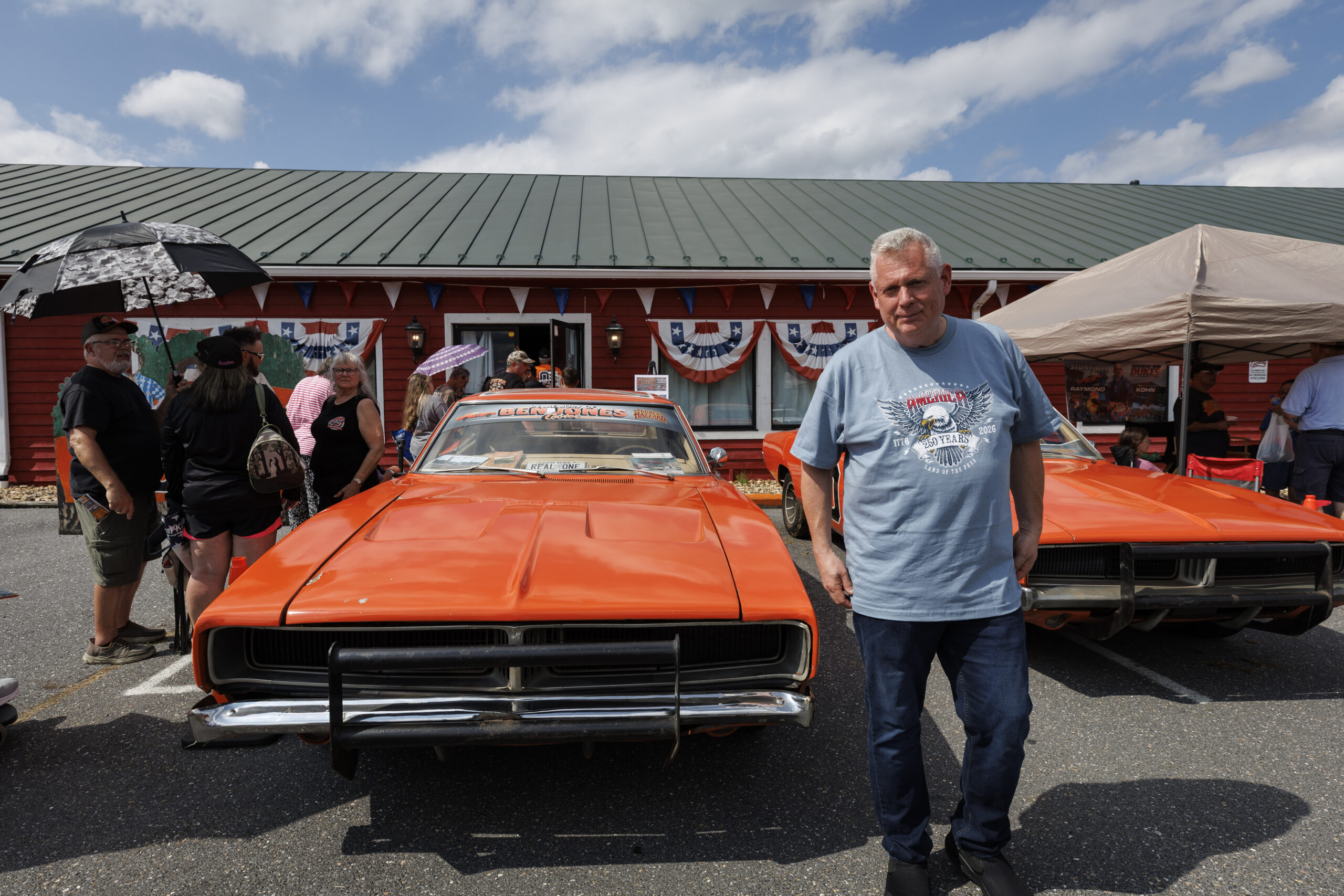
Joe Caldwell, a retired police officer from New York City, who owns one of the two original flame orange General Lee Dodge Chargers from The Dukes of Hazzard TV show, drove to the celebration with his wife, Roxanne. (Photo/Luke Christopher)
“There’s not a lot of opportunity to meet someone you saw on television, who was a star in your childhood, and when you meet him in real life, he’s better than you imagined,” said Christine Smith, former member of the Board of Supervisors. She recalled stopping at the Sperryville Cooter’s Place in 2000 — carrying her baby son, teething and fussing — to introduce herself. She remembers that Jones immediately commented on what a fine-looking boy he was, took out his handkerchief and dried his tears. Calm returned.
A living kaleidoscope
Ben Jones’ wildly varied life is kaleidoscopic. From a childhood in a railroad section house lacking electricity and indoor plumbing in Portsmouth, Virginia, he made it to top-ranking colleges in North Carolina, and into a multistoried career as musician, actor, writer, U.S. congressman, TV star and impresario of Southern-culture jamborees.
A Georgian and a Virginian, he was a tireless defender of the Confederacy and its flag, while quoting Martin Luther King Jr. and maintaining a life membership in the NAACP. Straddling one fault line after another, Jones knew the chaos of alcoholism and the relief of sustained sobriety. He experienced divorces and fractured relationships and a lasting marriage with Alma Viator, whom he called “the morning and the evening star.”
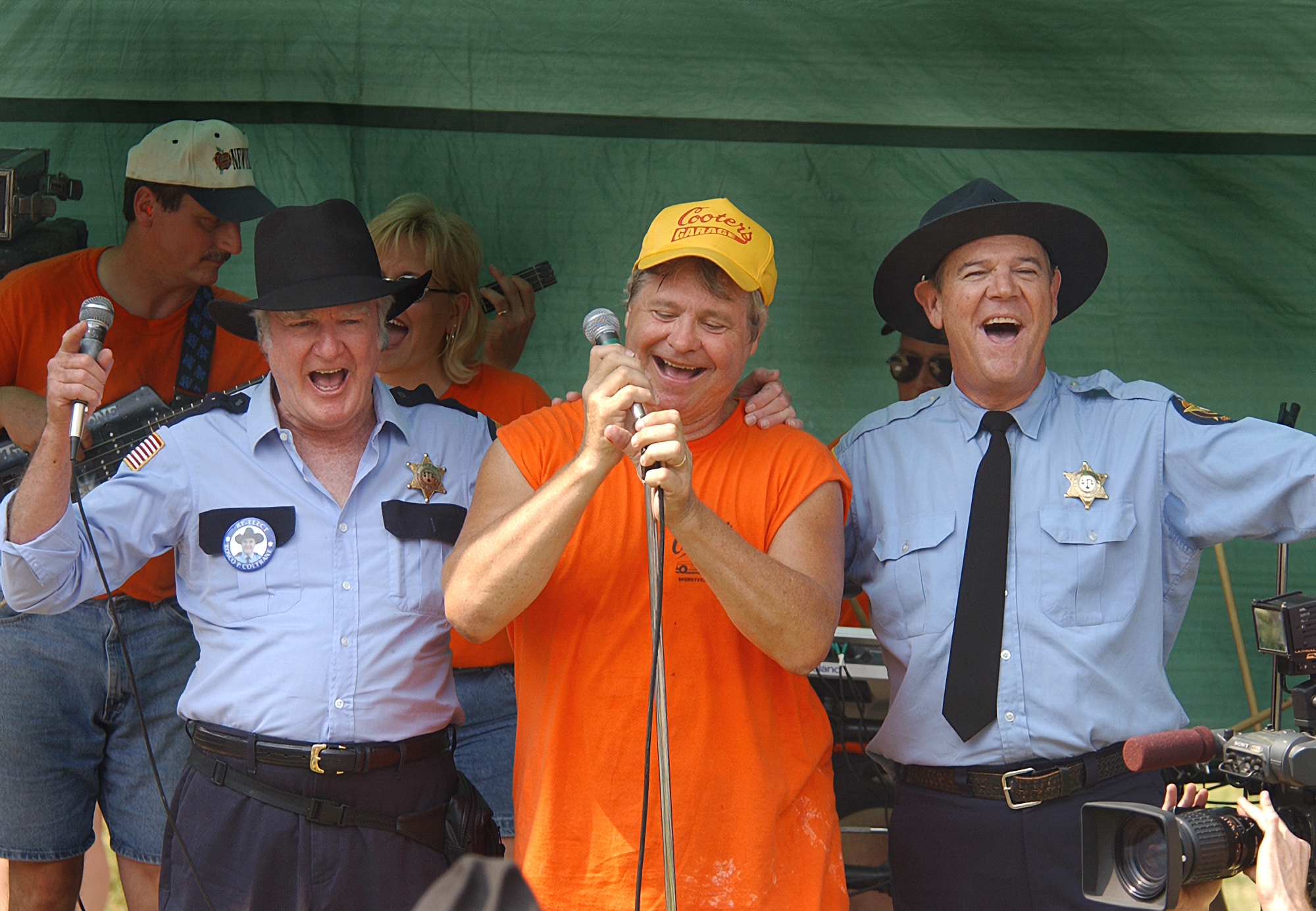
Ben Jones (center) who played “Cooter” on the popular television show “The Dukes of Hazzard” with former co-stars James Best “Roscoe Coltrane” (left) and Sonny Shroyer “Enos” (right) at a reunion at Jones’ “Cooter’s by the Country” store formerly in Rappahannock County, Va. in 2001.
A drive to Rappahannock
In a wide-ranging interview last week from their Harris Hollow home, Alma Viator remembered driving to Rappahannock one morning in 1998 to check out a property which Jones hoped might provide enough quiet to read and write. Initially noncommittal, Viator, a high-octane publicist and lobbyist for the National Theatre in Washington, D.C. and other arts enterprises, was swept away by the property, and by 1:30 p.m., she was in Front Royal signing a contract.
Rappahannock was small town and agricultural — almost reminiscent of a “Dukes of Hazzard” setting. But, as many Rappahannock residents know, the county mixes longtime rural Virginians with migrants from Greater Washington, D.C.
Jones was a Greater Washington man, but the small-town rural residents triggered his passionate loyalty for underdogs, while perceived elites endured withering critiques.
Jenks Hobson, rector of Trinity Episcopal Church in the Town of Washington for 42 years, recalled Jones’ “little grenades” in commentaries he penned for the Rappahannock News. A typical fusillade from the archives protested “the yuppie-fied, artsy-fartsy, real estate rabid, and ever so precious Sperryville.”
“I got on his bad side at one point,” Hobson said in an interview, “but we laughed about it more than getting bothered by it.” He warmly recalls watching the election returns with Jones the night Barack Obama won the White House.
Forever feisty, Jones earlier threw himself into the cause of Black American underdogs. In his memoir, “Red Neck Boy in the Promised Land: The Confessions of ‘Crazy Cooter,’” he wrote: “I battled the Klan on a few occasions, got sucker-punched, kicked, shot at on two occasions, and I spent a lot of time in the crowded jails of the Tar Heel State.”
Not long after China’s Tiananmen Square protest and violent crackdown, Jones, then a congressman on an official visit to Beijing, concealed a banner of solidarity with the protesters in his underwear, breaking away from the tightly scripted itinerary to unfurl a clear message in a public location: “For those who died for freedom in Tiananmen Square.” He had alerted a CNN camera crew in advance.
Citing the incident, Viator said, “I fell in love with my husband because of his integrity,” adding, “I felt so safe.”
County controversies
Once established in Rappahannock, Jones often provided music for nonprofit fundraisers, while never shying away from controversy or debate. In 2014, Washington, D.C. developer Jim Abdo bought several properties in the Town of Washington, pitching the investment as part of a larger plan to bring a “pulse” to an excessively quiet town.
Immediately, Jones was on the warpath. In a passionate critique published in The Washington Post, he blasted Abdo’s development as “a nightmare,” adding a sarcastic punch: “Suddenly we are corridors, we have catalysts, we are being leveraged.” A town hall forum in the Little Washington Theatre erupted in cacophony, with Jones ripping into the Abdo plan, while more sympathetic residents booed the former congressman’s caustic attack.
Jones stormed out of the meeting, and the Abdo plan, which had involved bringing a bakery and a family-style Italian restaurant to the town, dissolved. Abdo’s properties sat dormant for the next decade, some even longer.
In 2016, Jones’ Sperryville establishment on Route 211, Cooters in the Country, found itself at the center of a controversy. The standoff involved zoning issues, particularly parking on a field designated for agricultural use. In addition, residents were worried about noise and traffic during large concert events.
Anticipating continuing pushback from the local authorities, Jones bitterly announced that he and Viator would shift the operation to Luray. “Simply put, we are sick and tired of jumping through the hoops of those who are determined to put restrictions on our business,” Jones said in a social media statement at the time. The couple soon began planning a triumphant relocation to Luray. Just before the opening, Jones was quoted saying, “The fans are ecstatic!”
“It was a real loss for our county when Cooter’s moved to Luray,” Christine Smith said. Jones and Viator had first opened a Cooter’s Place operation in 1999. There are also two Cooters operations in Tennessee.
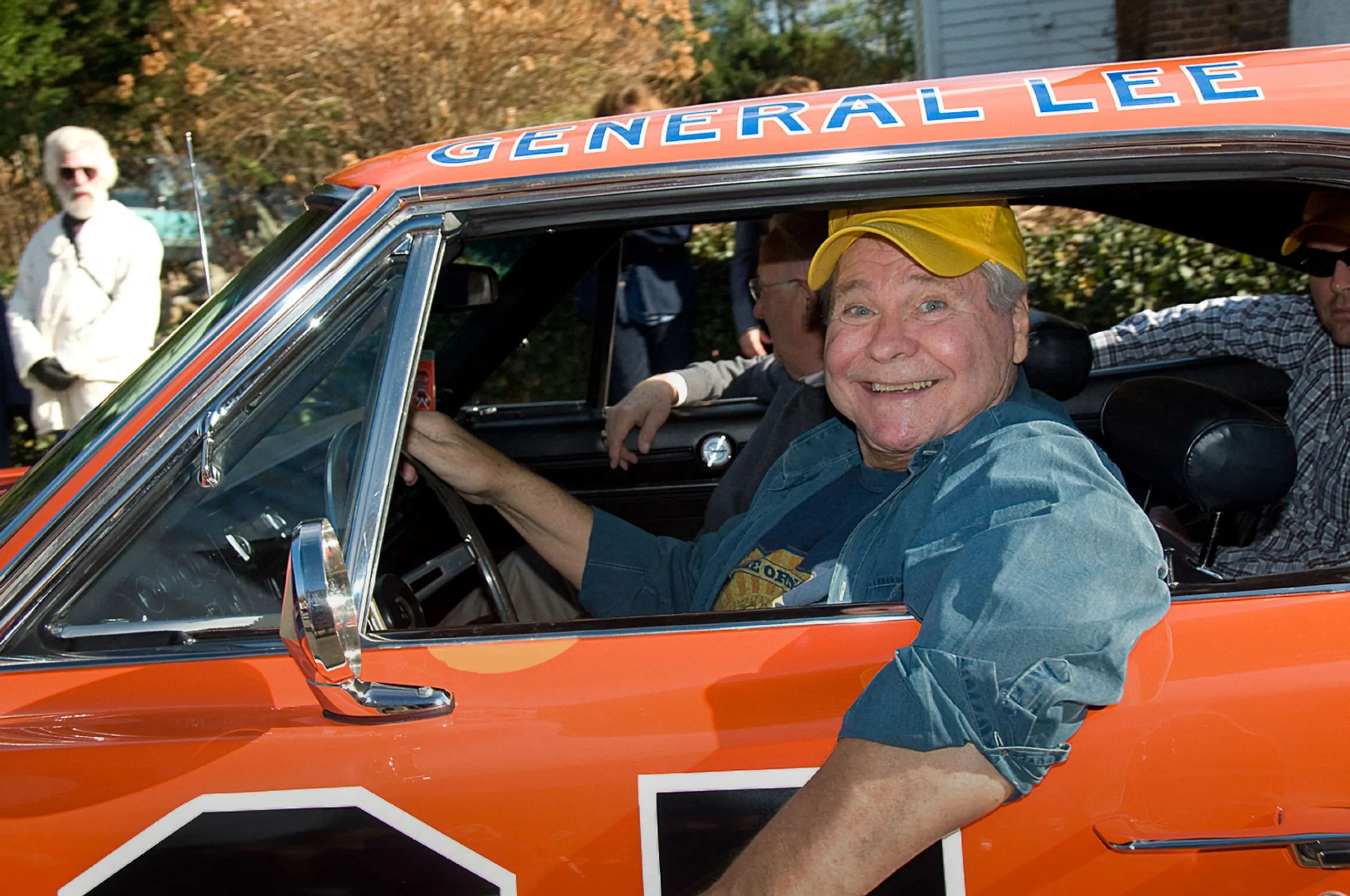
Ben Jones driving “The General Lee” car from “The Dukes of Hazzard” television show in the 2011 Little Washington Christmas parade.
Faulkner’s ghosts
“Ben loved Faulkner,” Viator said, standing among shelves of Civil War histories and American literature in one of several book-filled rooms in their home. Jones’ commentaries were often appended with the famous quote from the Mississippi Nobel Prize novelist: “The past is never dead. It’s not even past.”
“Never dead” for Jones were the impoverishing effects of the Civil War and its aftermath. A personal letter he sent to former Rappahannock News publisher Walter Nicklin quotes Union Gen. William Tecumseh Sherman telling his wife in a letter that his purpose was the “extermination, not of soldiers alone but of the people” of the South.
In the same letter, Jones also noted that in 1864, Union Gen. Philip Sheridan reported to Gen. Ulysses Grant: “I have destroyed over 2,000 barns filled with wheat, hay and farming implements; over 70 mills filled with flour and wheat, and have driven in front of the Army over 4,000 head of stock and have killed and issued to the troops not less than 3,000 sheep.” Jones was convinced that the Union generals viewed impoverishment as a punishment for the South’s secession.
But where Faulkner explored ghosts in the defeated Confederate states, Jones found angels. In the TV character of Cooter Davenport, the hardworking, well-meaning car mechanic, Jones wrested a comic hero from the Faulknerian maelstrom.
Mass murder and mood change
Viator said the national mood changed in 2015 with the murder of nine Black congregants at the Emanuel African Methodist Episcopal Church in Charleston. Law enforcement agencies quickly found a website showing the shooter with a Confederate flag and a racist manifesto.
The nation recoiled. Statehouse legislators in the South voted to remove the Confederate flag, now sullied by a traumatizing association with contemporary and vicious racism. The backlash reached Jones’ immediate interests, when the syndicated reruns of The Dukes of Hazzard were halted. The gatherings, the General Lee Dodge Chargers and retail items at Cooters’ shops would keep the Dukes alive.
With George Floyd’s killing in 2020, Confederate statues fell across the country. In a commentary in the Rappahannock News, Jones seethed, “You will not ‘culturally cleanse’ me. I will fight you till Hell freezes over and then I will fight you on the ice.”
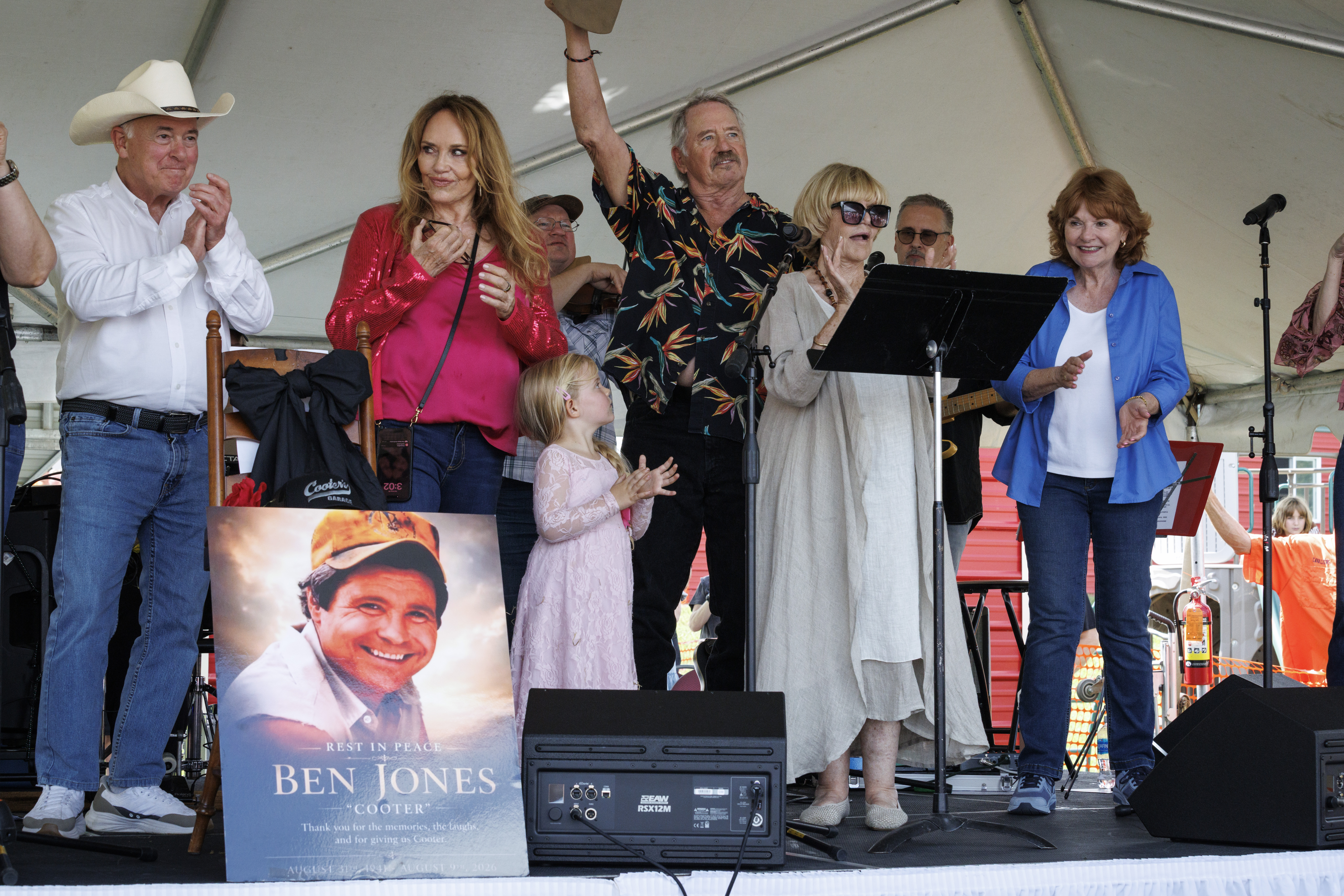
Catherine “Daisy Duke” Bach, (center) Tom “Luke Duke” Wopat, Alma Viator and granddaughter Carolina Poppy Callaghan at Ben “Cooter” Jones’ celebration of life last Saturday in Luray, Va. (Photo/Luke Christopher)
Broken and slipping
In his 80s, Jones became less visible in county and national debates, landing occasional jabs at “woke leftists” and “neo-Marxists” in his Rappahannock News commentaries.
His physical setbacks included six major fusions in his back, four knee replacements and a reconstructed hip that he reinjured. As surgeries and procedures added up, Viator found that “he was starting to slip,” adding, “he knew it and would make fun of himself.”
As Jones’ health declined, he penned a notable Rappahannock News commentary, published last March. The piece carried no “little grenades.” Rather, it was a tale of remorse over maiming a mouse in a mouse trap in his kitchen. Having set out cheese, milk and yogurt to help his victim recover, Jones returned to the scene, only to fall on his already fragile back. It is ultimately a humble fable of twin underdogs, the mouse and Jones.
In the end, the puzzle of Ben “Cooter” Jones resists simplification. His plural life, straddling multiple fault lines, is perhaps best explained inside a small farmhouse on his property. In a retreat space he used as an office, a library and a curiosity display, the walls are packed with images of his favorite blues and jazz musicians, writers, historical figures and family members.
When visitors appeared perplexed by the complex mosaic, he would explain with a smile, “This is what the inside of my brain looks like.”