

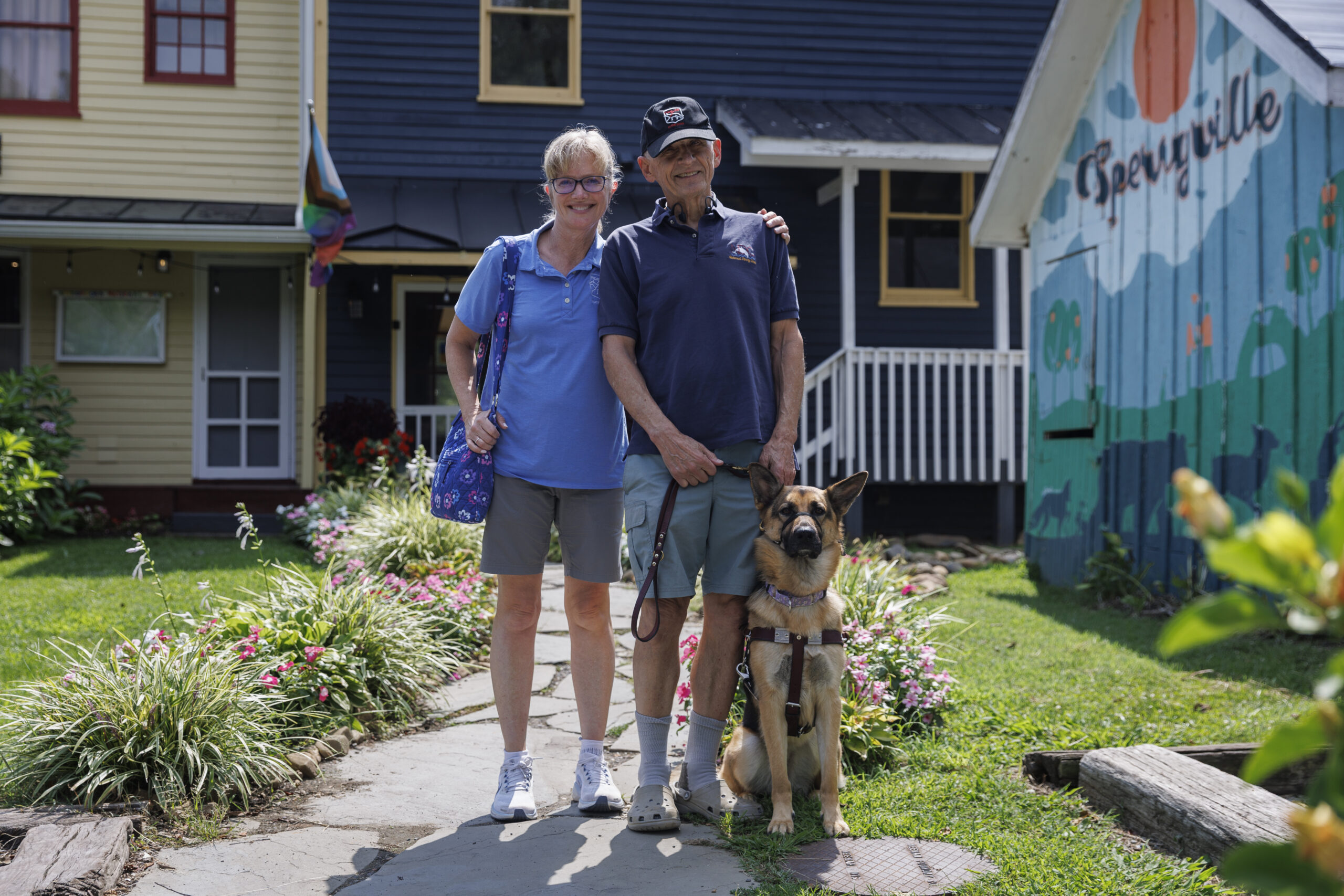
Retired Judge David Tatel and his new guide dog, Xyrah, learn how to navigate life together with trainer Jennifer Caley of the Fidelco Guide Dog Foundation at Before & After cafe in Sperryville. (Photo/Luke Christopher)
Two steps.
That’s all that separates the back and front rooms at Before & After cafe in Sperryville. It’s a simple descent, one that would ordinarily require little thought or effort. But at the moment, David Tatel and Xyrah, his new guide dog, are perched above the first step. Few words are spoken, but so much is being communicated.
Tatel gives the command, “Xyrah, forward.” But Xyrah doesn’t move forward. She pauses instead, engaging in what’s known as “willful disobedience.” She’s letting Tatel know that it’s not safe to proceed, that they must together deal with what’s in front of them. Only when Tatel lowers his right foot to the first step does Xyrah move forward with him.
It’s a brief interaction, but a critical one in what Tatel believes is the most unique of human-animal relationships — the one between a guide dog and its handler. “The human and the dog are working together to accomplish something,” he said in an interview. “There are certain things she does that I can’t do, and that I do that she can’t do. It’s in a class by itself.”
The visit to Before & After came near the end of Tatel’s second week of training with Xyrah (pronounced Zi-rah). She had been introduced to the home Tatel and his wife, Edie Tatel, have in Castleton, and had gone for her first walk with David on Long Mountain Road, where she saw her first cow. The previous week had been spent at their apartment in Washington, D.C., and accompanying David on the long escalators down to the Metro stations, then riding back and forth on the subway with him to his law office downtown.
The latter would seem to be the more taxing part of David’s and Xyrah’s shared training — the traffic, the pedestrians, the random bikes and scooters and a lot of other dogs on walks. But Jennifer Caley, a trainer with the Fidelco Guide Dog Foundation in Connecticut, pointed out that country life brings its own challenges.
“It requires a whole different skill set,” she said. “It seems like walking with the dog on a long, winding country road would be super easy. But there are so few landmarks to engage where you are at any given time. You might think you can listen for the river, but sometimes the river is so low it doesn’t make a sound. And for the dog, there are so many other potential distractions — birds, squirrels, other animals, smells of all sorts.”
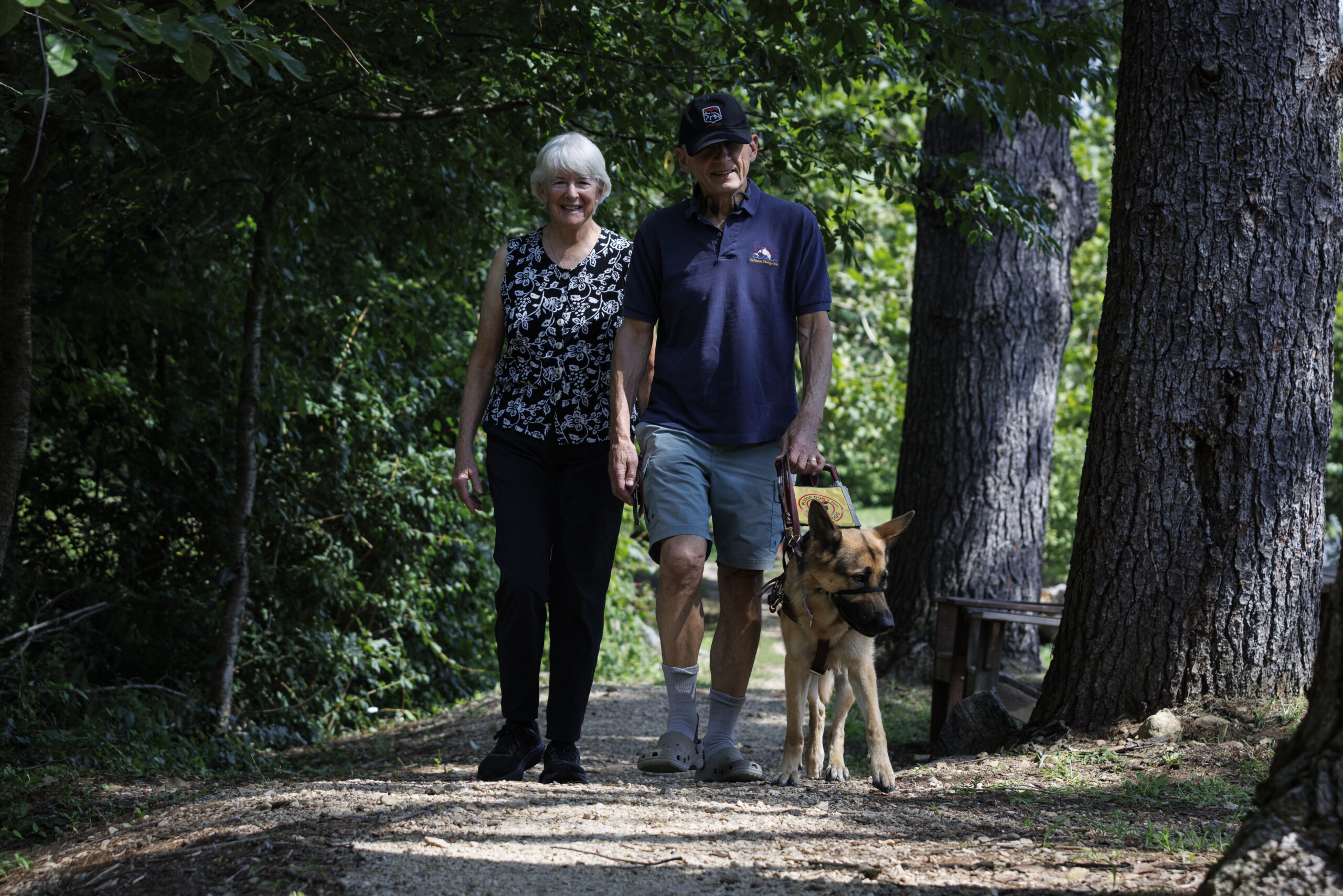
Edie Tatel and David Tatel walk along the Thornton River on the Sperryville Trail with a new member of their family, guide dog Xyrah. (Photo/Luke Christopher)
Building a bond
For David, it’s the latest chapter in a life of both persistent challenge and prestigious accomplishment. Now 84, he began losing his vision as a teenager, the result of a rare eye disease. But he achieved a highly successful legal career, culminating in an appointment to the U.S. Court of Appeals for the District of Columbia Circuit, where he served for almost three decades.
For years, David avoided using any aids that would draw attention to his blindness. He put off getting a white cane until he was almost 40, and it wasn’t until eight years ago that he followed up on his grandson Reuben’s suggestion that he listen to a podcast about guide dogs. That resulted in a decision to get his first dog from Fidelco, a German shepherd named Vixen, and begin a partnership he says profoundly changed how he felt about himself and his blindness.
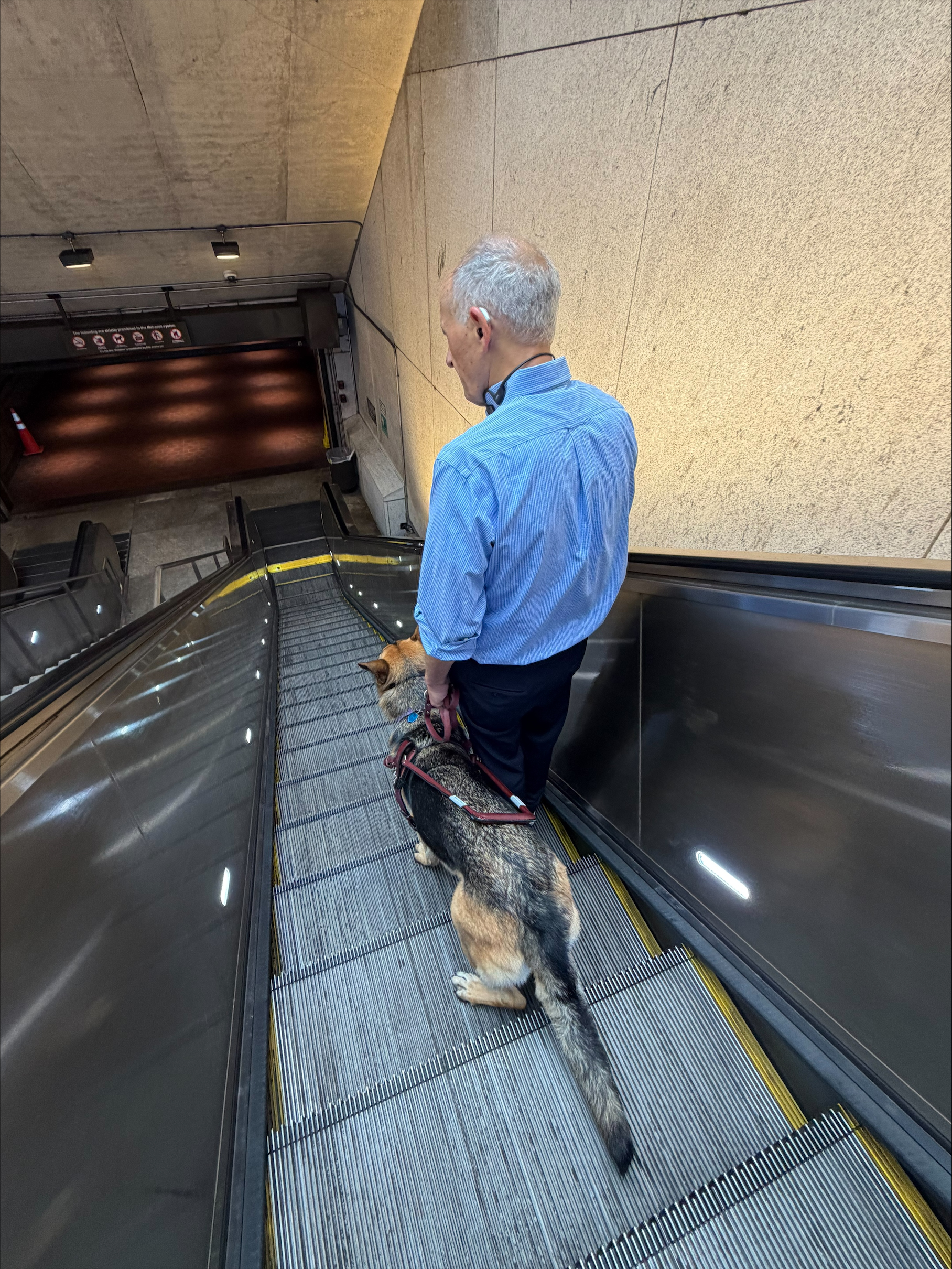
David Tatel and Xyrah learn how to go down a long escalator together to a Metro station in Washington, D.C. (Photo/Tiffany Riggs)
In his 2024 book, “Vision: A Memoir of Blindness and Justice,” he concedes that he had never been much of a dog person, that he saw the two collies his family had when his kids were growing up more as obstacles to trip over.
There was also concern about how it might affect his relationship with Edie. She had been his guide for decades, helping him navigate through their travels around the world. Would she be replaced on their long walks together? A friend told her she would need to get used to “not being top dog anymore.” On top of that, Edie learned that once Vixen arrived, she couldn’t interact with her. Only David could. Only he could bond with the dog so they could start building the connection and deep level of trust that was needed.
“Bringing the dog into the relationship changes things,” said David. “Edie and I over the years developed ways of functioning and getting around. So not only did we have a third ‘person’ in our relationship, but the dog would be doing things she used to do. Our youngest daughter told us, ‘Mom and Dad, you guys should get some counseling because this is going to be complicated.’”
And it was. David remembers his early training with Vixen as one of the hardest things he’s ever done, the times he told Edie that he didn’t think he’d be able to do it. As for Edie, she feared what it would mean to no longer fulfill an essential role in their partnership. How would that work?
In time, the three of them found a new balance, an equilibrium that gave the Tatels more independence. It was, as Edie put it, “Another opening of another door.”
Vixen’s retirement
For seven years, Vixen did her job and did it well. She helped David maneuver through the sidewalks of Washington, and trek along the back roads of Rappahannock. But Vixen was much more than his guide dog. She was, he says, a part of their marriage. When Vixen’s harness was on, she was “a professional,” he noted. When it was off, she was the family dog.
In time, though, Vixen began to slow down. David noticed that she was less enthused about going for walks, and when they went out, she would only pick up the pace when they were headed home. She was more distracted by other dogs. And she also had begun to vary her routes.
“German shepherds get bored,” he said. “She got bored and sometimes she decided ‘I’m not going that way again.’ So we go off a different way. Sometimes it took me a while to figure out where we were.”
Still, he initially resisted the notion of retiring Vixen and replacing her with a younger dog. There was not only the strong bond he and his wife had with her, but he also wondered how he would handle relearning the huge number of commands and situations to address with a new dog. He and Vixen communicated in many subtle ways. “We had all kinds of shortcuts,” he conceded.
Finally, last spring the Tatels and Vixen made the trip to Fidelco’s headquarters to engage in what one of their daughters described as “speed-dating” with young German shepherds. First, David was asked to get on a treadmill so they could get a sense of his walking pace. Then he was introduced to three two-year-olds who had been training since they were puppies – the dogs at Fidelco spend at least 18 months in training before they’re matched with a handler. Ultimately, given the Tatels’ active lifestyle and the disparate demands of guiding a person in the city and the country, a particularly versatile dog made the most sense. A match was made. Xyrah was headed south.
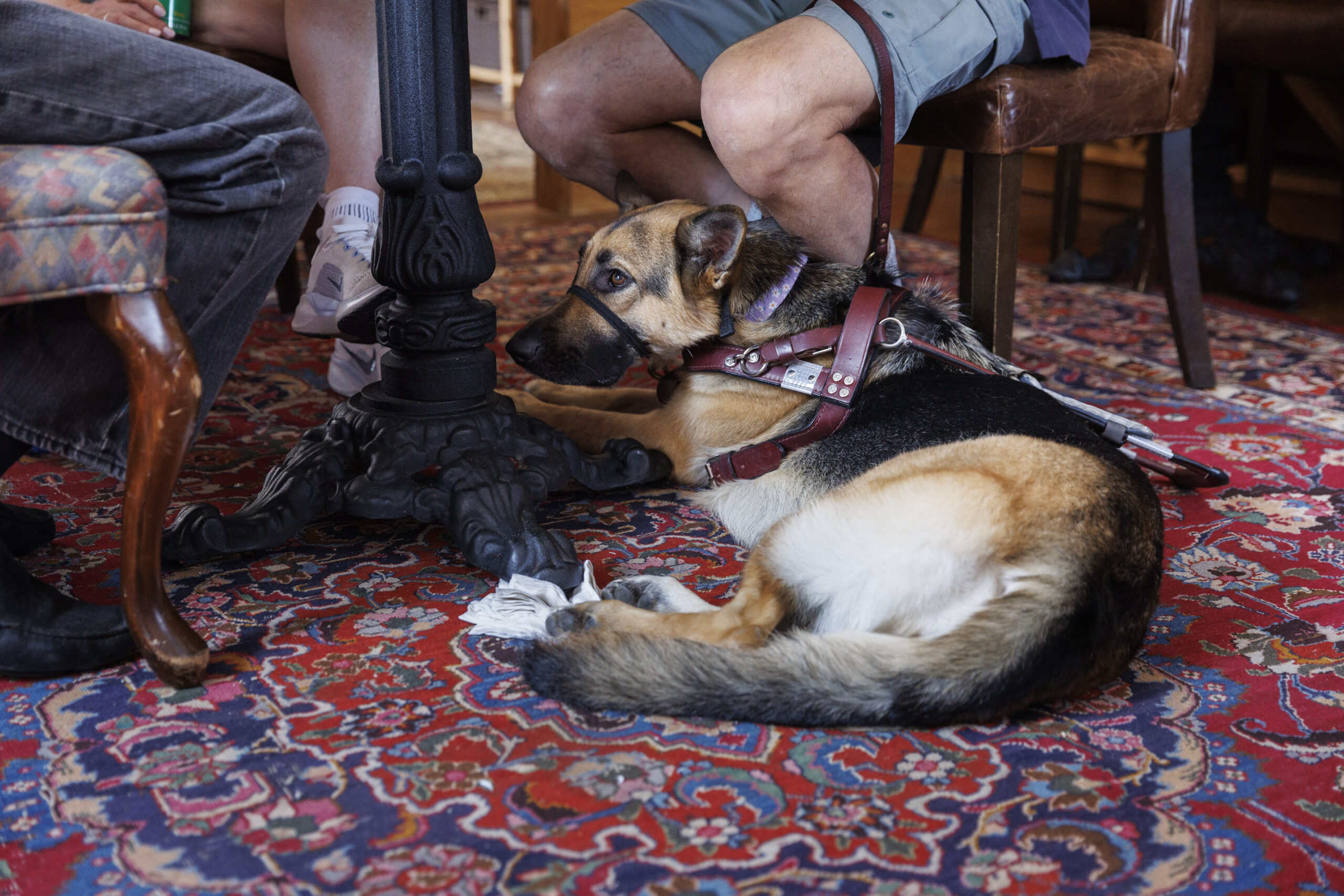
Xyrah, under a table at Before & After cafe in Sperryville, taking it all in during a day of training. (Photo/Luke Christopher)
Changing partners
Xyrah arrived earlier this month, along with Fidelco trainer Tiffany Riggs, who oversaw the city part of the training. (Xyrah’s name is in line with Fidelco’s requirement that all its puppies in one litter have names beginning with the same letter and are no longer than two syllables.) She had already received training on the sidewalks and subways of Boston and New York, so that part of her new job was familiar.
Still, it was a new environment, and there are a lot of other dogs in the Tatels’ city neighborhood. For his part. David had to relearn skills that he had no longer needed with Vixen.
“He didn’t really have to think about those things with Vixen,” said Riggs. “It was seamless because she was almost in robot mode.
“A new guide dog really picks up on the handler’s position for right and left turns, for example,” said Riggs. “So David had to remember that positioning was really important. He had to stop and make sure he was in the proper position before asking her to cross the street or take a right or left turn. With Vixen, it didn’t matter if he was hanging back or too far ahead.”
David quickly noticed the difference. “She reminds me of what Vixen was like when she was two years old,” he said. “She’s a completely different animal. This dog is out front pulling, which is what a guide dog is supposed to do. Not dragging, but always a light tension.”
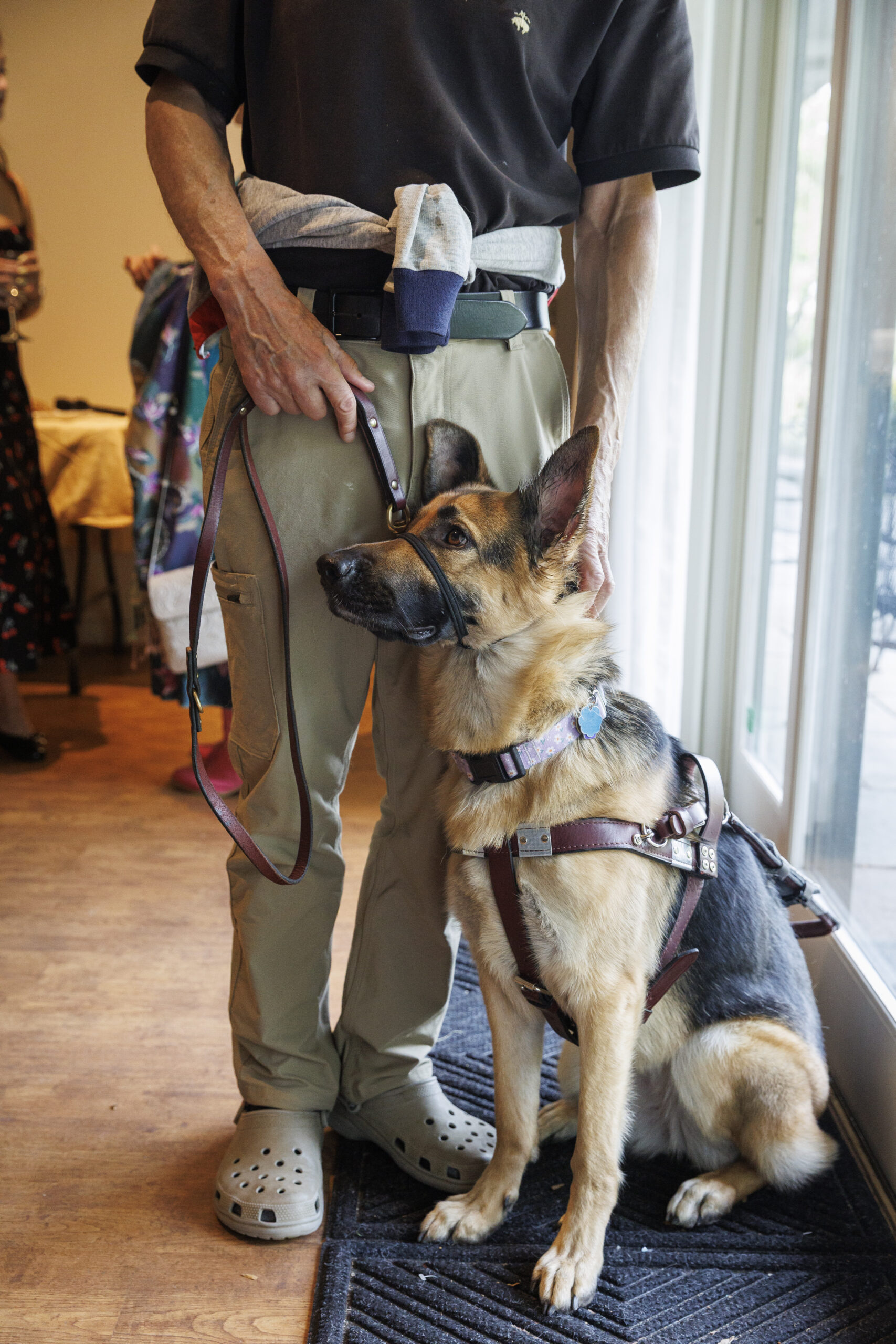
David Tatel with his new guide dog, Xyrah, after a performance at Castleton Theatre House on Aug. 15. (Photo/Luke Christopher)
Moving fluidly together is the first big step, but that means doing everything by the book, said Caley, Xyrah’s country trainer. “Over time, this dog will start reading his mind, too. But for now, he has to put himself in her head,” she said.
One thing that might make the transition go more smoothly is that there’s a genetic connection. Xyrah’s great-great-grandfather is Vixen’s dad.
Speaking of Vixen, she’s staying in the family. She’s spending her retirement living in Charlottesville with the Tatels’ daughter, Stephanie and her husband, Christian McMillen. “She’s very relaxed,” said Stephanie. “I think she was ready for retirement. She seems perfectly content to do a lot less.”
David speaks fondly of a recent reunion he had with his old partner. “I got an extraordinary greeting from Vixen, which was wonderful. I felt great, but I also felt great at the end of the evening.”
He watched his first guide dog trot off happily with his daughter. Vixen didn’t look back.