

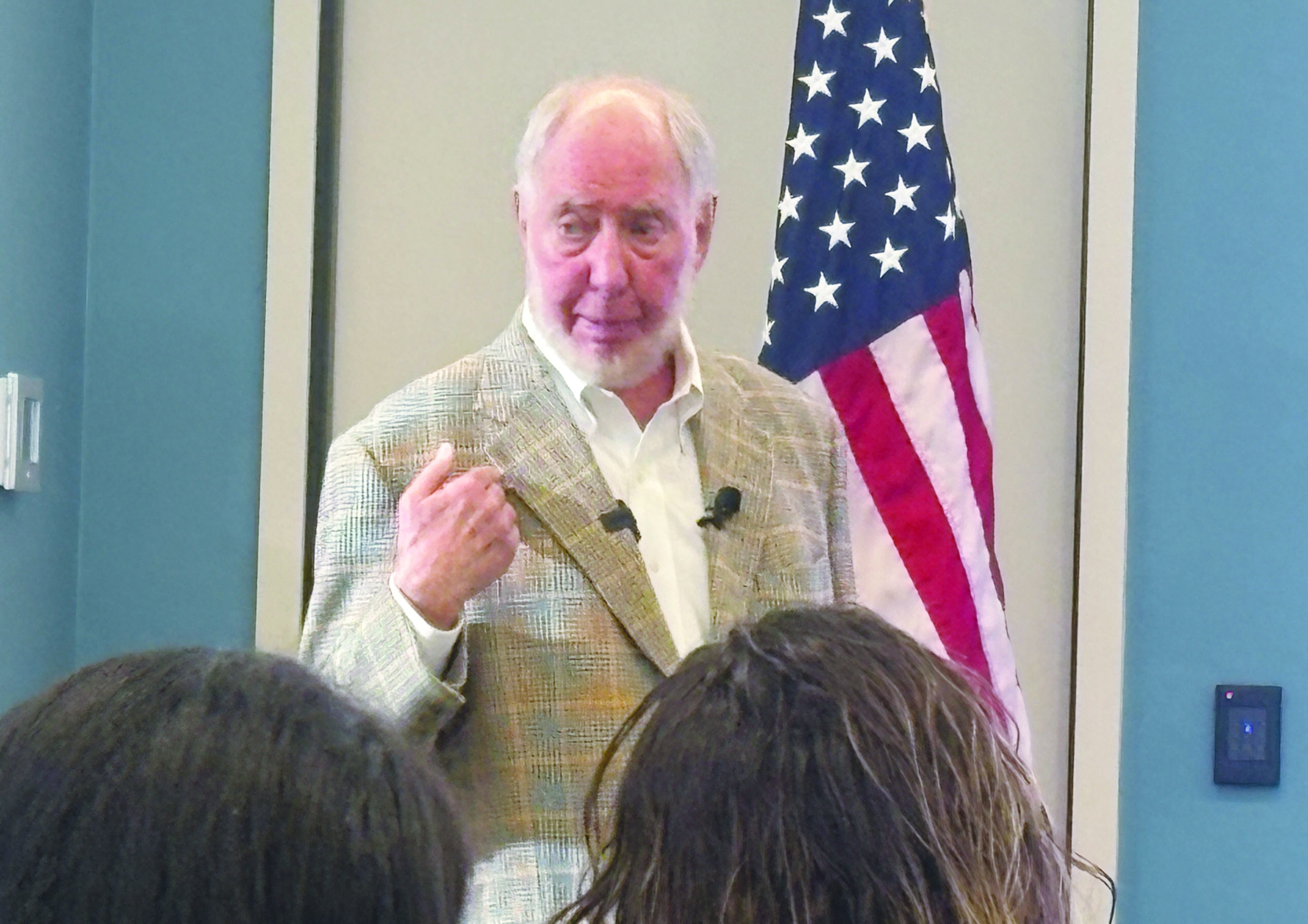
Harvard professor charts a path back together
Robert D. Putnam, a widely quoted prophet of America’s social isolation, economic inequity and political rancor, traveled to the Virginia Piedmont last Friday to talk about “the roots of the malaise we’re in right now and … how we’re going to get out of here.”
The 85-year-old Harvard University professor said that rural Virginians share the social stresses he explored in his 2000 landmark book, “Bowling Alone: The Collapse and Revival of American Community.”
His talk — delivered at the PATH Foundation’s headquarters in Warrenton — called for innovators to “go local,” engage the younger generation and learn from American reformers who responded to similar patterns of social fragmentation a century ago.
The current predicament, Putnam said, blends four interrelated strains:
polarized politics, widening gaps between wealthy and economically struggling Americans, pervasive social isolation and self-centered cultural patterns.
Common ground has become hard to locate, he said, because “we’re very much an “I-society” not a “we place.”
Putnam, who is Peter and Isabel Malkin Professor of Public Policy at Harvard’s John F. Kennedy School of Government, grew up in Port Clinton, Ohio, surrounded by social and civic organizations — including bowling leagues — whose national decline he has chronicled in his lectures and books. From the mid-1960s, he said, “all that joining stopped.”
PATH, which has drawn on Putnam’s social diagnostics before, provides grants and training for nonprofits and community-building initiatives in Rappahannock, Fauquier and Culpeper counties.
Rappahannock’s many nonprofits point to an active organizational life in the county, but polarizing conflicts have regularly erupted over such questions as bike paths, boundary adjustments and more recently, a restructured fire and rescue company and a proposed library relocation.
Drawing on findings over a century ago
Putnam takes a historian’s approach, focusing on decades and centuries more than months and years. In the talk at PATH, he drew on long-arc findings in his 2021 book, “The Upswing: How America Came Together a Century Ago and How We Can Do it Again.”
He argued that today’s political economy mirrors the one depicted in Mark Twain’s “Gilded Age: A Tale of Today” more than 150 years ago. According to Putnam’s “Upswing,” “the top 1 percent in recent years have garnered roughly 20 percent of household income, but nearly 40 percent of household wealth.”
Putnam pointed out that in the first decades of the 20th century — “the first Gilded Age”— New York City was home to crammed tenements and, nearby, opulent mansions. Thousands of rural homes lacked electricity and plumbing.
Various reforms emerged, including one emanating from small Midwestern towns: taxpayer-funded high schools. In “Upswing,” Putnam wrote that in 1910 “fewer than one in every ten young people received a high school degree, but within barely five decades, that mark of educational attainment exploded to nearly seven in ten.”
Putnam said research shows the impact of extending public education through high school: higher rates of economic growth and “a fairer start to kids from the wrong side of the tracks.” He added, “The idea didn’t come from some bureaucrat in Washington; it began in places just like this.”
Americans came together during World War II, and in the next decade Dwight D. Eisenhower governed as “the least partisan president of our lifetimes.” Putnam went on to say that the sense of unity peaked in 1960, after which society “went back to unequal, polarized, socially silo-gated and self-centered.”
Putnam argued that economic opportunities alone would fall short in healing today’s social fault lines. “There are a lot of big gaps right here in the Piedmont,” he said. “There are a lot of poor people here and most of them think that people are sneering at them.” He added: “It’s not the money. It’s the respect.”
The professor’s audience in Warrenton included board members and staffers from a mix of nonprofit organizations, as well as a cohort of college-age interns working at PATH this summer.
Addressing the interns, Putnam asked, “What are the right forms of connection for 2050? You inherit from us an awful state. You didn’t cause this, but if you don’t fix it, it’s not going to get better.”