


Band director composes a life in Rappahannock
Retired Marine Col. John R. Bourgeois’ road from a Bayou boyhood in Louisiana to conducting music for presidents at the White House took a turn into Rappahannock County in 1984, and he decided to stay.
After enjoying a picnic hosted by the conservative columnist James J. Kilpatrick in Woodville, the renowned director of “The President’s Own” United States Marine Band visited a realtor, and ended up buying property off Hunters Road.
“The place was filled with bramble and barbed wire, and whatever plumbing there was had fallen down the hill,” Bourgeois recalled in a recent interview.
Building ‘Metairie’
Undeterred, he renovated and rebuilt the house, naming it Metairie, or “little farm,” in the Bayou French of his youth. In 1990, an electrical fire destroyed the house, and Bourgeois ordered a kit for constructing a log cabin, which he installed on the charred footprint of the previous house.
With Metairie revived, Bourgeois focused on his gift for friendship, his passion for music and his impulse to collect. In 1996, amidst celebratory performances and standing ovations in Washington, D.C., Bourgeois retired from a musical career that spanned nine presidencies, from Dwight D. Eisenhower to Bill Clinton, directing the United States Marine Band for 17 years. Though the Marine Band ties have remained strong, the bandmaster was ready to begin composing his life in Rappahannock.
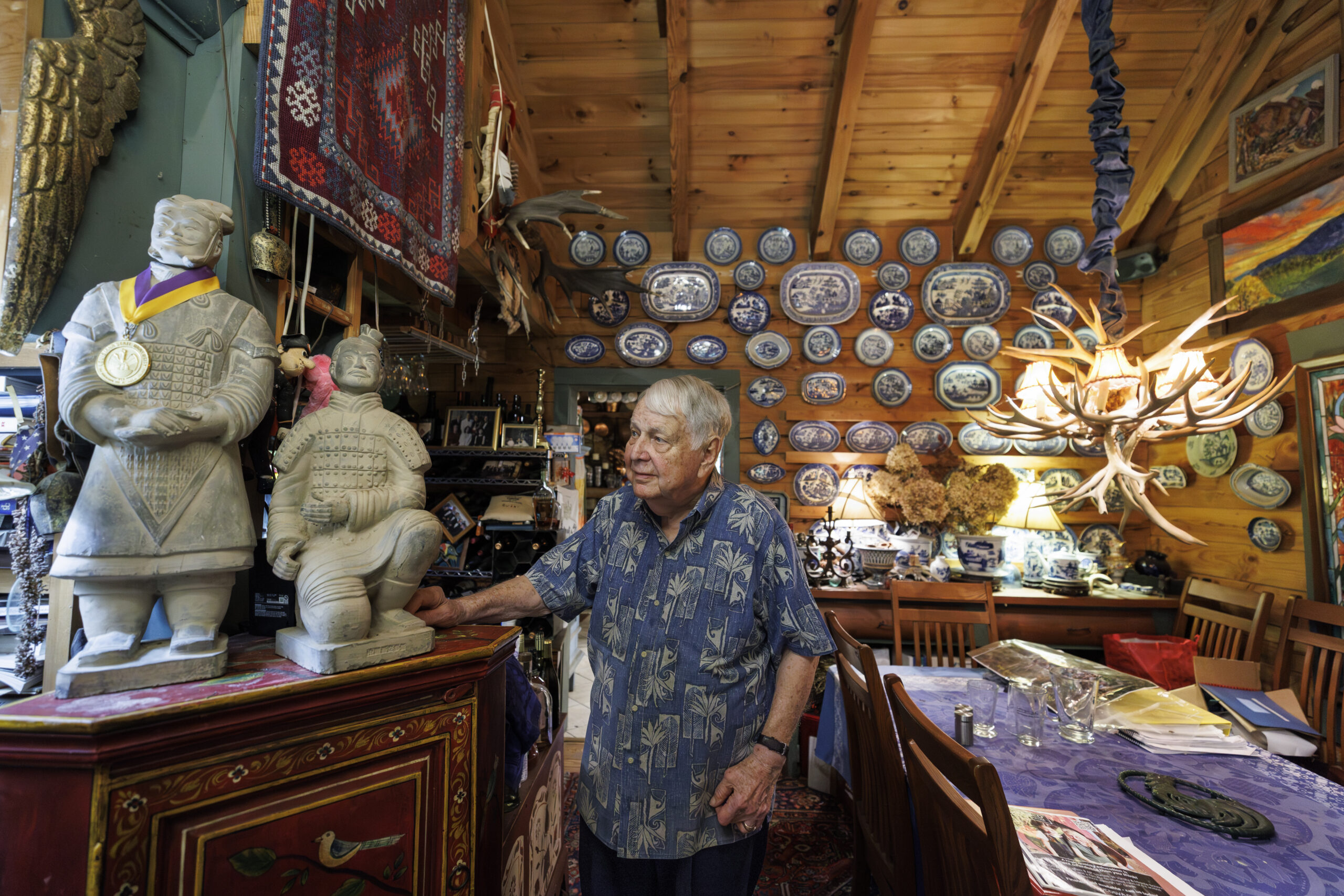
Col. John Bourgeois with replica Terracotta Warriors from Xi’An China. He calls the wall behind him that’s mounted with many porcelain pieces his “Chinese Wall.”
Over 30 years, the log house became a collection of collections, with groups of objects drawn from musical tours, military honors, ancestral geographies and artistic friendships. The porches that surround most of the house are festooned with flags of the United States, England, France, Germany, Canada, Cuba, New Orleans, Virginia, Maryland, the Marines and Acadiana, the official name for the French region of Louisiana that took in the French speakers who were expelled from Canada in the 1700s.
Inside, one wall carries a collection of Blue Willow china, tableware first created in England in the late 18th century; on another hangs a collection of copper cookware evoking a French country kitchen. An outbuilding houses the “Napoleana” collection, with statuary, prints, a pewter miniature of the Napoleonic band and the French emperor’s first console. There is a collection of cowbells and another of cross-stitched rugs of Bourgeois’ own design and masterful workmanship.
The most recent collection is of paintings by Rappahannock artists, including Robin Purnell, Rex Slack, Chris Stephens, Tom Mullany and Ruthie Windsor-Mann, and, in full disclosure, two pictures by this writer.
Beyond the discrete collections, Metairie is home to one-off acquisitions and impulse accumulations, including an Irish harp, two terracotta warriors acquired in China, where Bourgeois traveled on three concert tours, antlers forming a lamp and chandelier and a phone booth replete with a Superman costume.
At one time, Bourgeois conceded, “I was auction-house crazy.” This year, he acquired a set of Turkish tiles he is arranging on his front porch. The house itself has undergone permutations, including a hand-crafted wing liberally ventilated for safe socializing during the COVID pandemic.

Photos of the Colonel from his book “Play On! A Marine’s Musical Journey from the Bayou to the White House” with both Bush presidents and at the Vatican. (Photo/Luke Christopher)
Friendships multiplied
While the house was becoming a three-dimensional collage, the Colonel’s friendships multiplied in similar fashion. The bandmaster functioned as a magnet for weeknight open-table dinners at the former Tula’s in Little Washington, and lunch-bunch gatherings of Rappahannock men. Bourgeois, who is divorced with two adult sons, “was always the extra person you wanted at a dinner party,” said one neighbor.
The bandmaster’s commitments included Rappahannock’s large network of nonprofits. He twice chaired the board of The Child Care & Learning Center. He was president of the Rappahannock Historical Society and served on the board of RappCats. In 2011, he was honored as Grand Marshall of the Christmas parade in Little Washington.
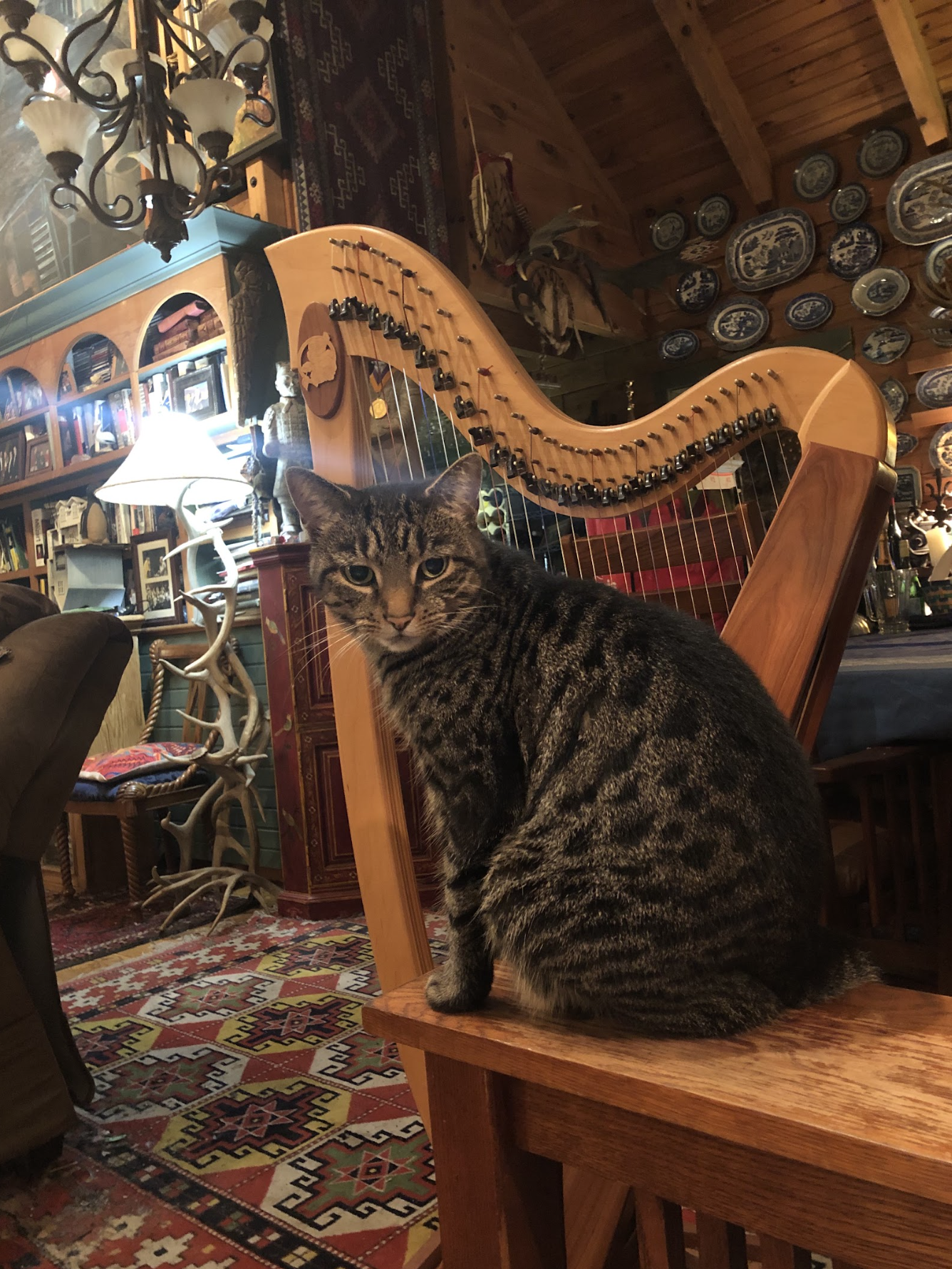
Col. John R. Bourgeois’ rescue cat, Delilah, also a music lover. (Photo/Mary Ann Kuhn)
“He’s a little like the Music Man who comes into a sleepy town and brings everybody together,” said Mary-Sherman Willis, who assisted Bourgeois in composing his 2021 memoir, “ Play On! A Marine’s Musical Journey from the Bayou to the White House.” The comparison to the popular musical breaks down on the fact the lead character, though compelling, is a seasoned con man.
In contrast, many county residents say that while they enjoy Bourgeois’ celebrated musical career and colorful personality, they particularly appreciate his capacity for ordinary kindness.
“He is one of the most thoughtful men I’ve ever known,” said Lynda Webster, adding that he remembers her favorite red wine and brings her a bottle whenever they see one another.
Webster befriended the musician after she and her husband, Judge William H. Webster, became his across-the-road neighbors 24 years ago. Webster, who led both the FBI and the CIA in his Washington life, regularly visited Bourgeois for a glass of wine and conversation about dogs, land and history — never, according to Bourgeois, politics. Webster died last August at 101.
Bourgeois’ effect on other people was evident at the height of his demanding career in Washington, D.C. Upon the band leader’s retirement, Colin Powell, formerly the chairman of the Joint Chiefs of Staff and Secretary of State, wrote to extend congratulations and best wishes, adding this personal observation: “Whenever I saw you, my step lightened, my soul stirred, pride stiffened my spine and I always feel better, ready for anything.”
On the final pages of his memoir, Bourgeois, in the common publishing format, acknowledged friends. What is unusual, is that the acknowledgements include the names of 370 Rappahannock County residents, nodding also to “those who have slipped through the net of my aging recollections.”
Bourgeois’ Rappahannock life has been punctuated with trips to Washington, D.C.for gatherings with the Gridiron and Alfalfa clubs, along with journeys around the country and abroad to conduct performances or attend meetings of music-related societies. In one post-retirement year, he traveled to New York, Las Vegas, Chicago, Colorado and Tennessee.
Having overseen hundreds of performances a year from the White House — some concerts with the full band, others short ceremonial events or recitals with smaller ensembles — Bourgeois enjoys a less pressured calendar. But he has yet to retire from the musician’s life. After stepping back from his White House responsibilities, Bourgeois began editing musical scores where he discovered errors, such as setting a piece in the wrong key or adding a surplus fanfare.
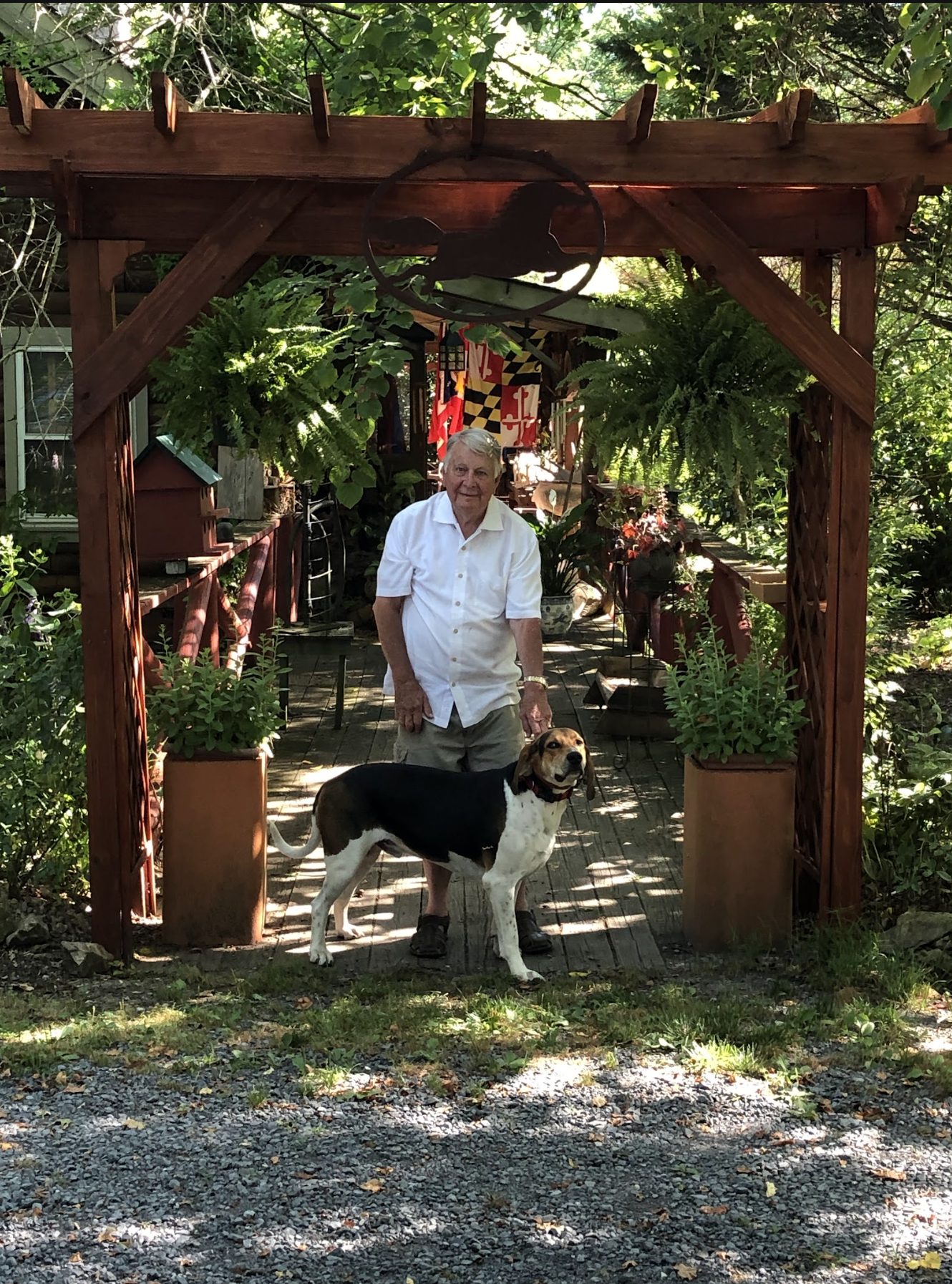
Col. John R. Bourgeois and his dog, Will Full, who he adopted from RAWL several years ago, under an arch the colonel single-handedly built during COVID-19. (Photi/Mary Ann Kuhn)
Working in an outbuilding on his property, he has now edited and published 90-some compositions, one of which is part of the soundtrack of “Mayday,” an action film about a Cold War spy mission gone awry, starring Kenneth Branagh. The movie comes out in September, generating a royalty for Bourgeois.
Bourgeois acknowledged that his collection-packed house and his many commitments could suggest an overcrowded existence. But at a 90th birthday party thrown by close friends two years ago, he made it clear that his experience was one of abundance, not clutter.
As a roomful of guests headed toward a buffet of Cajun food, the bandmaster, resplendent in a brocade dinner jacket, raised his arms and led the crowd in a familiar Doxology: “Praise God from whom all blessings flow. Praise Him, all creatures here below…”
The guests — churchgoers, pagans and atheists — sang along enthusiastically.