

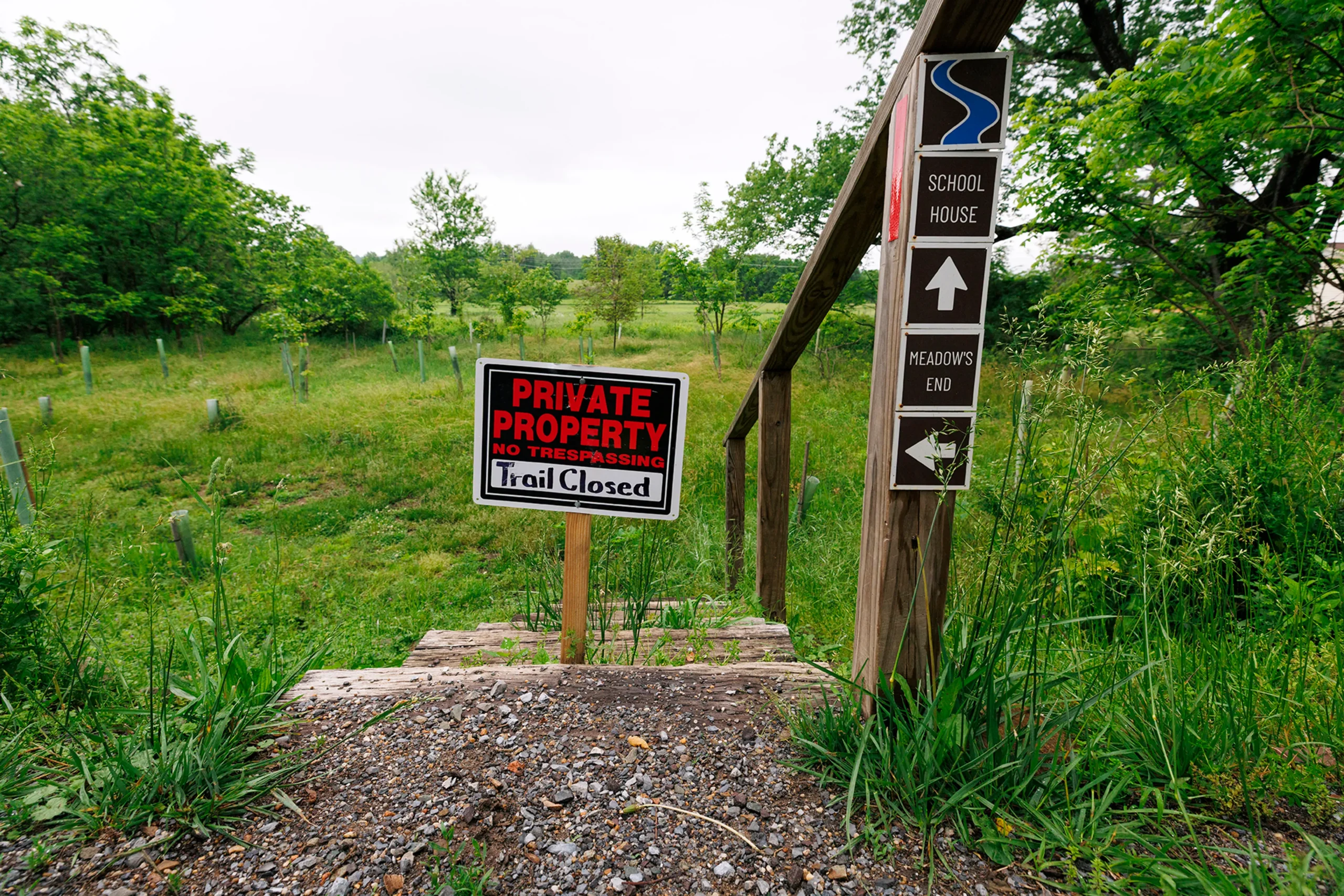
A sign posted at the Water Street entrance to the Sperryville River Trail delivers a stark message: “Private Property. No Trespassing. Trail Closed.”
The closure prompted a somber meeting of the Sperryville Community Alliance, which gathered last week to discuss the future of the group’s signature asset. The 1.5-mile path winds along the Thornton River from the Before & After cafe on Main Street, up to Pen Druid Brewing, and over to the River District and Marketplace. Now about two-thirds of the trail is closed. Walkers can still travel from the segment behind Before & After to the shorter segment behind the Sperryville Schoolhouse.
Kerry Sutten, owner of Before & After and a key architect of the trail, described the mood at the meeting: “We sort of sat there and said, ‘This is sad. What can we do?’”
Later in the discussion, he added, “There was an ember of hope that we can generate something that is as good as what we had.”
Still, no one yet knows how — or if — the community trail can be reconfigured.
The closure reflects a broader generational transition within the Miller family, longtime landowners in Sperryville. Clifford Miller III, 85, a supporter of the Sperryville Community Alliance and its trail, lives primarily in a retirement community in Richmond.
Miller Properties LC, which owns more than 800 acres in and around Sperryville, is managed by his daughter, Laura Miller Meyers of Richmond and his California-based son, Clifford Miller IV, plus first cousins holding a minority interest. With the next generation firmly in control, parcels are being prepared for sale, and longstanding informal arrangements are increasingly uncertain.
Since opening in 2019, the trail has become a popular community gathering place. Volunteers have contributed countless hours maintaining the path, building benches, steps and even a “fairy garden” on a segment that is now closed.
The trail has also hosted events such as a whimsical duck race down the Thornton River during the annual spring SperryFest, as well as more recent exhibitions of “ephemeral art” made from natural materials.
Joanne Jordan, a board member of the Rappahannock League for Environmental Protection (RLEP), regrets the disruption for the Ephemeral Art program, which she helps manage for RLEP.
“There is a loss,” she said in an interview. “We’ve had this shared creative space that belonged to everyone.”
Claire Cassel, on the boards of both RLEP and the Rappahannock Association for Arts and Community (RAAC), helped launch the program in 2022, and made the point that the artists involved valued the chance to find “the perfect place for an ephemeral art installation” (subject to the approval of the owner of the land.)
But despite the trail’s popularity, it always depended on a fragile arrangement. The pathway crossed strips of land owned not only by the Miller family but also by seven smaller property owners who agreed to allow public access.
Sutten praised Cliff Miller III’s generosity in making the riverside segments available, but acknowledged the uncertainty built into the arrangement from the beginning. “It’s private property and they have the right to do what they’re doing,” he said.
Initially, Laura Miller Meyers had expressed concern about the risk of injuries from wayward golf balls hit from a nearby course, which was created by Clifford Miller IV, and is now owned and managed by Curtis and Karen Buxton through an enterprise called Schoolhouse Nine.
The Sperryville Community Alliance offered to install netting to lessen the risks, and Eddie Sutton, president of the Sperryville Community Alliance, uncovered statutes that limit landowners’ liability involving acreage that is made available for public uses. In addition, Sutton proposed new agreements that provided indemnity to landowners in the event of claims.
The Millers moved forward with their plans to withdraw their riverfront land from public use. The other seven property owners are continuing to make their land available.