


By Emily Freehling
A stranger comes to Rappahannock County and starts walking into public offices.
“Can I have a copy of the superintendent’s employment contract?” she asks the receptionist at the Rappahannock County Public Schools administration office.
“I’d like a list of all property owners delinquent on the real estate tax,” she asks the county Treasurer’s Office.
She makes similar requests at every county, town and constitutional office while others on her team seek documents at the Rappahannock-Rapidan Regional Commission in Culpeper and the RSW Regional Jail in Front Royal serving Rappahannock, Shenandoah and Warrenton counties.
These requests for public records were part of a Freedom of Information Act (FOIA) audit that Foothills Forum conducted on Feb. 18 and 19 to test how responsive local offices are to in-person records requests from the public. The results appear during national Sunshine Week March 15-21 which focuses attention on the importance of freedom of information at both the state and federal levels.
While response times are growing for documents requested under federal FOIA and many state FOIA laws, the results of this local audit were encouraging. Responses for the most part were prompt, friendly and complete.
The reporting team’s requests sought records that were indisputably public under state law. This list was compiled in consultation with the Virginia Coalition for Open Government, a 30-year-old nonprofit alliance that promotes expanded access to state and local government records.
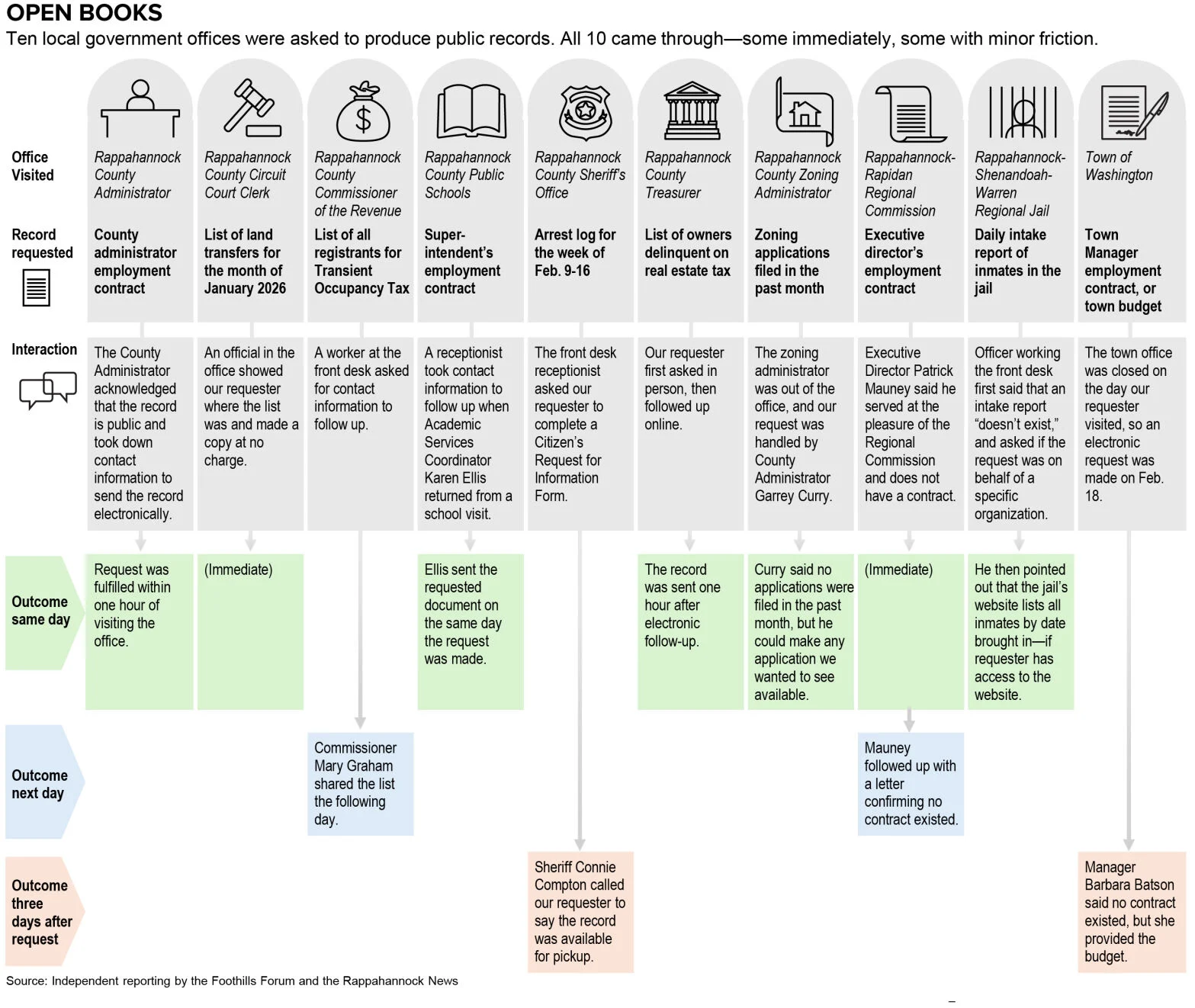
Graphic by Laura Stanton and Emily Freehling
No questions asked
According to Virginia’s FOIA, public officials may ask requesters to provide their name and address since the law explicitly guarantees access to documents to Virginia residents and representatives of Virginia-based media. But officials can’t ask the reason for the request as a condition for releasing documents.
With the exception of the RSW Regional Jail, where staff inquired if a requester was with any particular organization, staffers didn’t ask who the requesters represented or why they wanted the information, which ranged from an arrest log to a list of entities registered for the lodging tax.
At the jail, a staffer initially said the record sought — an intake list of inmates for the previous day — didn’t exist. On the requester’s way out, though, she was told that the information was readily accessible on the jail’s website, a level of openness not all Virginia jails provide.

Garrey Curry, county administrator and the county’s FOIA officer. Curry said that in a small locality without an IT department, he is often the one searching to fulfill records requests, a process that can become time consuming and costly depending on how broad the request is. (File photo/Luke Christopher)
A request is a request
State law requires requesters to identify the records they seek “with reasonable specificity.” But citizens don’t need to use a government form or submit the request in writing for the request to be subject to the legally mandated time limits for a response and other provisions of the law.
Some local agencies did ask requesters to complete a form to aid in tracking the request. For example, the Rappahannock County Sheriff’s Office asked a requester to fill out a “Citizen’s Request for Information” form, which a staffer then time-stamped for tracking.
But most agencies simply asked for contact information to follow up. In fact, Rappahannock County Administrator Garrey Curry simply pulled out a piece of scrap paper to write down the requester’s name and e-mail address, adding, “I don’t need you to fill out a form for this to be a records request.” He followed up with the requested record within an hour.
While some agencies fulfilled requests on the spot, others took up to three business days, well within the five working days the law allows in most cases.
Engagement promotes openness
In an interview after the audit ended, Curry noted that county residents are not shy about exercising their rights under state open records laws — and that helps promote a more open government.
“We do have a very involved citizenry,” he said. “They are engaged probably more than the average community, which is good.”
Page Glennie is among those involved citizens. Glennie, who has served on multiple county volunteer boards, follows his local government closely and regularly makes use of FOIA to gain a deeper understanding of various proposals.
During last year’s local budget process, he said, he requested the names, job titles and compensation of all employees of both Rappahannock County and the Rappahannock County Public Schools.
Glennie said he recalls paying around $200 to have the request fulfilled. He fears big bills for open records requests can amount to an “intimidation tactic” by governments. “For the average citizen who just has curiosity, that is going to stop them immediately,” he said.

Page Glennie with his two dogs at his home in Amissville. Glennie regularly submits public records requests, and said the more people pay attention and ask questions, the more government offices will develop the habit of openness. (Photo/Ireland Hayes)
Legislation to limit how much state and local offices can charge, which Sen. Danica Roem, D-Manassas, has introduced in several General Assembly sessions, passed the Senate in February, but a House subcommittee tabled the measure.
State law allows a government office to bill for “reasonable charges not to exceed its actual cost incurred” to fulfill records requests. Rappahannock County details its cost schedule in a FOIA rights and responsibilities document on its website.
Copies are five cents a page, but anything under $1 is free. Officials can charge the actual direct labor rate of the person doing such work as copying, searching, retrieving and otherwise working to fulfill requests. Sometimes that means the county administrator’s rate. “With us being small, we don’t have an [information technology] department. I am the person who has sole access to the email archive, and when we need to search it, I do it, so I charge my direct labor rate,” which is $101.56 an hour, Curry said.
The broader a request is, the more time it takes to search the email archive for records that match the request, Curry said. For that reason, he encourages residents to be as specific as possible — even including specific words to search — about the documents they seek.
The county has taken steps to limit the need to charge for requests or the possibility that processing records requests could interfere with other needed work. Curry said his staff has pushed to make many commonly requested records available on the county’s website. For example, the county created a webpage for vendor payment information. Visitors can download a spreadsheet listing county payments for things like office supplies, fuel and professional services. The county updates the spreadsheet monthly.
Recently, Curry said, citizen interest in zoning applications prompted the county to build a web page to give the public access to information about zoning applications that require public hearings. In the past, the public wouldn’t have had access to the information until the posting of the meeting agenda the week before the hearing.
This page also gives an updated status of where the application stands with both the Planning Commission and Board of Supervisors and lists newly submitted applications the county is processing.
Curry said these resources supplement the full meeting agendas and memos the county posts through the BoardDocs section of its website. They help keep information flowing to the public without overburdening the county’s small staff.
What’s clear is that citizens want to know about the workings of their local government. As Glennie said, the more people pay attention and ask questions, the more government offices will develop the habit of openness.