

Flock cameras stay, privacy worries persist
Rappahannock’s three Flock Safety cameras will continue to record the movement of cars as they traverse county roads, and notwithstanding widespread public unease, a fourth will soon be installed.
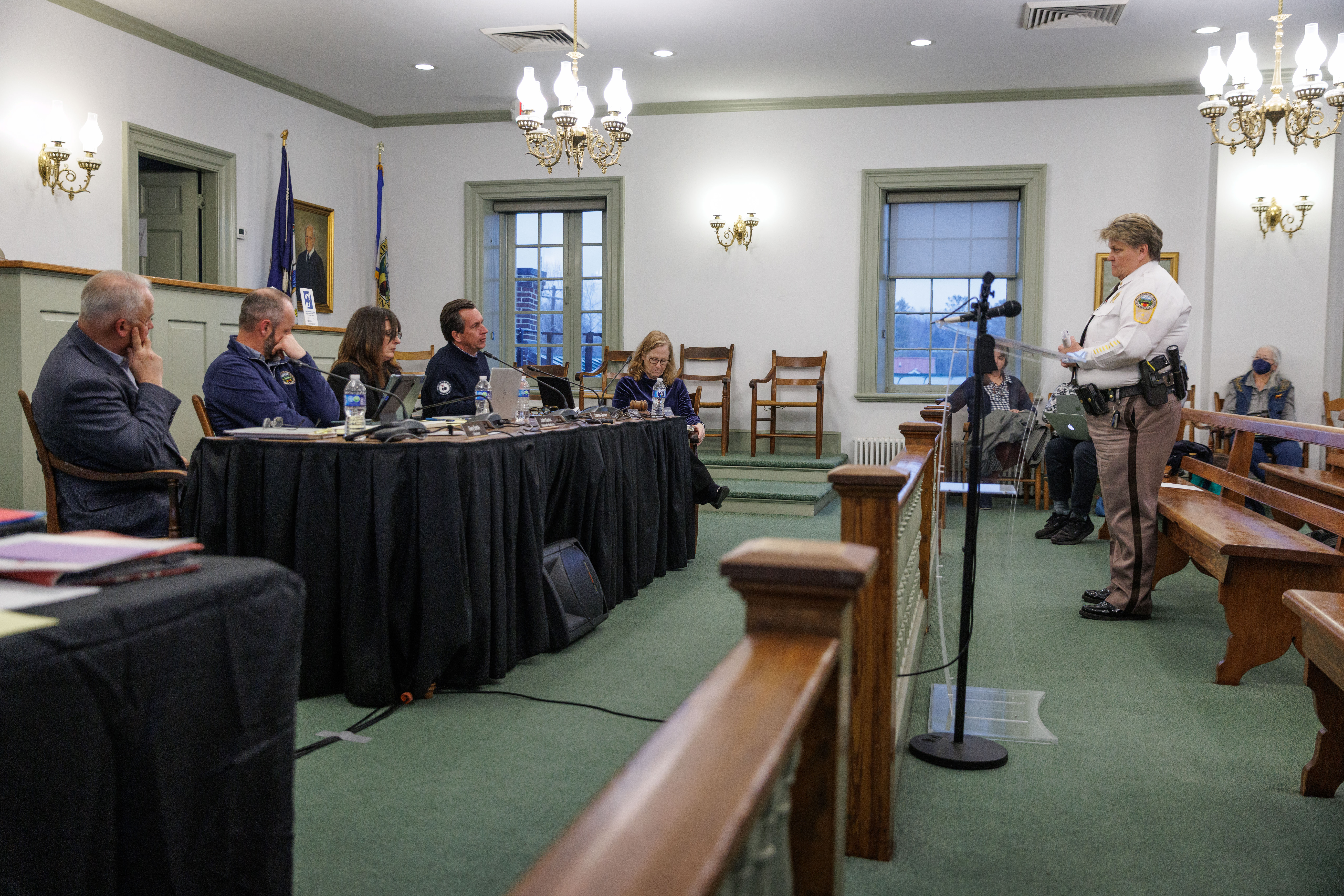
As a Board of Supervisors’ meeting unfolded Monday afternoon in the Town of Washington’s historic courthouse, the county’s five elected supervisors edged their way to unanimous acceptance of surveillance technology many citizens dislike or actively oppose.
Citizens and supervisors spoke about the risks and benefits of cameras that capture the license plates of every passing car.
Sheriff Connie Compton, who stood at the back of the courtroom for most of the session, eventually took the floor, defending surveillance tools she believes are crucial to tracking people capable of — or guilty of — serious crimes such as child abduction or homicide.
“We could have an abduction,” the sheriff said. “I hope we never have any, but if we do, I hope we have those cameras.”
Hampton Supervisor Keir Whitson was on record opposing the surveillance cameras, which were quietly installed last year without public discussion or conversation among the supervisors.
However, Whitson began Monday’s discussion by speaking about his respect and affection for Compton, briefly overcome by emotion. When he was recovering in Milwaukee from a catastrophic heart attack and cardiac arrest four years ago, he said, “the sheriff and her deputies looked after my house.”
“I love the sheriff. I love her deputies,” Whitson said, adding he also was “full of gratitude for the citizens who are impassioned members of our community.”
He later told the meeting: “I can’t say that every citizen I’ve talked to is against them, but most are.”
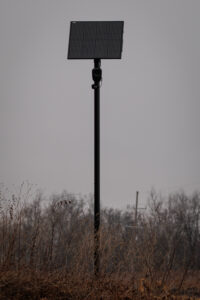
A Flock Safety camera located in Huntly. (Photo/Luke Christopher)
Citizen opposition to cameras
During the times set aside for public comments, both in the afternoon and at a subsequent evening session, eight citizens commented on the surveillance systems, all in opposition.
Whitson also underscored a crucial legal detail: As a “constitutional officer” of the state, the sheriff isn’t generally subject to overriding actions by the Board of Supervisors.
“You’re elected, I’m elected,” he said, “but you’re a constitutional officer and I’m not. I can’t command you to do anything.”
The supervisors do shape and reshape the county budget, but the surveillance cameras are funded by a state grant under a long-established program designed to curtail car theft.
Whitson did invite the sheriff to “pause” the program voluntarily to give the public a chance to voice concerns about the feared loss of privacy as information about their movements gathers in a vast data bank that is at least partly controlled by Flock Safety, a privately held company based in Atlanta that has all but blanketed much of the U.S. with automated license-reading cameras. Compton firmly rejected the suggestion.
But Compton acknowledged a mistake. “It was an oversight on my part not putting it out prior to erecting those (cameras). There’s no excuse,” she said. “Not notifying citizens — that’s wholly on me.” The statement only solidified her successful defense of the surveillance tool others were hoping to shut down.
Becky Burr, a county resident and lawyer specializing in privacy concerns, and one of the commenters to sound alarms about the Flock cameras, said, “To her credit, she did own the lack of notice and consultation.”
For his part, Whitson said later, “It was quite extraordinary to hear her apology to everyone.”
Supervisors weigh in
Stonewall-Hawthorne Supervisor John Genho suggested the formulation of a Rappahannock policy for surveillance cameras, chiefly as a mechanism to provide the public an occasion to voice any concerns. Because the resulting policy would carry no clear authority, the idea quickly collapsed.
Piedmont Supervisor Gary Settle, formerly the superintendent of the Virginia State Police, stated: “I think the sheriff is in the best position to educate the public on this.” Addressing the public unease with surveillance cameras connected to data bases, he noted, “This is the world we live in.” But he mainly pointed to situations, such as a dangerous criminal abducting a juvenile, adding, “We would say, ‘thank God a camera got the license plate.’”
Consistent with Settle’s point about “the world we live in,” Compton noted last week that beyond the borders of Rappahannock, there are 57 Flock cameras lining the roads of neighboring counties.
Wakefield Supervisor and Chair Debbie Donehey said the surveillance program is “about the good of the citizens,” adding that “the rollout could have been smoother.”
Worries persist about how Flock Safety manages and protects the waves of information that flow in from the cameras. Near the conclusion of the discussion, Donehey said, “The issue is the data.”
Burr, the lawyer specializing in privacy questions, said in an interview, “It’s important to consider the power of big data, especially when it is combined with artificial intelligence, which is sometimes right and sometimes wrong.”
Flock itself is a privately held company, whose executives haven’t responded to requests for additional information about the company’s policies and business models. The stated Flock policy is to purge the data gathered by the cameras after 21 days.
“When you say that that’s purged, what does that mean?” asked Donehey. Others say they wonder if the data might still exist in the online data “cloud.”
A number of observers knowledgeable about database management point out that 21 days provides ample time to mix the data with other information, or add value to it by engaging artificial intelligence.