

Sheriff: License readers help catch criminals
Concerns: Some residents, supervisor worry about data collection
Across the United States, tens of thousands of cameras line roads and highways, sometimes hidden, forming an unprecedented license plate surveillance system that hums day and night, capturing images of traveling vehicles whose drivers seldom know they’re being watched.
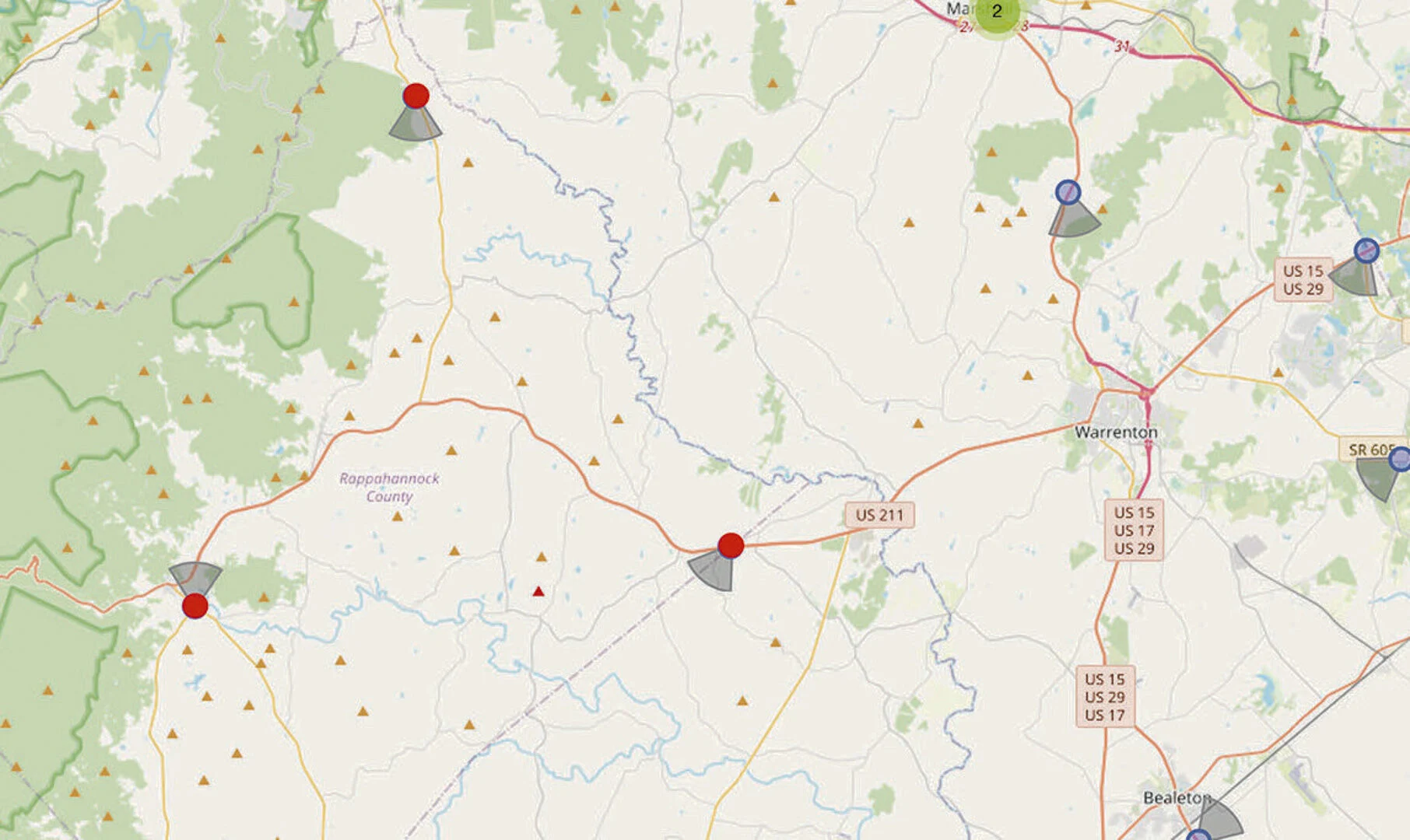
Last year, Rappahannock County quietly became part of this sprawling network, which is managed by Flock Safety, a privately held Atlanta-based company, without Rappahannock’s Board of Supervisors’ (BOS) consideration, or any form of public hearings.
The images from the cameras get packed into data tanks, where artificial intelligence amps up their value by mixing them with other pieces of information including images from other roadside cameras.
Sheriff Connie Compton praised the Flock cameras for helping solve law enforcement challenges. “They have assisted us with lost and endangered individuals as late as last night,” she said Tuesday. “Last week we had an incident where a child was almost struck getting on a school bus. We only got a partial tag and entered it into the Flock system, and it gave us the exact car we were looking for.”
As for leaks to other agencies, Compton said, “For another agency to use the information, they have to put in a case number and a reason as to why they are accessing our cameras.” She said Rappahannock hasn’t provided data to federal immigration enforcement agencies.
Robert B. Lehmann, a former law enforcement officer and now a professor in criminal law at Virginia Commonwealth University in Richmond, said his analysis of the Flock camera network shows that information gathered in one locality often travels far afield — including to other local law enforcement agencies or federal agencies, including those leading the immigration crackdown. He added that this may have occurred when local agencies provided permission.
Lehmann also pointed out that “in our society we hear about data leaks from a bank or a health care company or a country.” He asked, “How are we going to be able to protect from the negatives?”
Privacy concerns and general skittishness about mass surveillance without clear guardrails last year prompted the city of Staunton, Va. to cancel an existing Flock Safety arrangement. Out of similar concerns, the Warrenton Town Council voted to end the police department’s discussion about entering a contract with Flock. But these cancellations are the exceptions, with Flock cameras sprouting up elsewhere in Fauquier County, in Front Royal and Culpeper.
‘I just don’t want them in our county’
Some Rappahannock citizens now are sounding alarms — and getting traction.
“I don’t like these cameras,” said BOS vice chair and Hampton supervisor Keir Whitson in a recent interview. “I don’t like the idea of them. I just don’t want them in our county.”
He has heard from his constituents on opposite sides of the broader political divide, and found they were equally queasy about the magnitude of Flock’s information intake.
Whitson, who said he discussed his concerns with Sheriff Connie Compton, emphasized that while he strongly supports the sheriff and her law enforcement mission, he is deeply apprehensive about mass surveillance cameras in Rappahannock.
Cameras that ‘never sleep’
“To solve and eliminate crime — you need evidence,” Flock’s website proclaims. “Protect your community, business or school 24/7 with coverage that never sleeps.”
Unmentioned is a critical detail: A surveillance system that “never sleeps” snares criminals only after recording the movements of nearly everyone else in the vicinity. And by essentially knowing everything about everyone, the technology cultivates unease.
“I was raised in this area, and the Piedmont is my home,” said Drew Smith, who lives with his family near the Town of Washington. “I’ve always had a sense of freedom moving around these parts.”
He went on to say that the Flock cameras have “stolen that freedom,” while they “have the ability to track and monitor all of our daily movements in and out of the county.” He added that he is concerned that the Flock live feeds and data bases “are potentially accessible to either hackers, or law enforcement without probable cause.”
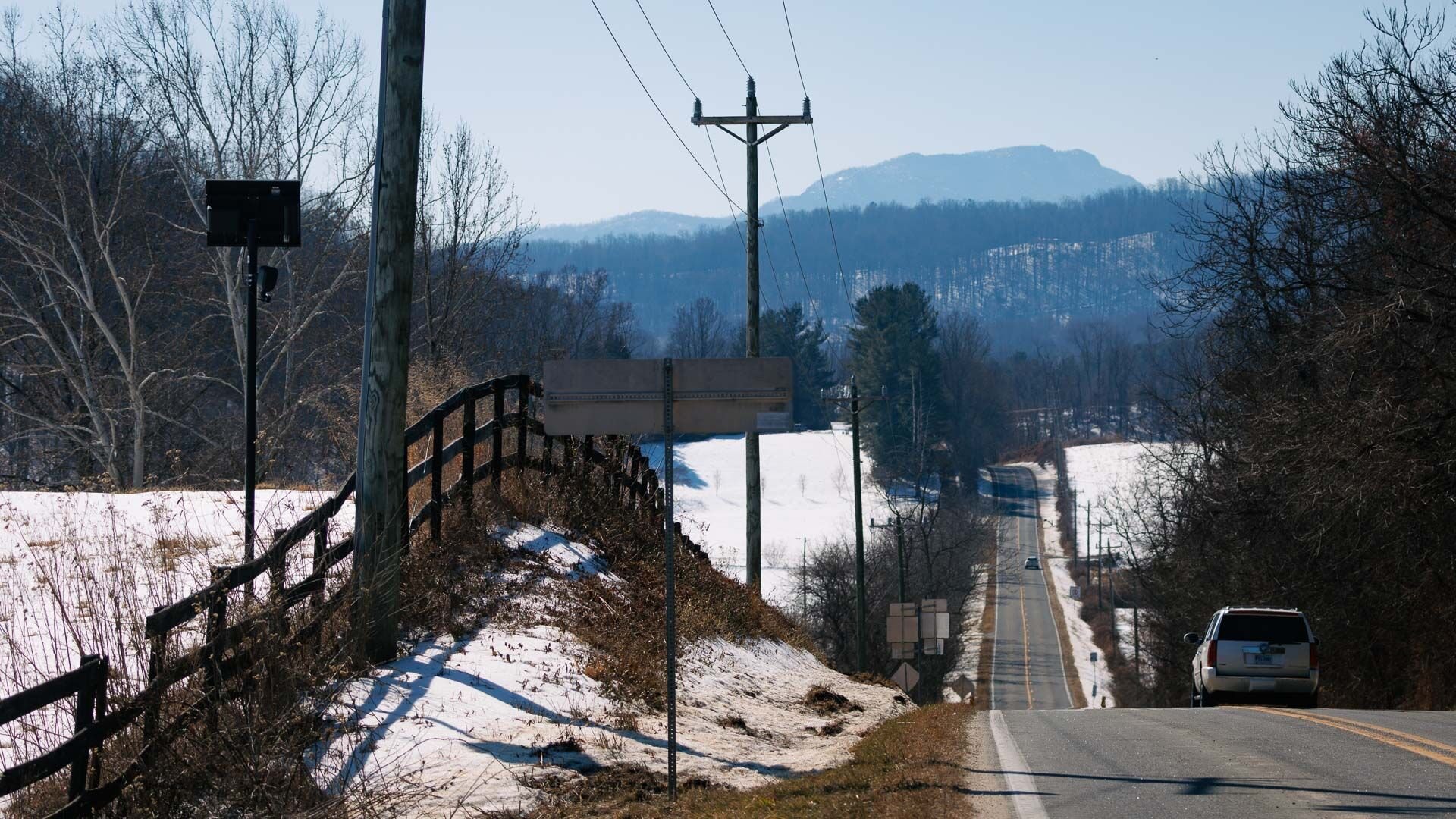
Late last summer, Rebecca Beardsley and her partner Kris Forrest were surprised to see a Flock camera perched directly across the road from their home at the edge of Sperryville. The camera continuously records the licenses of traveling vehicles, but in the background, within the sightline of the camera, stands the couple’s house and driveway.
“We don’t consent to photos being taken of our kids, photos which are accessible,” said Beardsley.
Beardsley and Forrest are former CIA officers, and both are currently engaged in private sector work that involves intelligence analysis. Beardsley also works part time for Foothills Forum, a nonprofit that works in partnership with the Rappahannock News, and has nothing to do with intelligence gathering or national security.
After the couple got in touch, Sheriff Compton visited their home with a deputy and listened to their concerns. However, the couple has heard nothing further from the Sheriff’s Office, and the Flock camera “that never sleeps” continues to hum across the road.
Flock cameras resemble those used to catch drivers exceeding the speed limit or running a stop sign, but they function differently. The cameras used in driving infractions have a narrow purpose — detecting a violation, then issuing a ticket — all under the full control of the local law enforcement agency that put them in place.
Flock and other companies marketing automated license plate readers “are data brokers,” said Benn Jordan, a passionate critic of mass surveillance who has launched a YouTube campaign opposing the national network of Flock cameras.
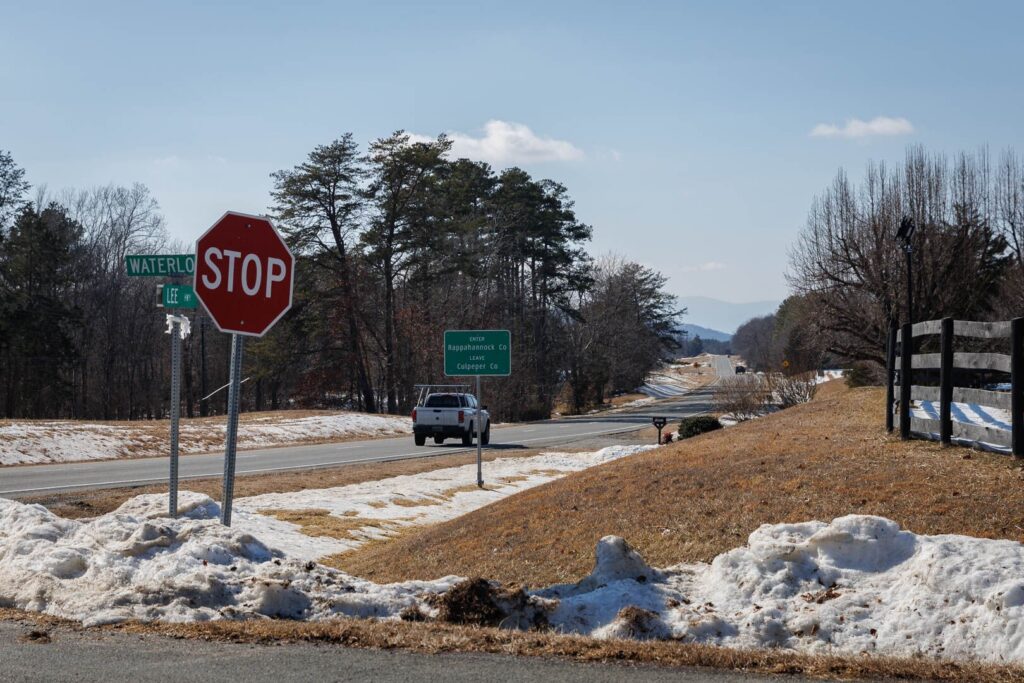
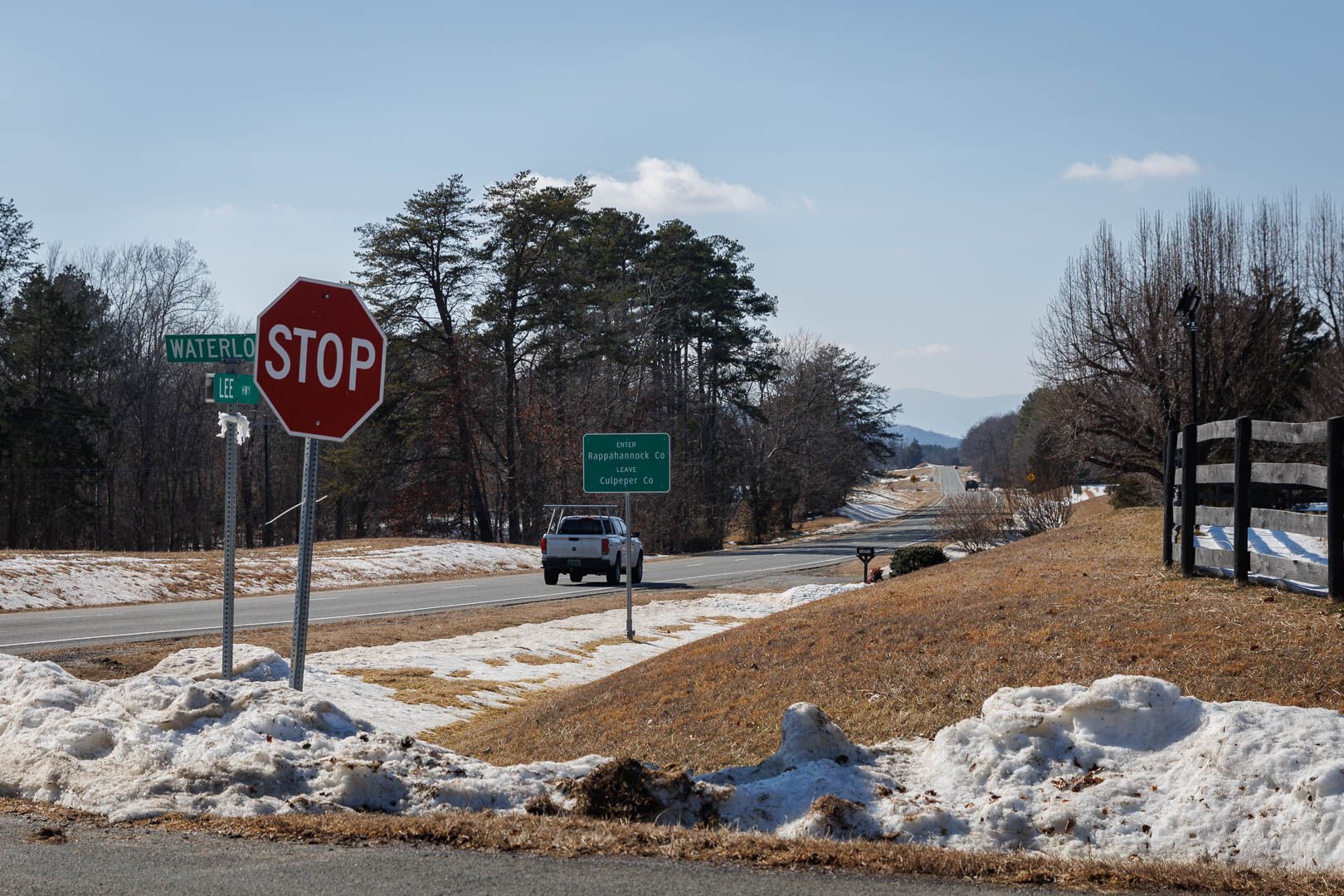
The intersection of Route 211 and Waterloo Road as you enter Rappahannock County driving west. (Photo/Luke Christopher)
Sleepy Bridgewater’s experience
The Virginia Center for Investigative Journalism last September released a story about Flock cameras in the slow-moving Shenandoah Valley town of Bridgewater, with a population of 6,600 and a crime record well below the national average.
According to the report, five strategically placed Flock cameras in the town pulled in images of more than 60,000 traveling vehicles every month. More striking is the second finding on Bridgewater’s experience: Law enforcement agencies across the country accessed Bridgewater’s data 6.9 million times over 12 months, presumably for their own investigative and enforcement pursuits. The study found that among these nearly 7 million hits were 500,000 queries coursing in from Houston — for reasons that weren’t explained.
The study found that between June 2024 and June 2025, law enforcement agencies in Houston accessed Bridgewater data more than 500,000 times, for reasons that weren’t explained. It is likely that these searches involved many other localities.
ICE and Border Patrol
With immigration crackdowns unfolding across the United States, there are concerns about how agencies of the Department of Homeland Security might use the data banks fed by the Flock cameras. Flock Safety has issued public statements that it doesn’t provide direct access to U.S. Immigration and Customs Enforcement (ICE) or other Department of Homeland Security agencies such as Border Patrol.
But local law enforcement agencies can share Flock data with these agencies, and some apparently do so. Audits show that in Illinois and other states thousands of data searches were linked to brief explanations of “immigration” and “ICE.” After some of these findings surfaced last year, Flock said it would “pause” ongoing cooperative pilot programs it was carrying out with Border Patrol and Homeland Security Investigations, another arm of the department. The company didn’t explain what the pilot programs were or how they might evolve if they are resuscitated.
Flock CEO warns of ‘coordinated attack’
When the Staunton police last year were edging toward pulling out of a contract with Flock, Garrett Langley, Flock Safety’s founder and chief executive officer, fired off an email to the Staunton police chief stating: “Flock and the law enforcement agencies we work with are under coordinated attack…We’ve been dealing with this since our founding from the same activist groups who want to defund the police, weaken public safety and normalize lawlessness.”
Beyond the local and national debates about mass camera surveillance, it’s clear that databases are central in these times of conflict and confrontation. The New York Times this week circulated a video showing an ICE agent facing down an angry protester, telling her, “We have a nice little database, and now you’re considered a terrorist.”
After the video appeared, a Department of Homeland Security spokeswoman denied such a database exists. News reporting has detailed how federal authorities appear to use technology to track protestors.