

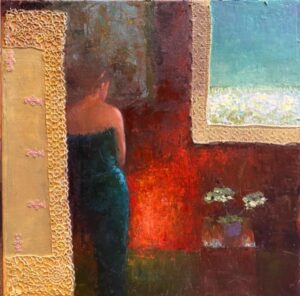
Kathy Stewart’s exhibit features figure studies in pastel with mixed media compositions using lace. (Photo/Courtesy)
Kathy Waller Stewart, currently the featured artist at the Middle Street Gallery, followed a road to art that ran through years of medical training, parenthood, a career as an oncologist, then, after early retirement, a rigorous four-year immersion at the Studio Incamminati art school in Philadelphia.
She now paints in a hilltop studio her adult son built for her off Tiger Valley Road. Five years ago, she decided to take up residence in Rappahannock, having noticed the county’s beauty on trips to Charlottesville, and learned of its reputation as a place friendly to the arts. At the time, she knew no one in the county.
Stewart’s work as physician and artist offers a quiet testament to the fact that lives are composed of both reinventions and continuities. Her figurative paintings, drawn with the skills she developed in Philadelphia, were strongly influenced by her many encounters with individuals facing the sobering realities of cancer and its often debilitating treatments.
Discussing her life in medicine and at the easel, Stewart, who is 69, makes it clear that the turn from oncologist to artist was neither a clear break, nor the result of exhaustion or dissatisfaction. “I can’t think of a day I got up and didn’t want to go to work,” Stewart says of the 23 years of treating cancer patients with Shenandoah Oncology Associates in Winchester.
Emphasis on human connection
Stewart understands the threatening intricacies of cancer, but her focus — and her passion — rests squarely with the patients. “The most important thing to me being a physician was my relationship with the patients,” she says. “I was privileged to be a part of their lives in such an important moment.”
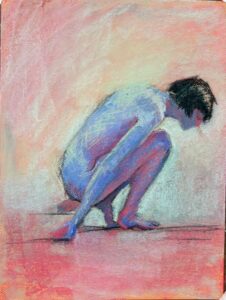
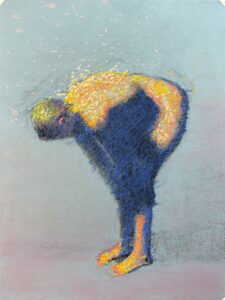
The same relational emphasis is evident in Stewart’s art. In the way Stewart the oncologist sought to honor the reality of each of her patients, Stewart the artist locates the dignity of the models who come to her studio to pose, naked and unadorned, sharing both their vulnerability and their strength.
Her current show at the gallery in the Town of Washington, titled “Pastels and Lace,” runs through Jan. 18. The pastels evolve from sessions with the models. And in an experiment with untraditional materials, there are still-life and figurative compositions in which antique lace donated by a 96-year-old acquaintance, is fixed to the canvas and painted — a mixed-media innovation for Stewart.
Patients, even when they are supported by doctors, friends and families, must individually
come to terms with diagnoses, and in this same way, the figures in Stewart’s pictures are mostly solitary, as though occupying their various circumstances on their own. The figures don’t appear bereft, however, projecting instead both dynamism and individuality.
Each picture reveals something of the model and something of Stewart’s own reaction to her subject, recalling the slow coalescing of a relationship between physician and patient.
Stewart’s training at the Studio Incamminati was entirely focused on the human form. Students work for months drawing from the model to master the anatomy and physical proportions before delving into paint and color. The school states that its goal is to provide a “comprehensive foundation in realist painting, drawing upon deep Humanist values.” The curriculum mixes the methodologies of both the Italian art academia, with strong emphasis on depicting the human form, and the French atelier, influenced by the later Impressionist emphasis on color and light.
Since moving to Rappahannock, Stewart says she has focused considerable time on landscapes, still-life paintings and interiors, genres she didn’t pursue in Philadelphia. And to expand her range further, she takes two painting excursions each year to the American West, where shapes, light effects and colors differ markedly from those found in the Virginia Piedmont.
There are still occasions to relate to people facing medical challenges. Soon after moving to the county, Stewart became a member of the Sperryville Volunteer Rescue Squad where she is an Advanced EMT and Education Coordinator. After a career of detailed diagnostic and treatment assessments, she finds that responding to trauma and emergency presents a fresh experience. And when a fellow volunteer was undergoing cancer treatments, he said he found a sympathetic and knowledgeable sounding board in the oncologist-turned-artist.
The work of healing and painting are necessarily communal. While composing a painting, Stewart experiences a mysterious connection with the unknown collectors who might later purchase and live with her work, along with others who will simply look on it with passing appreciation.
“It doesn’t have to be someone who buys it,” she says. “It’s a community.” Even while spending much of every day alone in her studio, Stewart seems enlivened by connections. She is perhaps finding new ways to recapture the experience of talking with a cancer patient, “privileged to be a part of their life in such an important moment.”
Middle Street Gallery, located at 311 Gay St. in Little Washington, is open 11 a.m. -5 p.m. Friday through Sunday. Kathy Stewart’s show runs through Jan. 18.