

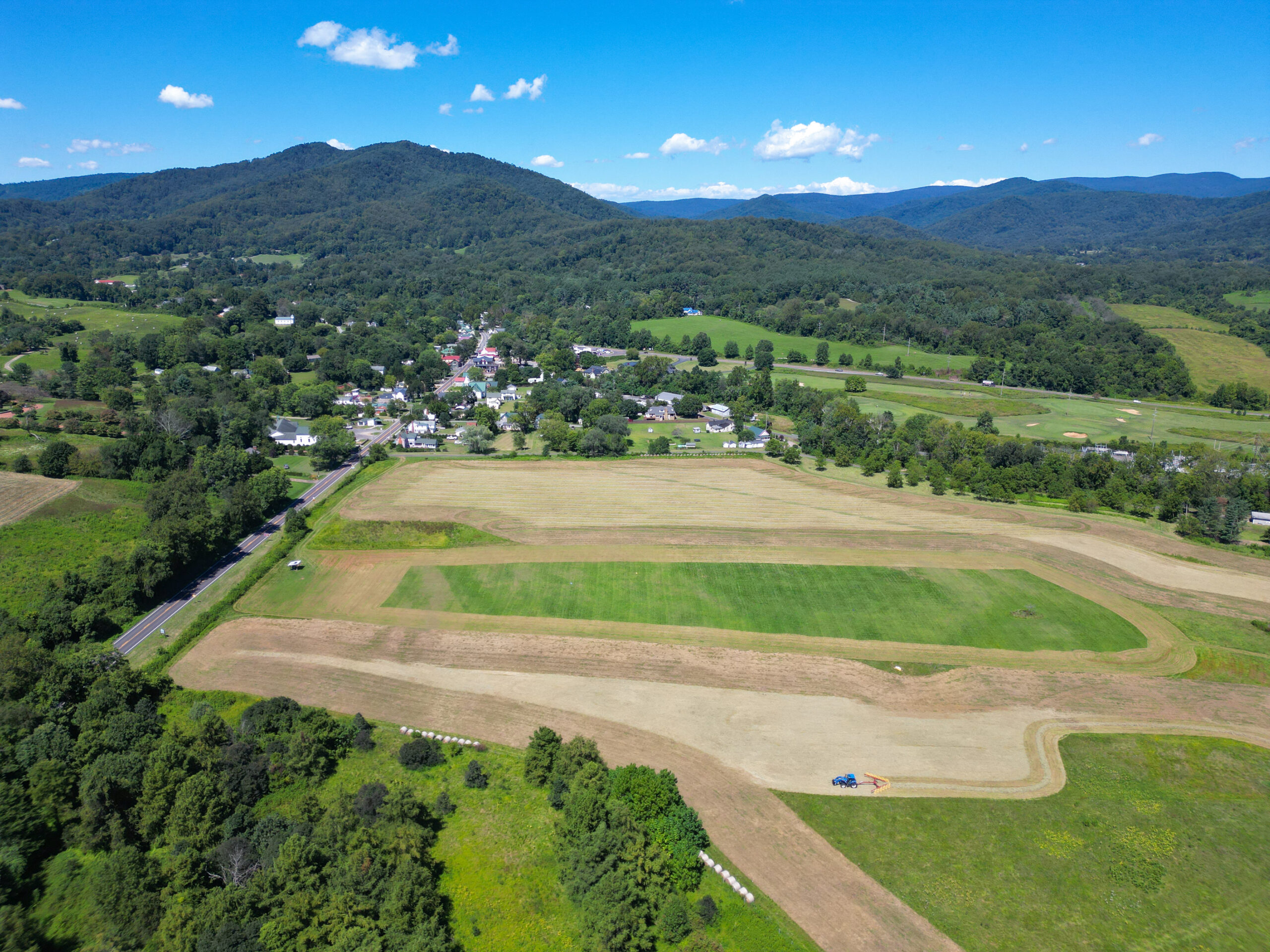
Longtime resident buys land to explore housing project at village’s edge
Two families with Rappahannock roots that go back generations were buyer and seller in a land transaction last week that could result in Sperryville being the site of the most ambitious housing development in Rappahannock County to date.
Longtime landowner and businessman H.B. Wood bought 38.5 acres on Route 522 at the edge of Sperryville from the Cliff Miller III family, with plans to explore building homes. The land sale came to $860,000, or $22,000 per acre, a comparatively high price for the county.
The housing plan is early-stage embryonic: There are no maps, no architectural sketches, no power-point slides, no fact sheets or brochures for regulators and citizen groups.
Wood’s 23-year-old son Henry, who now manages construction projects in Northern Virginia, would return to Rappahannock County, according to his father, to oversee the real estate enterprise — if it materializes. H.B. Wood, who financed the purchase, will continue in his role as president of Harris Hollow Foods L.C., an international brokerage firm in fruit, purees and juice concentrates with offices in the Town of Washington
The ritual county clash between long-time landholders and upstart developers collapses in this transaction where both buyer and seller come from families whose Rappahannock histories stretch back centuries, not decades.
Wood can point to 10 generations of forebears living and farming around Red Oak Mountain, near where he now lives. The family’s first acres, where apple orchards soon flourished, date to the days when Lord Fairfax was doling out land grants in the 1740s. Miller was the fifth generation of his family since 1827 to tend the 845-acre Mount Vernon Farm property in Sperryville.
For now, a ‘listening tour’
History notwithstanding, any vision for new housing in Sperryville will face intense public scrutiny, with vetting from the county’s Planning Commission, the Board of Supervisors and the Water & Sewer Authority.
“We are currently conducting a listening tour to gather the community’s thoughts on how best to use this property,” said Wood. “After community input, we need to put together a viable business plan.”
Directly across Route 522 from the proposed housing lives Diane Bruce, former longtime clerk of Rappahannock County Circuit Court. She tracks county developments closely, and isn’t shy when she feels critiques are in order. She has a keen interest in the Woods’ plan: From her front porch, she looks out on the land where new homes theoretically might rise, and she cares deeply about the scale and character of what might be built. But it is also true that her family and the Woods have long and affectionate ties.
‘Non-millionaire housing’
The Wood family responded earlier this fall, when the property appeared on Zillow, the national real estate platform, and quickly readied an offer. There were at least two possible competitors also eyeing the land — a driving range — which one Sperryville resident prescribed as “one of the most logical places to increase the density a bit.” This neighbor and others have pointed out that the county’s Comprehensive Plan calls for carefully designed development, concentrated in and around the villages.
Meeting in the Little Washington offices of Harris Hollow Foods on Main Street for a recent interview, Wood underscored mainly what the possible housing development will not be: It will not be a Sperryville variation of Clevengers Corner, the bulky housing development at the intersection of Route 211 ( Lee Highway) and Route 229 ( Rixeyville Road); nor should it be characterized as an affordable housing project. Rather, Wood said, “This is non-millionaire housing.”
That designation may be difficult to maintain. The National Association of Homebuilders shows an average price of a newly built single family home to be $514,000, and the Trump administration’s tariffs are pushing up the costs of construction materials. Northern Virginia is growing especially pricey. Along Rixeyville Road, a modest home with three bedrooms and two baths, sitting on 1.3 acres, is currently listed at $619,900.
Some have suggested the new homes might be ideal for older residents wishing to downsize and live simpler lives in a village community.
Succession of hurdles
Once the Woods take stock of community preferences and shape a specific plan for new housing, a succession of regulatory proceedings will follow, and could take years to run their course. The first issue to address will be zoning, because the land is now designated for agriculture, not housing.
“The process to change the zoning of a parcel from one district to another requires application and public hearings before the Planning Commission and the Board of Supervisors,” said County Administrator Garrey Curry. “Any future subdivision — dividing a singular parcel into multiple parcels — is a totally separate process and would follow the rezoning.”
He added that in some cases, the landowners offer a “master plan” that would offer decision-makers and citizens a clear sense of how the village as a whole might be affected.
Sewer challenges
Sperryville’s already troubled sewer system looms as perhaps the biggest obstacle facing any proposed housing project. Kerry Sutten, owner of the Before & After cafe, and head of the Sperrville Community Alliance, said, “I’m a big supporter of building starter homes and apartments. It’s a perfect extension of the village — if the plan is to grow the village in a historically appropriate manner. But it will have to be linked to the sewer, and the sewer is limited.”
Currently, the land isn’t part of the sewer system’s official footprint. An engineering report commissioned by the Water & Sewer Authority came out last year, presenting a daunting list of badly needed improvements on elements of the system ranging from the sludge treatment tanks to the electrical components to the grinder pump station. In one category after another, the report states that the equipment “is nearing the end of its useful life.”
Sewer rates are rising for residents, and the county’s Water & Sewer Authority has set out a plan to invest $1.4 million to make the array of improvements the engineering report found to be necessary. The price tag could rise as individual contracts are negotiated.
Realtor Cheri Woodard, who recently stepped down as chair of the authority and who remains on the board, said the investments are intended to fix the structural shortcomings of the present system, not expand its capacity. “It’s upgrading the existing system,” she said. “It’s not about opening the gates.”
There appears to be some room for adding new users to the system, though it’s unclear how much. The Woods calculate that each new dwelling would pay $15,000 to connect — which increases the cost, and naturally the price tag, for each new home that might be built on the newly acquired site.
Builders say some housing developments, including in Virginia, are creating dedicated sewer treatment facilities, avoiding the cost and complication of connecting to existing systems. “Five years ago, it was completely uneconomical, but it’s getting closer,” one housing professional said, though the dedicated systems are still more expensive than the traditional alternative.
Methodical, family-oriented
H.B. Wood is an unpretentious, hard-working 58-year-old, so allergic to gestures of self-aggrandizement that he politely refused to be photographed for this newspaper on the land he had just acquired. “Take a picture of the property without us,” he directed in an email.
Family connections — to both ancestors and immediate family members — are deeply important. His wife Angela — like her husband, a CPA with considerable experience in corporate accounting and financial structures — plays a leading role in managing Harris Hollow Foods, which the couple bought in 2010. Discussing the emerging project in Sperryville, Wood returns repeatedly to his desire to bring his son Henry back to the county to work and live. For his part, Henry Wood, though busy managing construction projects in Northern Virginia, said, “I think it’s very important for me to come home, and it would be good to be back.”
The Harris Hollow enterprise suggests H.B. Wood’s capacity for mixing continuity and change. When Rappahannock’s once-dominant orchards aged and faded in economic importance, Wood persisted with fruit, but in a new modality — buying berries and other produce from Canada, Mexico and Europe and selling to large U.S. food companies.
Methodical and realistic, Wood says he is prepared for a complex process that will demand patience akin to what his ancestors showed as they built an unlikely empire of apple trees on wild meadows and hillsides.
”At this point, I own a very expensive hayfield,” he said.