


Many of the world’s art treasures are celebrated for having endured the battering of multiple millennia; others fascinate us because they fall apart soon after they’re created.
This so-called ephemeral art is the focus of a first-time Rappahannock competition, with the three winning creations lining the Sperryville trail network. Set against the soft flows of the Thornton River, the works are composed of reeds, grasses, vines and rocks. The artists’ inventive scope is on full display – initially – but time and gravity will come to dominate these slow dramas, as the vines dry and crack, the rocks tumble, and the grasses turn crisp and blow away.
The Rappahannock Association for Arts and Community is sponsoring the program, with the Sperryville Community Alliance and Rappahannock League for Environmental Protection. The winning artists for the inaugural competition are: Donna Marquisee, Patricia Brennan and Jen Cable, and Janet Kerig. Their works will remain in place through the Fall Art Tour, the first weekend of November.
Just beyond Before & After, Donna Marquisee has composed a small galaxy of vine-made circles and orbs, dangled from tree branches along the water. The rings, made of blackberry, grapevine and willow branches, capture the spirit of the ephemeral enterprise – featuring materials from nature repositioned within nature – while the balls carry a festive, holiday feel that underscores the temporary nature of the installation, which carries the boggling title of “Orbesque Concantenation.”
Working with flotsam pulled from the land requires artists to step back, humbly retiring all perfectionist goals. “You just let the vines take you,” says Marquisee.
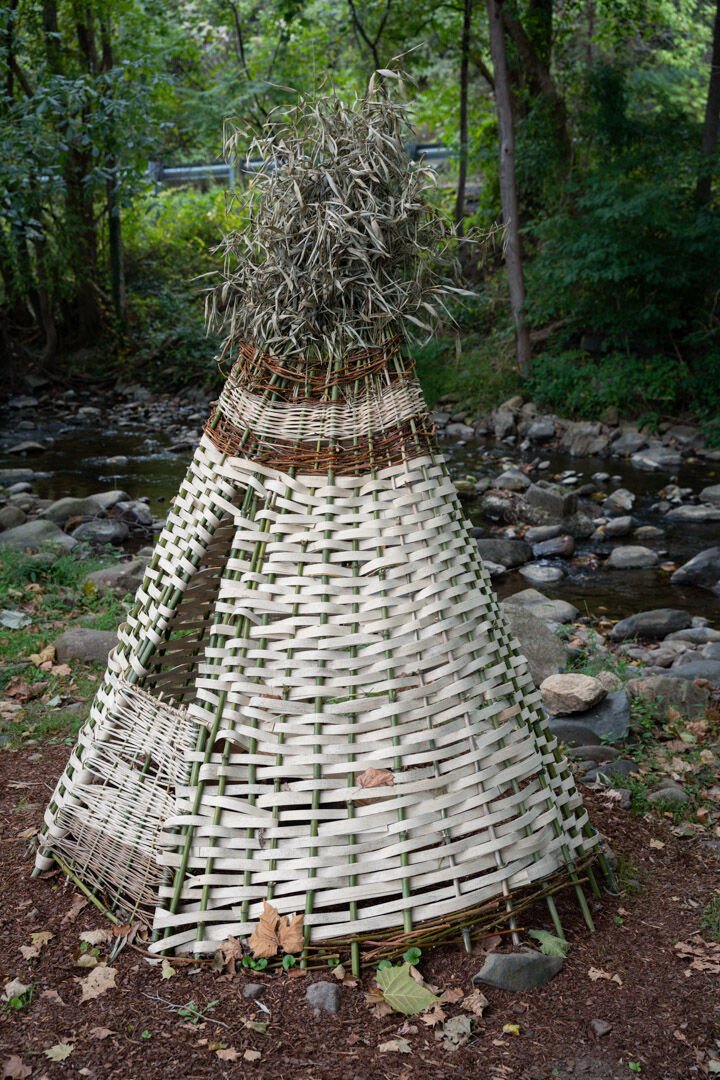
Next is a meticulously woven shelter, a cone-shaped structure made of bamboo, willow, and pine splits, large enough to accommodate a bench on which a couple of viewers can sit to observe a growing number of stone cairns, and beyond them, the river. The grass tepee was built by Jen Cable, whose Flourish Root Floral Studio creates a variety of plant and flower arrangements, and Patricia Brennan, a seasoned stained-glass artist. The pair was partly inspired by improvised shelters in the remote reaches of Ethiopia, underscoring the reality that many people have long relied on free materials found in nature.
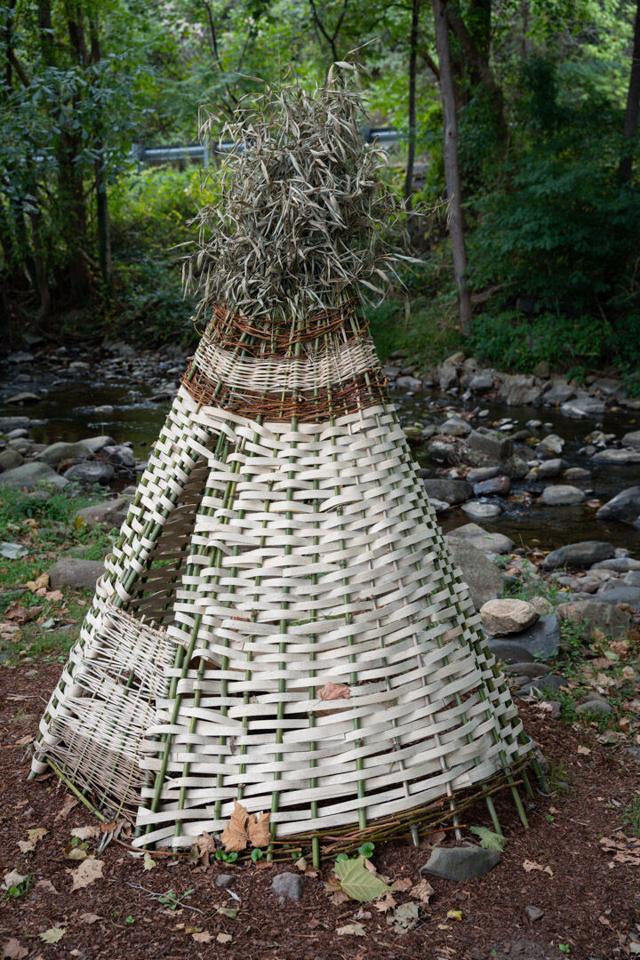
“Peace of Mine” by Patricia Brennan and Jen Cable (Photo/Luke Christopher)
For Brennan, whose stained glass works are usually drawn from natural forms that fascinate her, the project was a lively experiment to move from representing nature to working with materials straight from the earth. She and Cable didn’t only observe the bamboo, willow, and pine splits forms but held them, bent them, looped them into one another, to create a structure they named “Peace of Mine.”
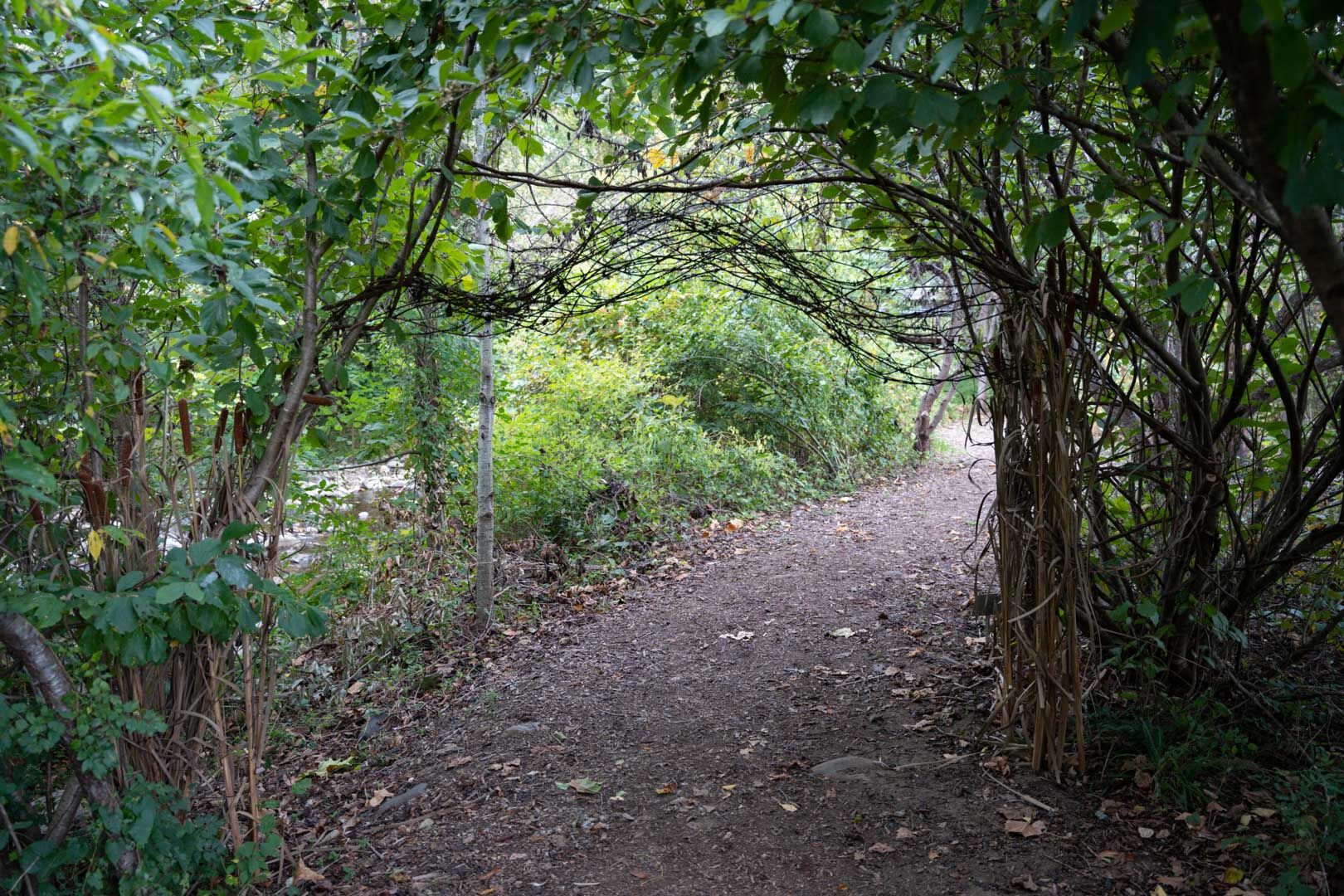
The third ephemeral work is an arc of honeysuckle vines and cattails further down the path. Created by Janet Kerig, who manages an arts and crafts camp, the gateway creates a sensation of moving from one segment of the popular trail to the next.
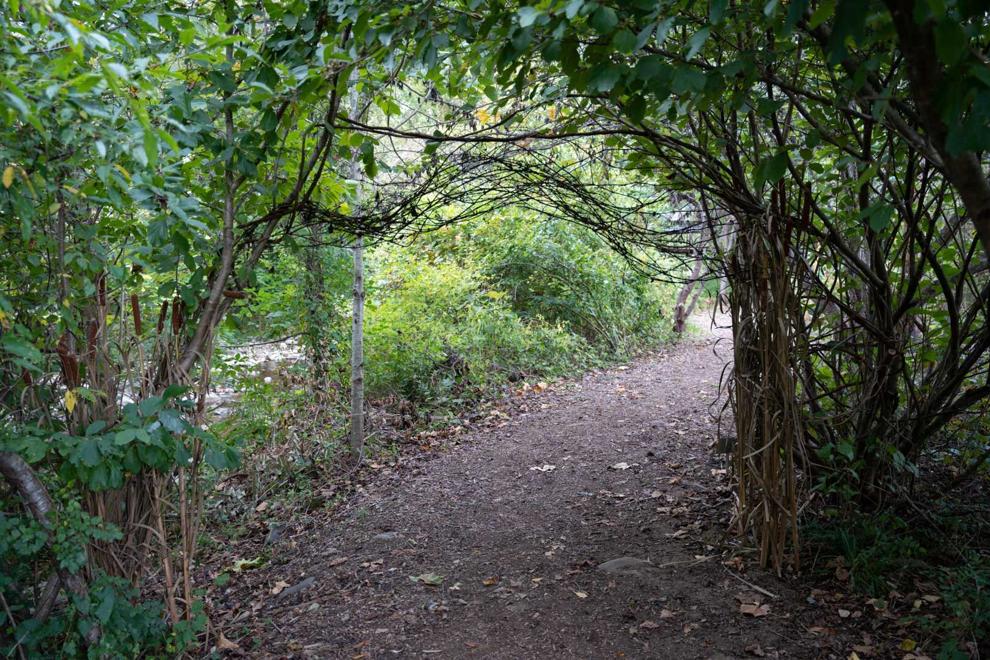
“Ephemeral Gateway” by Janet Kerig (Photo/Luke Christopher)
Not only will these works never adorn living rooms or sit in galleries, they are already being changed by nature, time – and, it turns out, human hands. Some of Marquisee’s rings are mutating into ovals rather than circles. Grasses in the tepee have taken on a slightly grayer hue. But there are welcome additions: stone cairns, piled by visitors, are proliferating in front of the “Peace of Mine”, and Marquisee plans to use the Fall Art Tour as an occasion to invite children to make birds out of seed pods and place them in the rings and orbs hanging over the river. Later this year, all the works will live up to their names, and disappear.
Pete Pazmino and Claire Cassel, who planned the new RAAC initiative, envision future iterations where new ephemeral pieces will appear at other locations in the county.
The effort links to a global movement of land art that’s gathered particular strength in Britain. Andy Goldsworthy, who worked on farms earlier in life, understands the humbling contingency of laboring within nature (https://www.livingyourwildcreativity.com). His world-famous ephemeral art might involve ice slowly melting, snow, ocean tides, stones, twigs and thorns.
Some ephemeral art can be hotly controversial. Chris Drury, a British artist born in Sri Lanka, composed an outdoor artwork titled Carbon Sink at the University of Wyoming. Because the work emphasized climate change concerns in a state dependent on extractive industries, energy lobbyists erupted in protest and the sculpture was removed, true to the concept that ephemeral art can expect to be short-lived.