



How to use — and not use — local land drives Rappahannock debates
The search for a growth recipe that’s right for Rappahannock has entered a critical phase.
Development debates dominated 2021, the pages of this newspaper and the campaigns of candidates for public office. A pair of development dramas gripped the county’s two main areas — Washington and Sperryville — with divergent outcomes. And 2022 promises record-breaking rancor over an additional development plan that requires a controversial three-acre-plus enlargement of Washington.
Snapshot 2021: Intro, Schools, Broadband, News Ticker
Building new buildings is fraught in Rappahannock, because the county’s sustaining asset is a landscape, most of whose beloved hills, hollows, meadows and mountains don’t have — and probably don’t want — houses or businesses on them. Long a feisty steward of its landscape, Rappahannock is embracing an island mentality as malls, corporate centers and housing complexes proliferate around it.
A green gem
Incoming Supervisor Van Carney (Stonewall-Hawthorne) sees Rappahannock as a “green gem in the middle of a state that is aggressively pushing development.”

Van Carney (Photo/Luke Christopher)
From 2010 to 2020 Virginia added 630,369 new residents to a population that has now reached 8.6 million, and for the state, growth and development is the song that’s currently playing. On just one day in December, Gov. Ralph Northam touted a medical technology firm expanding operations in Albemarle County and a company making military drones that’s coming to Stafford County. Universal broadband, the state’s goal, will attract businesses as well as residents.
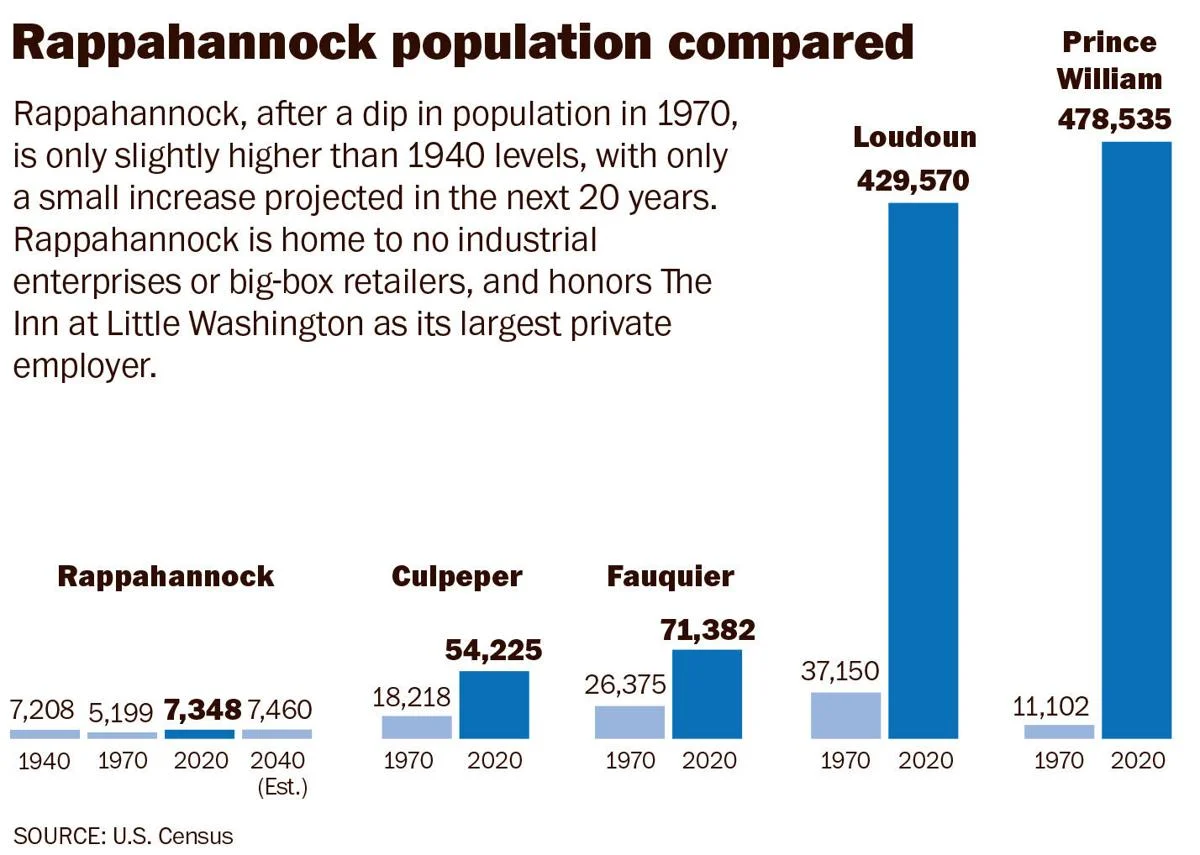
Growth has engulfed surrounding counties, the U.S. Census shows. From 1970 until 2020, Fauquier’s population jumped from 26,375 to 71,382; Prince William’s from 11,102 to 478,535; Culpeper’s from 18,218 to 54,225; and Loudoun’s from 37,150 to 429,570.
Nothing like that has happened in Rappahannock, whose population stood at 7,208 in 1940, sinking to 5,199 in 1970, and rising modestly to 7,348 in 2020, a slight decrease from 2010. The Census estimates a population of 7,460 in 2040. Distinctly, Rappahannock is home to no industrial enterprises or big-box retailers, and honors The Inn at Little Washington as its largest private employer.
But residents worry. The optimists hope the explosive growth elsewhere will lessen pressures on Rappahannock, but the pessimists view the region’s rapid development as a virus that eventually will spread. Keir Whitson, the Hampton district supervisor and chair of the county’s Planning Commission, views the county’s aversion to growth as part of the landscape. “There’s no remedy,” he says. “People are nervous. The vast majority do not want to see a bunch of new stuff built in the county.”
7,348: The Rappahannock County population in 2020 — a slight decrease from 2010 while higher than 5,199 in 1970.
A tale of two towns
Last year’s development debates in Washington and Sperryville offer useful lessons in the county’s fitful journey toward a right-for-Rappahannock growth model. Both plans were at least partly aligned with the county’s 2020 Comprehensive Plan, which says new housing should be in the “designated village areas,” and provide some homes that young and elderly people can afford. But in both Sperryville and Washington, battle lines were quickly drawn, with heated exchanges in hearings, petitions and signatures, and sharply worded letters to the editor.
The outcomes were more illuminating than the surrounding rhetoric.
• In Sperryville, Tom Taylor, an established and popular resident, sought a rezoning to build as many as 18 houses on a scenic 35-acre hillside along Woodward Road at the edge of town. Later, a slope and floodplain analysis narrowed the options, so that the project would have resulted in 10 new houses. Still, the idea drew about 400 opposing signatures from all over the county. The Board of Supervisors nixed the two-acre rezoning plan, concluding that the existing five-acre zoning was exactly what it should be.
• In Washington, Chuck Akre, a giant in the wealth management business, proposed making a gift of land he owned for creation of a mixed-used development project known as Rush River Commons. Akre is a longtime resident, but operates in a different sphere than most county citizens. Critics of the plan portrayed him as a real estate developer (which he isn’t) intent on remaking the county.

July 7, 2021: Chuck Akre and members of the Town of Washington government tour the proposed Rush River Commons site. (Photo/Luke Christopher)
The Washington Planning Commission worked with the project’s architects and design team, requesting 25 changes to the original plans, based on citizen concerns about matters such as height, impact on views, and the number of housing units. The Akre team accepted all the requested changes, and presented the town’s Planning Commission with a revised plan which ultimately won unanimous Town Council approval.
The tale of two towns shows that bred-in-the-bone county residents, however well-liked, don’t always get what they want; while cultural outsiders may endure barbs on the email listservs, while advancing their plans if they’re responsive to public concerns.
However, the most important distinction is jurisdiction: The Akre project lay within the incorporated town of Washington, while the Taylor project required the approval of the County Board of Supervisors, since Sperryville lacks not only incorporation as a town but clearly defined borders. Critics of both projects came from all corners of the county, but for Rush River Commons, the power to decide resided squarely within the town, a fact that riled a number of county opponents.
The next fight
Washington — with 133 residents — is not only much smaller, but its experience with change is markedly different than the county’s. In the town, an oil-splotched gas station of long ago has been remade into a world-renowned, Michelin three-star restaurant and inn, and more recently the former Post Office and Country Cafe building cater-corner to the inn has been supplanted by Patty O’s Cafe & Bakery, which opened in November to rave reviews.
These enterprises attract thousands of visitors each year, and generate hundreds of thousands in meals and lodging taxes. As a result, Washington denizens have learned to trust change, at least when it’s well designed and carefully vetted. When the Rush River Commons project first surfaced, Town Treasurer Gail Swift said she considered it a “win-win.”
(Photo/Laura Stanton)
Caroline Anstey, who chairs Washington’s Planning Commission and oversaw public hearings on the Akre plan, says the process should assure residents that proposals for new businesses or housing don’t have to erupt in culture wars. “I think the discussion around the Rush River Commons — with the input from the community and the input from the town council — has really shown that managed growth is desirable and possible,” she observes.
This view will be challenged in the new year when sharp differences between town and county are expected to explode over Phase Two of the Rush River Commons project. Under this plan, Washington’s borders would be expanded to take in Akre’s adjoining three-acre parcel just outside the present boundary. The change would enable added structures beyond those already approved by the town. Rush River Commons would gain some new elements, and Washington would bring in fees once the added structures are connected to its costly water and sewer system.
The boundary change requires approval by both the town and the county, followed by a sign-off by a circuit judge. The town approved the boundary shift in 2021, communicating its decision to the county. The Board of Supervisors isn’t going to be rushed, and even moderates worry that this next phase of the Akre plan may be one change too many in too short a time. The county is bracing for a battle.
Sally Haynes, longtime Sperryville resident:
WHAT WORRIES HER: “The county is not nearly as pretty as it used to be. I see more and more houses popping up on mountainsides.”
Keir Whitson, Hampton District Supervisor:
WHAT GIVES HIM HOPE: “With our cash on hand and little debt, we should be able to manage without putting more pressure on taxpayers. We could use more land-use and planning resources to bolster our abilities.”
BY THE NUMBERS: Rappahannock County had a 2020 population of 7,348 — a slight decrease from 2010 while higher than 5,199 in 1970. But surrounding counties have ballooned during that period: Fauquier’s population jumped from 26,375 to 71,382; Prince William’s from 11,102 to 478,535; Culpeper’s from 18,218 to 54,225; and Loudoun’s from 37,150 to 429,570.